Your business registration came through three months ago. Your website is live, your LinkedIn profile says "freelance" in big letters, and your inbox is still empty.
Nothing is wrong with you. Finding your first clients when you go self-employed almost never happens by waiting for them to show up.
Your first clients will most often come from people who already know you, then from messages you send yourself, one at a time. The website and the platforms help later on.
So let's look at who to start with, what to write, what the law allows and how to keep track of every lead, even without a network or a portfolio.
Why is nobody contacting you when everything is ready?
Because nobody finds a brand-new website. Google takes a long time to show a page nobody visits, and your future clients are not typing your name.
It is like opening a shop at the end of a dead-end street. The window looks great, the prices are on display, and nobody walks past.
Organic traffic (visitors who arrive from search engines, without advertising) may come later. For your first clients, it is up to you to go to other people.
Redoing your logo, polishing your "About" page, ordering business cards… It all feels like progress. If you are doing it to put off writing to someone, it is a form of procrastination that is very common when you work alone.
Who should you start with if you have no network?
With the people who know you. You do have a network, even if you think you don't: it just has nothing professional about it.
Take a sheet of paper and write down thirty names, without sorting them. Think of:
- your former employer and former colleagues, including those who have moved on;
- the clients and suppliers you used to deal with in your previous job;
- the shopkeepers and tradespeople you see every week;
- your self-employed friends, who know other freelancers;
- your family, who often don't quite know what you do.
Then put each name in one of two columns. On one side, people who could buy something from you. On the other, people who know someone who could.
Don't overlook the second column. Someone who recommends you lends you their trust, and that is exactly what you lack when nobody knows you.
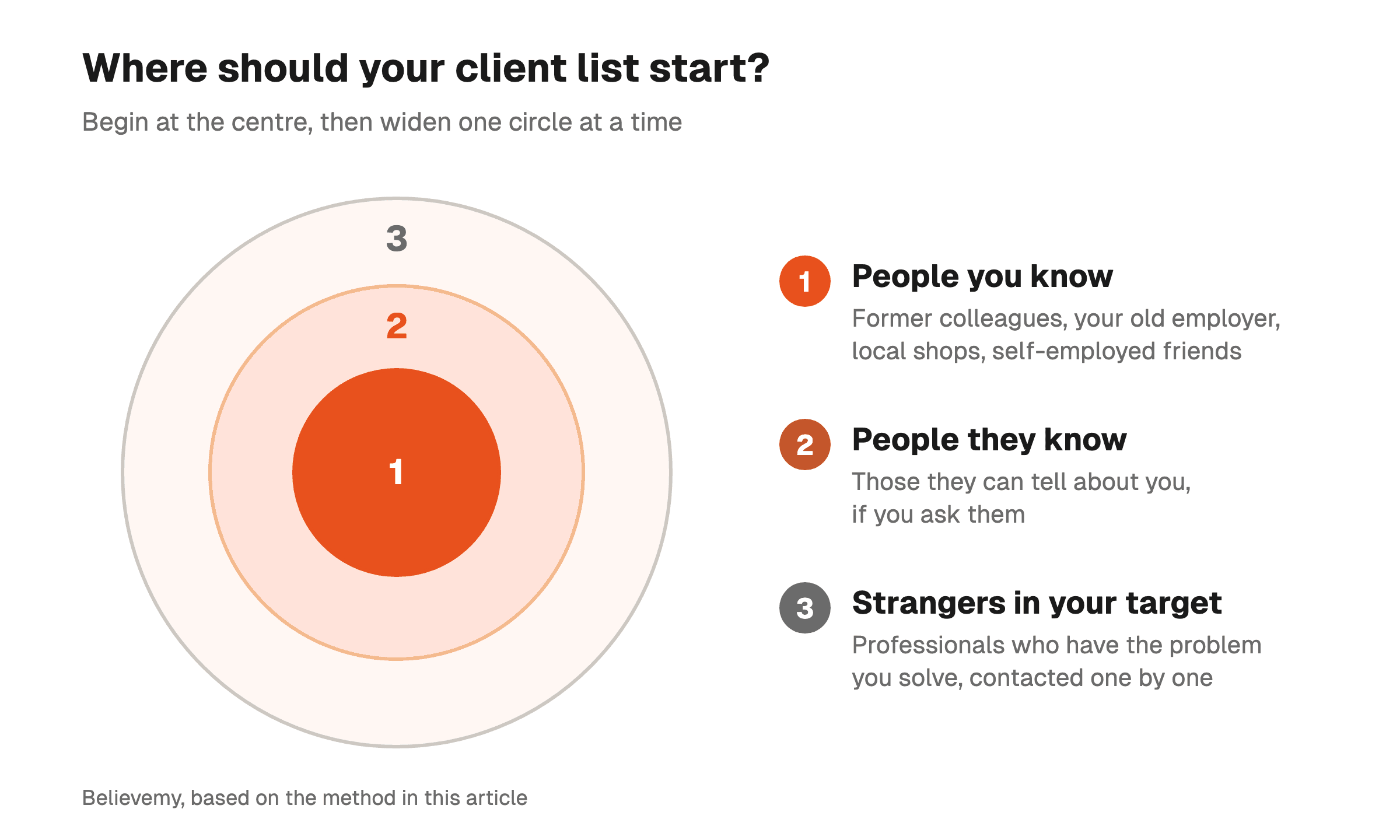
Let's go back to Camille, the former medical secretary from our article on working out what to sell. She offers physiotherapists a website with online booking.
On her list, she finds only two physios. But there is also her former manager, who knows every practitioner in the area, and her cousin, an osteopath who shares a practice with three physios.
I didn't find my first client online either. It was the brother of a former colleague, who had mentioned me to him over a coffee 😉
What should you say in the first message?
As little as possible. A short message that is about the other person gets read to the end more often than a description of your services.
Three rules are enough:
- say what you do in one sentence, with the problem you solve;
- don't ask for work, ask whether they know someone who has that problem;
- ask a single question, one that can be answered in a line.
Asking for an introduction puts people at ease. They have nothing to turn down, and they can help you without spending a penny.
Here is the message Camille sends to her former manager.
"Hi Martine, I've gone self-employed. I set up online booking for physiotherapists, so they stop missing calls during their sessions. Do you know a physio who might find it useful?"
No brochure attached, no link to your prices. If they are interested, they will ask, and that is where the conversation starts.
Sending this kind of message is hard when you don't feel legitimate. If that's you, read our article on impostor syndrome when you're self-employed: you will see you are far from the only one who hesitates.
Are you allowed to write to strangers?
Yes, to professionals, at least under French law. In France, a prospecting email sent to a professional is allowed without their prior consent. That is what the CNIL page on email prospecting says (in French; the CNIL is the French data protection authority).
Three conditions must all be met:
- your message relates to their job, for example a booking website offered to a physio;
- you say clearly who you are, with your name and your business;
- they can refuse further messages in a simple way, such as replying "no thanks".
With a private individual, it is the other way round. You need their consent before sending them a prospecting email or text message. If you sell to individuals, go through the people you know, your posts, or the places where they come looking for you.
A message like this, sent to someone who doesn't know you, is called a cold email. It works when it is written for one specific person, rarely when it goes out to two hundred copy-pasted addresses.
Aim for a qualified lead instead, meaning someone you know has the problem you solve. A physio whose listing says "call me between 12 and 2" clearly struggles to pick up during sessions.
Send only a few, and personalise each one. One sentence that proves you have looked at their website or listing is enough to show you are not writing at random.
Are freelance platforms worth it at the start?
They have one big advantage: clients there are already looking for someone. On Malt, Codeur.com or Fiverr, nobody stumbles on you by chance, people arrive with a need.
The downside is competition. Your profile with no reviews appears next to freelancers who have dozens, and many beginners cut their prices to land a first job.
Every job also pays a commission to the platform, which varies by site and sometimes by client. Read each one's terms before setting your price, so you know what you will really keep.
Here is how the four main ways of finding clients compare when you are starting out.
| Where to look | Speed at the start | What it costs | What it takes |
|---|---|---|---|
| People you know | Often the fastest | Nothing | Daring to talk about it |
| Direct messages | Slower, and you choose who you write to | Your time | Consistency, every week |
| Platforms | Fast if your profile stands out | A commission on every job | A polished profile, tight prices at first |
| Your posts (LinkedIn, Instagram…) | The slowest | Your time | Posting for a long time before being read |
Nothing forces you to choose. Start with the people you know, open a platform profile alongside if you like, and keep posting for when you have work to show.
How do you keep track of your messages?
With a simple table, on paper or in a spreadsheet. A lead you forget to follow up is a lost lead, and after thirty messages, nobody remembers who replied what.
Four columns are enough:
- the name of the person and what they do;
- the date of your message;
- their reply, even a polite no;
- the follow-up date, one week later.
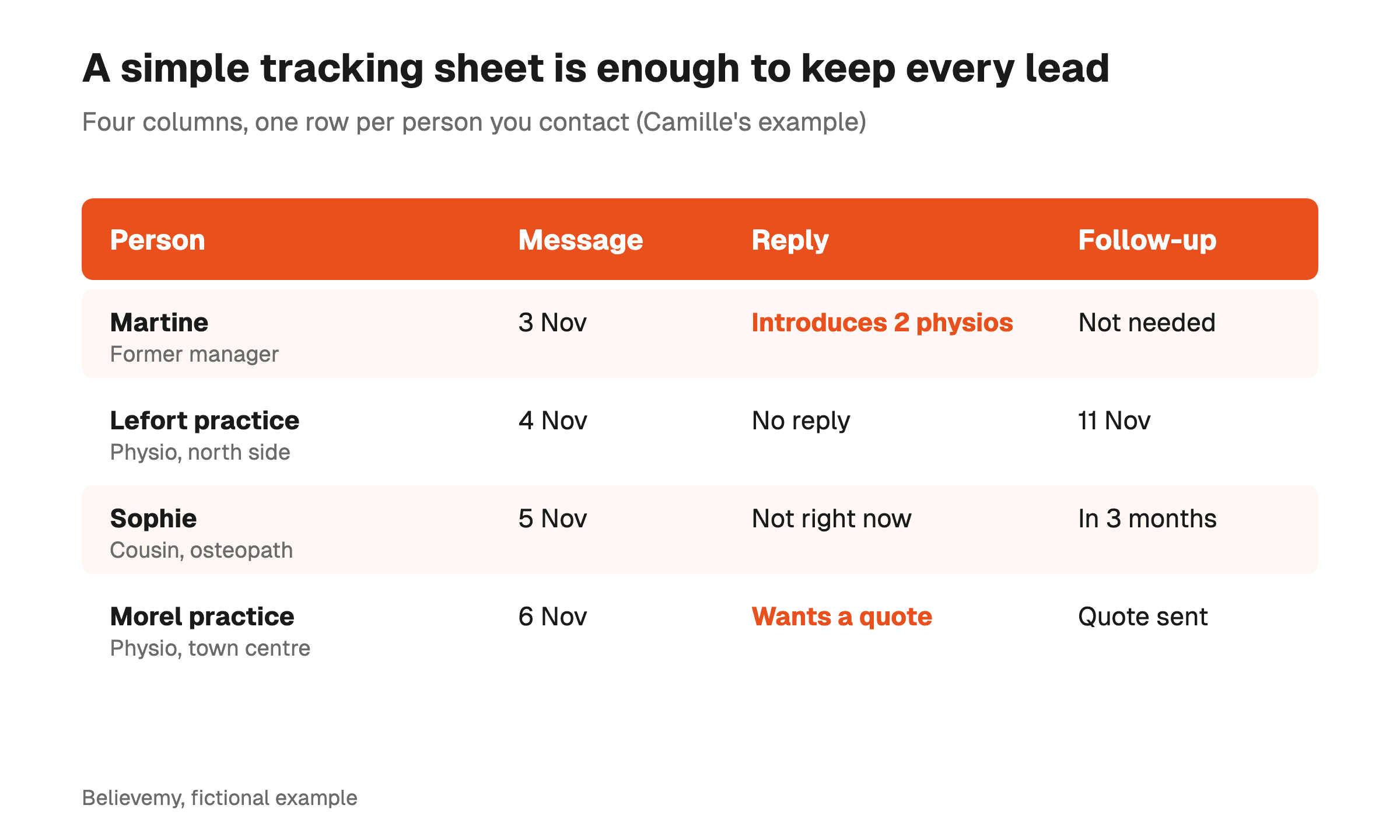
Follow up once, no more, with a message even shorter than the first. If there is still no reply, move on to the next name without taking it personally.
When someone asks your price, answer without hesitating. Our How much to charge calculator, built on French rules, gives you a day rate based on what you want to keep each month.
And when someone says yes, send your quote the same day, while they are still keen! Our compliant quotation template fills in the mandatory French mentions for you.
What should you do after your first job?
Ask your client for two things, at the moment they are happy with the result.
First, a written review, with their name and their job. It is your first piece of social proof (what shows the next people that others have trusted you).
Then, the names of two people they could tell about you. A happy physio knows other physios, and knows better than you which ones miss calls!
That is how word of mouth gets going. Every satisfied client introduces you to people on their own list.
For your first client, a list of names and a few well-written messages are enough. Take a sheet of paper, write down your thirty names, and send five messages this week 😉
Frequently asked questions
Do you need a website to find your first clients?
No. Your first clients are more likely to come from people you know and from your messages than from a new website, which Google takes a long time to show.
Start with a list of thirty people you know, then send each of them a short message.
How many messages do you need to send before you get a client?
No figure holds for everyone: it depends on your offer, your target and your messages. Note every message and every reply in a table to see what works.
Follow up only once, a week after the first message. If there is no reply, move on to the next name.
Is it legal to prospect by email in France?
Yes, with professionals. A prospecting email to a professional is allowed without prior consent. It must relate to their job, say who you are and let them easily refuse further messages.
With a private individual, you need their consent before any prospecting email or text message, according to the CNIL, the French data protection authority.
How do you find clients when you have no network?
By starting with people you already know, such as former colleagues, your old employer or self-employed friends. A list of thirty names is enough to get going.
Above all, ask whether they know someone who has the problem you solve. A recommendation opens more doors than a direct sale.