


You sent a quote ten days ago. On the phone, the client sounded genuinely interested. Since then, nothing.
You open a new email, type "Just following up on my previous message…", then delete the lot. You do not want to sound like you are begging.
Yet following up with a prospect often decides whether you get an answer. A short follow-up, one week later, lifts replies noticeably. Beyond two or three messages, nothing shows it pays off, and you risk losing the contact for good.
So let's look at why a prospect goes quiet, how often to follow up, and what to write so they want to reply, even if you hate selling.
Why does a prospect not reply?
A prospect's silence feels like a no. It rarely is. Most of the time, your message simply arrived at the wrong moment:
- They did not see it, stuck between an invoice and a newsletter;
- They read it on their phone, promising themselves they would reply later;
- They need to talk to someone first, a business partner, a spouse or their accountant;
- It is not their priority this week, even if your offer interests them.
A clear no, they would often have told you. Silence mostly means the decision has not been made yet.
If every silence makes you doubt your offer, watch out for impostor syndrome: it reads an unanswered email as a verdict on your skills.
Dunning, chasing a client who has not paid you, follows different rules. For that one, our Formal demand for an unpaid invoice tool, built on French law, drafts the letter for you.
Does following up with a prospect really work?
Yes, and the numbers are clear. In 2019, the website Backlinko and the tool Pitchbox analysed 12 million outreach emails. Only 8.5% of them got a reply.
With a single follow-up, that rate rose to 14.1%. Out of a hundred prospects, you go from eight or nine replies to fourteen.
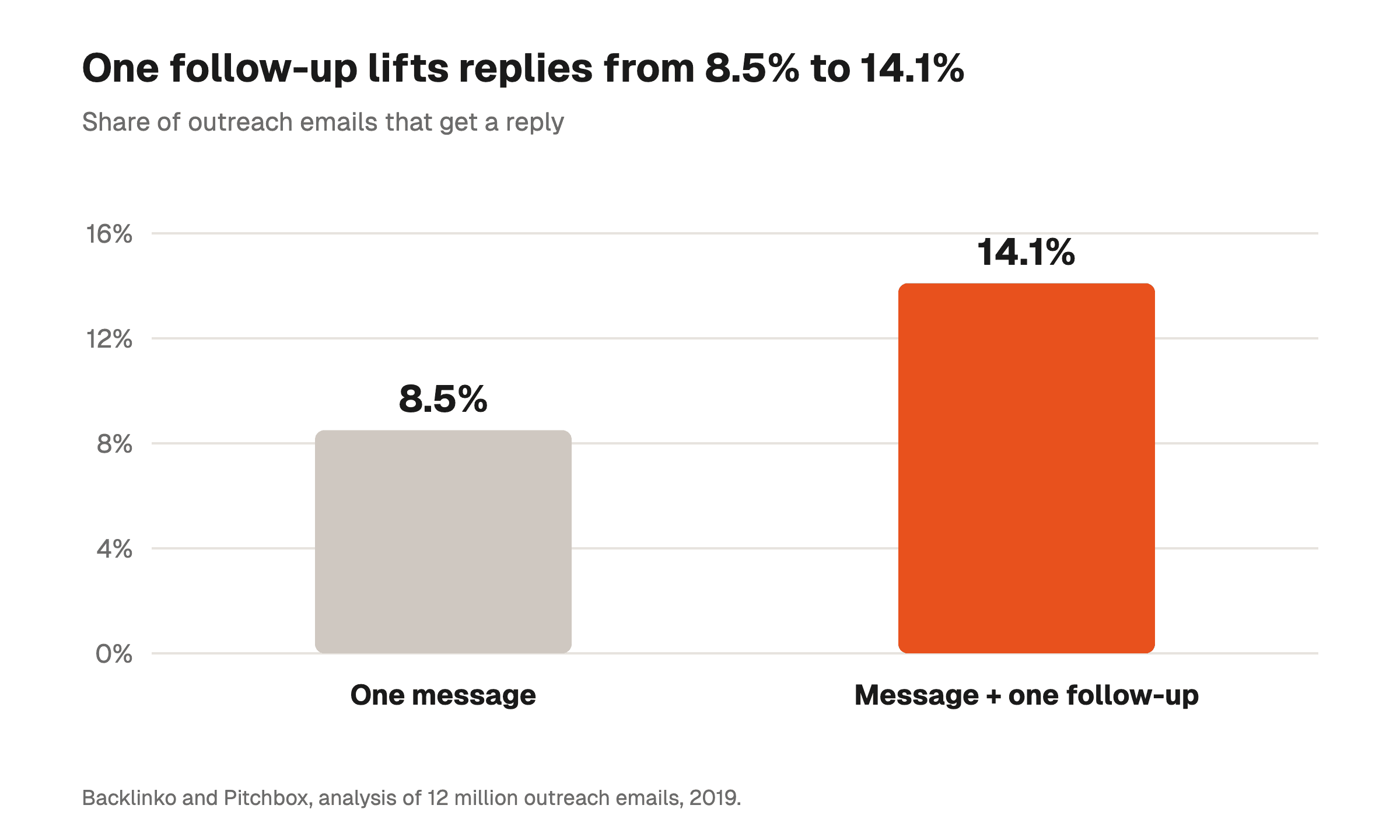
The same study announces "65.8% more replies". That is the relative gap between 8.5% and 14.1%. It does not mean that 65.8% of your prospects will reply.
According to Backlinko, sequences of three messages or more get the best reply rate. But every extra message also has a price, which this study does not measure.
How many times can you follow up without being pushy?
You will read everywhere that "80% of sales close after the fifth follow-up". No published study backs that figure. People who have hunted for its source find, at best, an old internal survey among American salespeople.
A proper experiment shows instead that every reminder has a cost. Economists Mette Trier Damgaard and Christina Gravert followed 17,391 donors to a Danish charity. Half of them, drawn at random, got a reminder one week after the donation request.
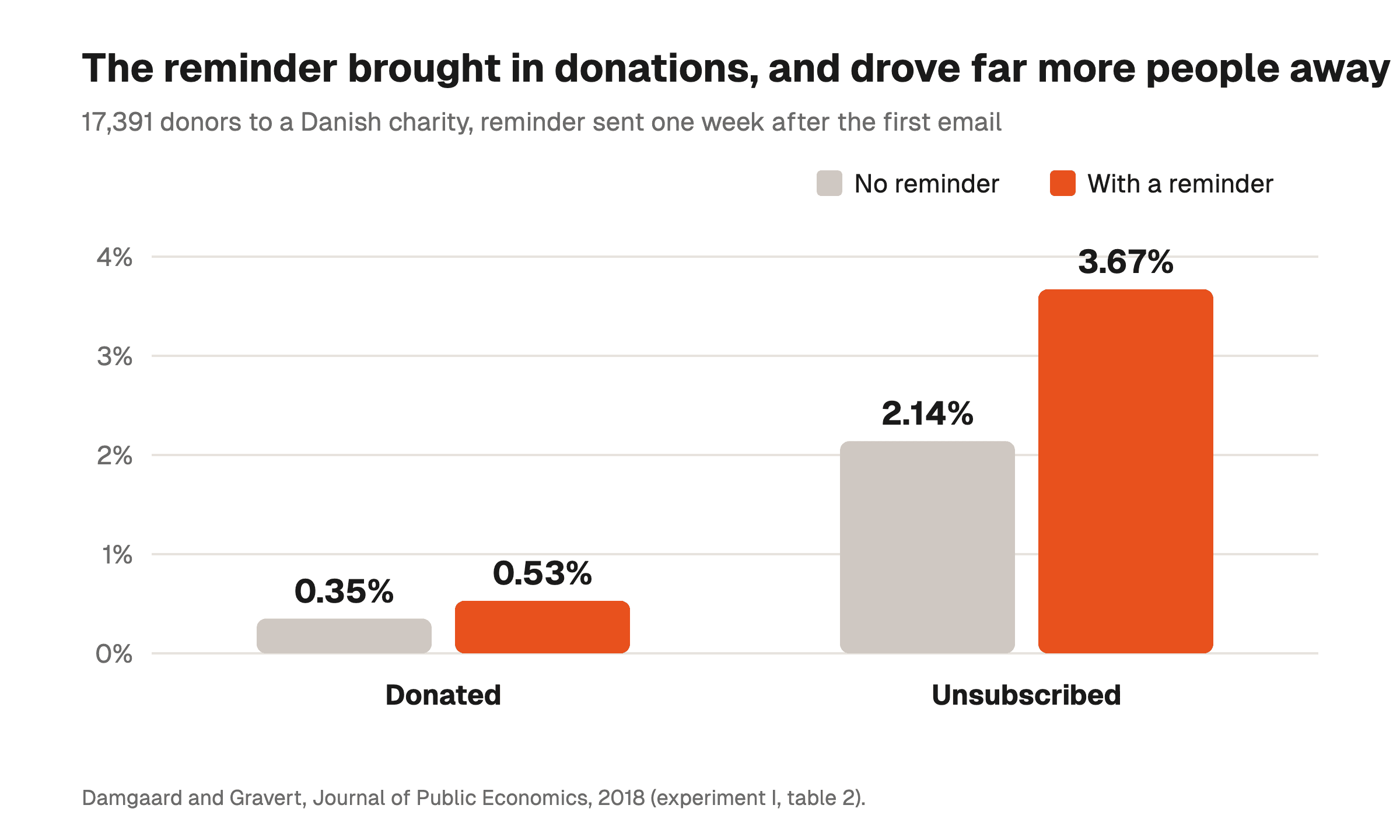
The reminder did push donations up, from 0.35% to 0.53%. But unsubscribes went from 2.14% to 3.67%. In headcount, it brought in 16 more donations… and drove away 132 more subscribers.
When you work alone, those departures hurt: your contact list holds a few dozen names, not 17,000. An annoyed prospect is someone you may never come across again.
The right number of follow-ups therefore depends on what the prospect has already told you.
| Their situation | How many follow-ups | When |
|---|---|---|
| Cold message, no reply | Just one | One week later |
| A quote or proposal they asked for | Two, then a last message | Three to five days after sending, then a week later |
| They told you "not now" | One, at the right time | On the date they gave you |
| They said no or asked you to stop | None | Never |
For a cold email, that is the rule we already gave for finding your first clients. No reply after the follow-up? Move on to the next name.
French law points the same way. According to the CNIL, France's data protection authority, you may email a professional if your message relates to their job. But every message must give them a simple way to stop receiving them, follow-ups included.
What should a follow-up email say?
A good follow-up is shorter than the first message. Send it as a reply to the previous one, so the prospect finds the context without searching.
Above all, it brings something new, an idea, an example or a useful piece of information. "Just following up" gives them no reason to reply today rather than tomorrow.
After a first cold message
You offered an estate agency to rework the search on its website, with no reply. One week later, you reply to your own message.
"Hi Claire, looking at your website again, I noticed visitors cannot sort properties by number of bedrooms. That is what I would fix first. Would you like me to show you the result in ten minutes?"
After a quote they asked for
Here, the prospect was waiting for your quote, they simply have not decided. An easy question is enough, and the second sentence answers a common sales objection in advance.
"Hi Marc, do you have any questions about the quote? If the timeline is a problem, I can split the project into two stages."
The last message
Once you have done the rounds, let them know you will not push any further. "I don't want to clutter your inbox. If the topic comes back later, I would be happy to pick it up with you."
Damgaard and Gravert tested a similar idea. They told some donors they would get only one email in the next three months, and unsubscribes fell from 0.49% to 0.30%. In their view, knowing you will not be pestered makes people more patient.
How do you stop a follow-up from slipping?
Decide on the follow-up when you send the first message. Gmail and Outlook let you schedule an email for a specific date. Just cancel it if the prospect replies in the meantime.
If a follow-up has been sitting on your list for three weeks, no tool will fix that. Our article on procrastination when self-employed explains why we put off this kind of task, and how to get back to it.
To begin, open your last unanswered quote and reply to it with a simple question. At worst, the client will not reply, which is what they were already doing 😉
Frequently asked questions
How many times should you follow up with a prospect?
Once after a cold message, twice and then a last message after a quote the prospect asked for.
Beyond that, nothing shows it pays off. The "80% of sales after the fifth follow-up" figure rests on no published study.
When should you follow up with a prospect who does not reply?
One week after a first message, three to five days after sending a quote they asked for.
If they told you "not now", follow up on the date they gave you.
How do you follow up without being pushy?
Reply in the same thread, keep it shorter than the first message and bring a new piece of information.
Avoid "just following up", which gives the prospect no reason to reply now.
Does following up with a prospect really work?
Yes. Across 12 million outreach emails analysed by Backlinko and Pitchbox in 2019, a single follow-up lifted replies from 8.5% to 14.1%.
Every reminder also has a cost. In an experiment published in 2018, a reminder pushed unsubscribes from 2.14% to 3.67%.
Is it legal to follow up with a prospect by email in France?
Yes, if they are a professional and your message relates to their job. Every message must let them stop receiving your emails, simply.
If they ask you to stop, you stop, follow-ups included.
