


A client asks you for a quote for their website. You type a figure, delete it, and type a smaller one.
Then you send it, fingers crossed that they won't find it too expensive. If that sounds familiar, don't worry: almost everyone sets their prices when self-employed this way at first.
A good price starts with a calculation, though. You take what you want to keep each month and add your contributions, your tax and your costs. Then you divide by the days you will actually bill.
Let's look at how to work out your minimum price, how to present it in a quote and how to raise it, even if you have never sold anything before.
Why does your old salary divided by twenty give a rate that's too low?
Take Thomas. He was an employed developer earning €2,200 net a month, and he goes self-employed to build websites for local tradespeople.
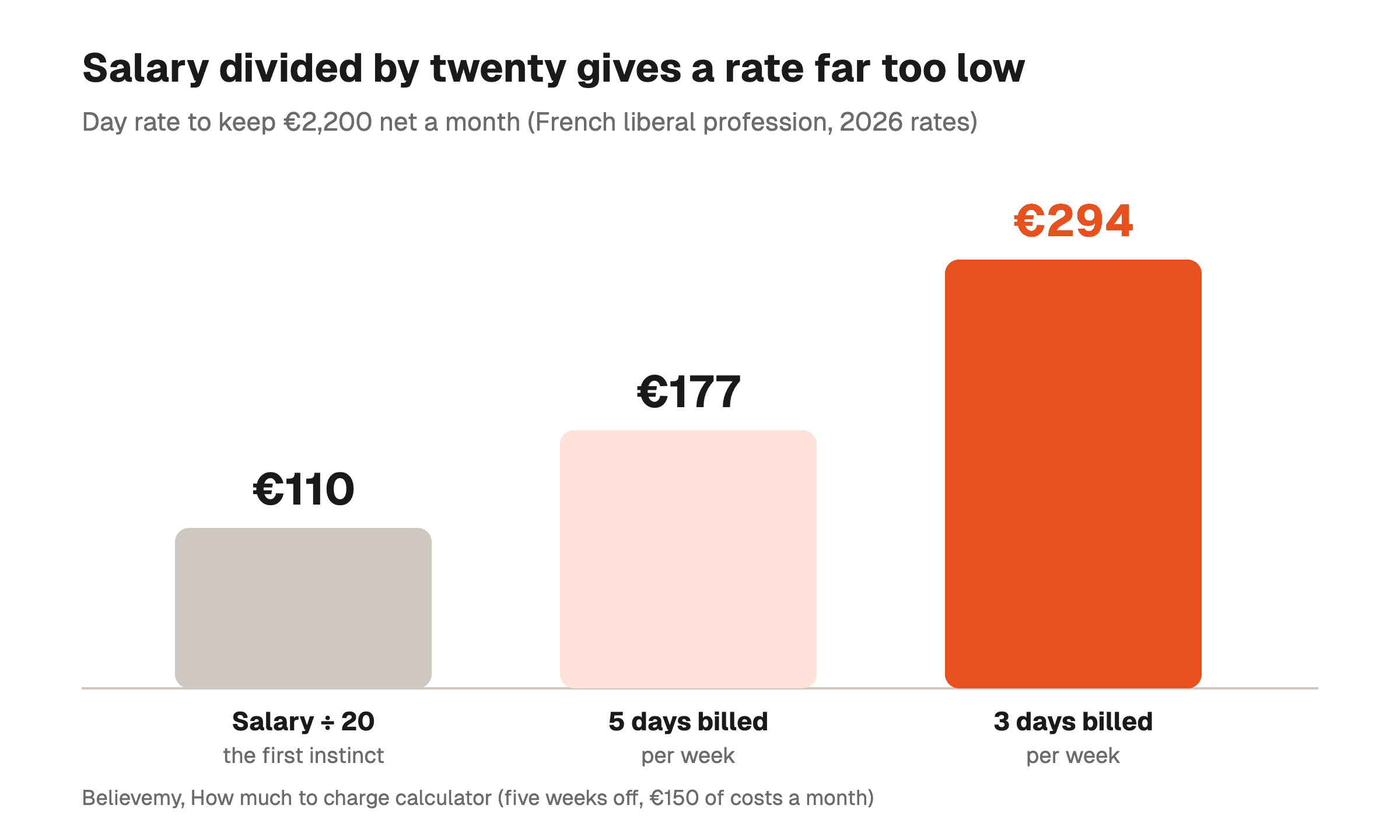
His first instinct is to divide €2,200 by twenty working days, which gives €110 a day. It looks logical, but it forgets three things:
- Contributions and tax, which an employee sees taken before payday and which you pay on what you bring in;
- Holidays and bank holidays, paid to an employee while you earn nothing on the days you don't bill;
- Time you can't bill, spent finding clients, preparing quotes, chasing replies and keeping your books.
That last one is the most often forgotten. At the start, a good part of the week goes on finding work rather than doing it.
With the real figures, Thomas needs to charge €177 a day if he bills five days a week. If he only bills three, he needs €294. Nearly three times his first estimate!
The first website I ever invoiced, I sold at the price I would have found reasonable as a customer. It took me the whole month, and by the end I had earned less than if I'd stayed in my job 🥲
How do you work out your minimum price?
Your minimum price is the rate below which you earn less than you are aiming for. It takes four steps:
- The income you want to keep each month, once everything is paid (€2,200 for Thomas);
- What the business costs you in software, equipment, insurance or an accountant (€150 a month in his case);
- What the state takes, meaning social contributions, the training levy and income tax;
- The days you will actually bill in the year, after holidays, bank holidays and prospecting.
The easiest way is to let our How much to charge calculator, just below, do the maths. It knows the 2026 contribution rates, the year's bank holidays and the income tax scale.
What is your activity?
It sets your contribution rate and the share of your turnover that gets taxed.
Indicative calculation, with no legal force, based on official rates.Open the full tool →
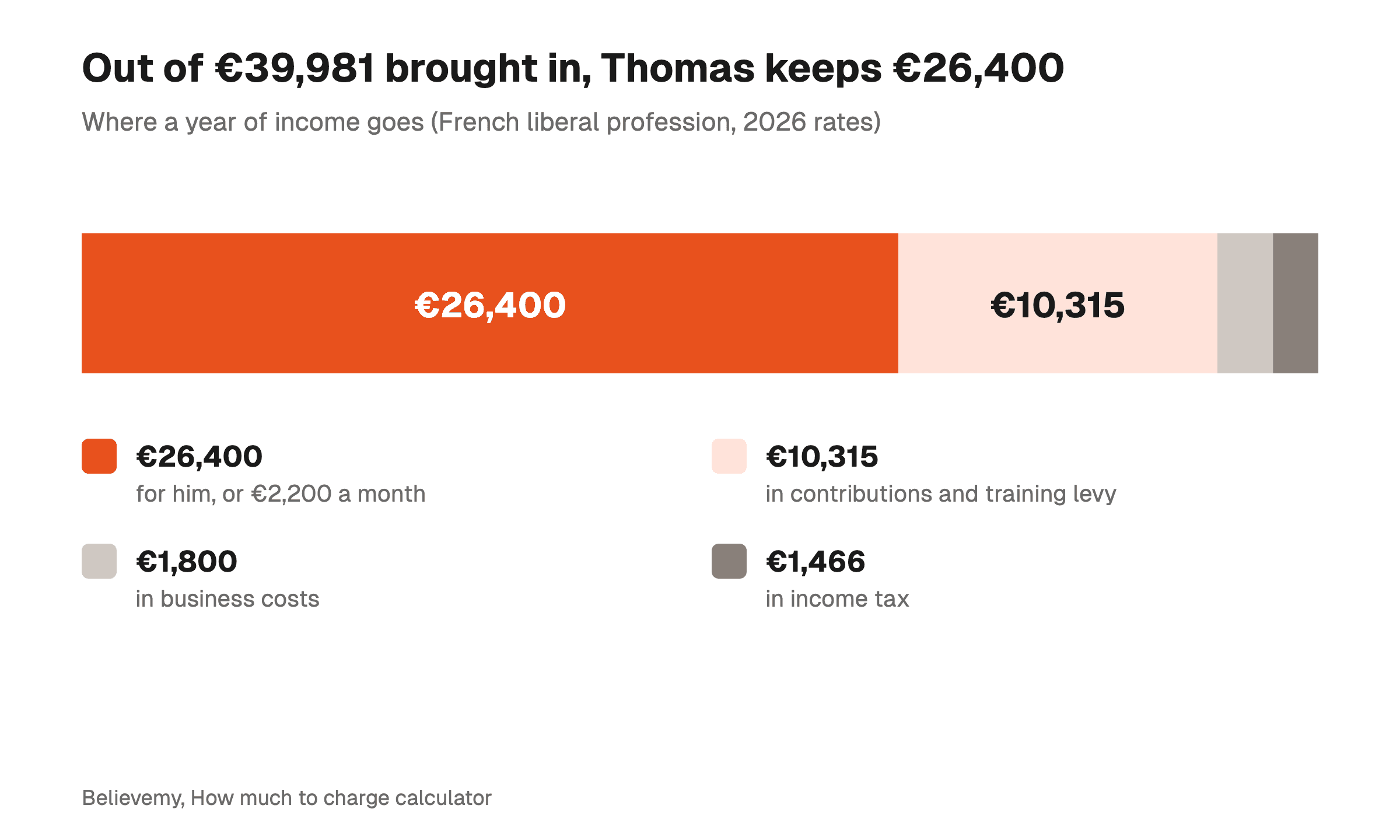
Thomas works in a liberal profession, lives alone and takes five weeks off. To keep €2,200 a month, he needs to bring in €39,981 over the year. Here is where that money goes:
- €26,400 for him, which is €2,200 a month;
- €10,235 in social contributions, plus €80 for the training levy;
- €1,466 in income tax;
- €1,800 in business costs.
In 2026, there are 227 working days after five weeks off and bank holidays. Dividing by that number gives €177 a day.
But Thomas won't bill every one of those days. At three days a week he bills only 136, and his minimum price rises to €294.
At €39,981 a year, Thomas goes over the French VAT exemption threshold, set at €37,500 in 2026 for services. He will have to add VAT to his prices from the following 1 January.
His business clients can reclaim it, but a private customer will pay 20% more. Check where you stand with our VAT threshold calculator.
Should you charge by the day, a fixed price or on value?
Your minimum is a day rate, what the French call a TJM. You don't have to show it to the client as it is.
There are three ways to charge, and they don't suit the same jobs:
| How you charge | How it works | Which jobs | The risk |
|---|---|---|---|
| By the day | Each day worked is billed | Long jobs or ones with a vague scope | The client counts your days and asks you to justify them |
| Fixed price | One set price for a defined result | A website, a logo, a training course | If you underestimated, the extra hours are on you |
| Value-based | A price based on what the result brings the client | A job that makes or saves the client a lot of money | You need to know the client's trade well to put a figure on that gain |
For a client working with you for the first time, a fixed price is often the most reassuring, since they know upfront what they'll pay. To work it out, start from your days.
Thomas reckons a small business website takes him five days. Five times €294 is €1,470. He adds 20% for revisions and surprises, then rounds it to €1,750 per site.
The client will never see this calculation. They see a price for a finished website, which is all they care about.
Value-based pricing works differently. If the new site brings a plumber two extra jobs a month, €1,750 looks like very little.
It means knowing your clients' numbers, though. Keep it for later, once you have a few jobs behind you.
How do you state your price without apologising?
You have your price. The hard part is writing it down without flinching 😉
Many beginners wrap it in justifications, in "it's a starter price" or in a discount offered before anyone asks. State it in one sentence, then stop.
"For the complete website (five pages, contact form, going live and two rounds of revisions), the price is €1,750. I can start next week."
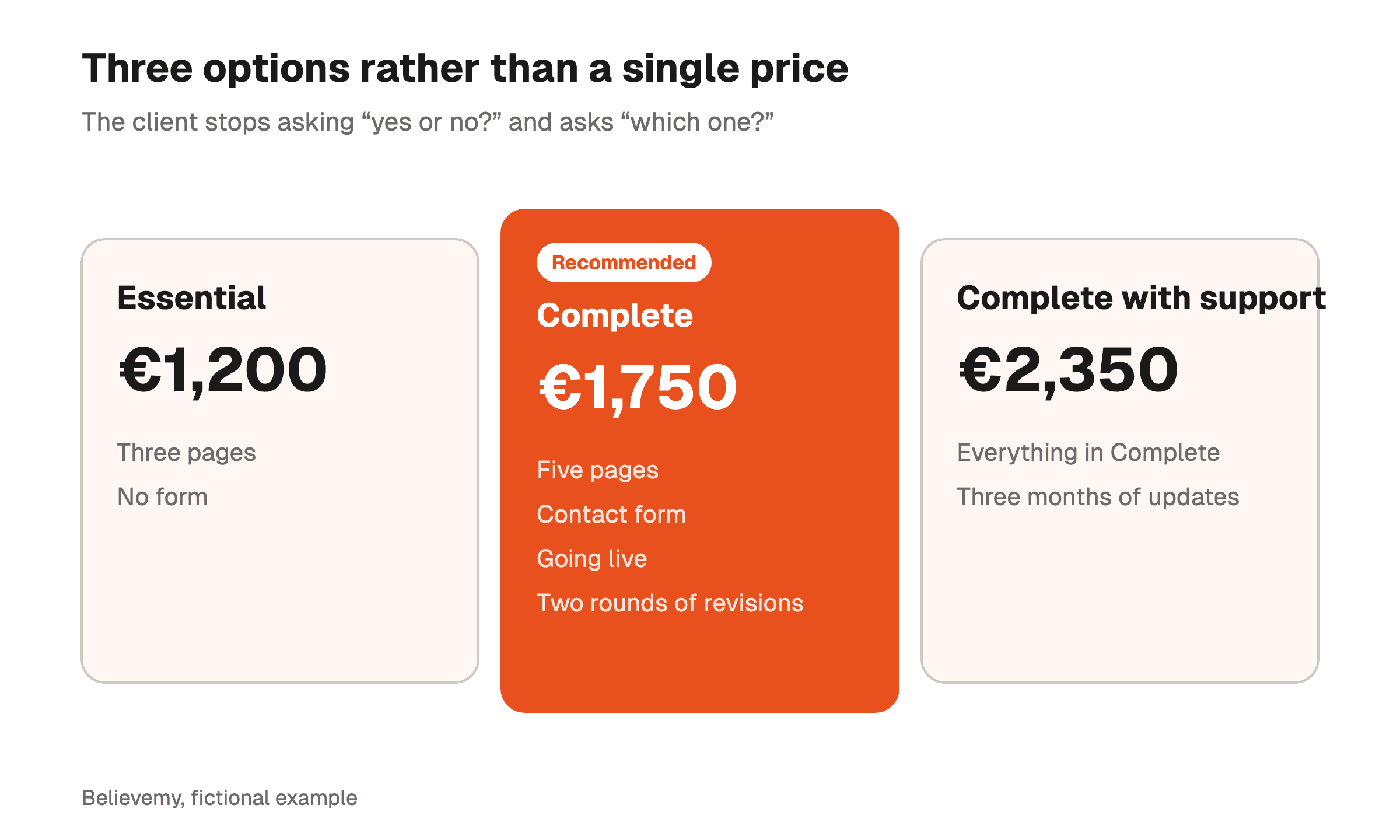
Better still, offer three options rather than one price. Faced with a single price, the client asks themselves "yes or no?". Faced with three, they ask "which one?".
Here is what Thomas offers every tradesperson:
- Essential at €1,200, with three pages and no form;
- Complete at €1,750, with five pages, a contact form and going live;
- Complete with support at €2,350, the same with three months of updates on top.
And if the client says it's too expensive? Don't lower the price for nothing, or they will conclude your first figure was inflated. You have three possible answers:
- Remove part of the work (fewer pages, no form) and lower the price to match;
- Spread the payment, with part on signing and the rest on delivery;
- Let the client go, politely. Someone who haggles over every euro at the start will haggle over every revision too.
If stating a price ties your stomach in knots, that's very common at the start. We talk about it in our article on impostor syndrome when self-employed.
What should a quote say so you don't end up working for free?
Once your client accepts a quote, the price binds you both. If the work grows beyond what was agreed, you can't charge more without the client's new agreement.
So the quote needs to say exactly what you deliver:
- The exact content, in pages, mock-ups or hours of training;
- How many rounds of revisions are included, for example two;
- What isn't included, such as writing the copy, photos or hosting;
- The price of any extra request, by the day or by the hour;
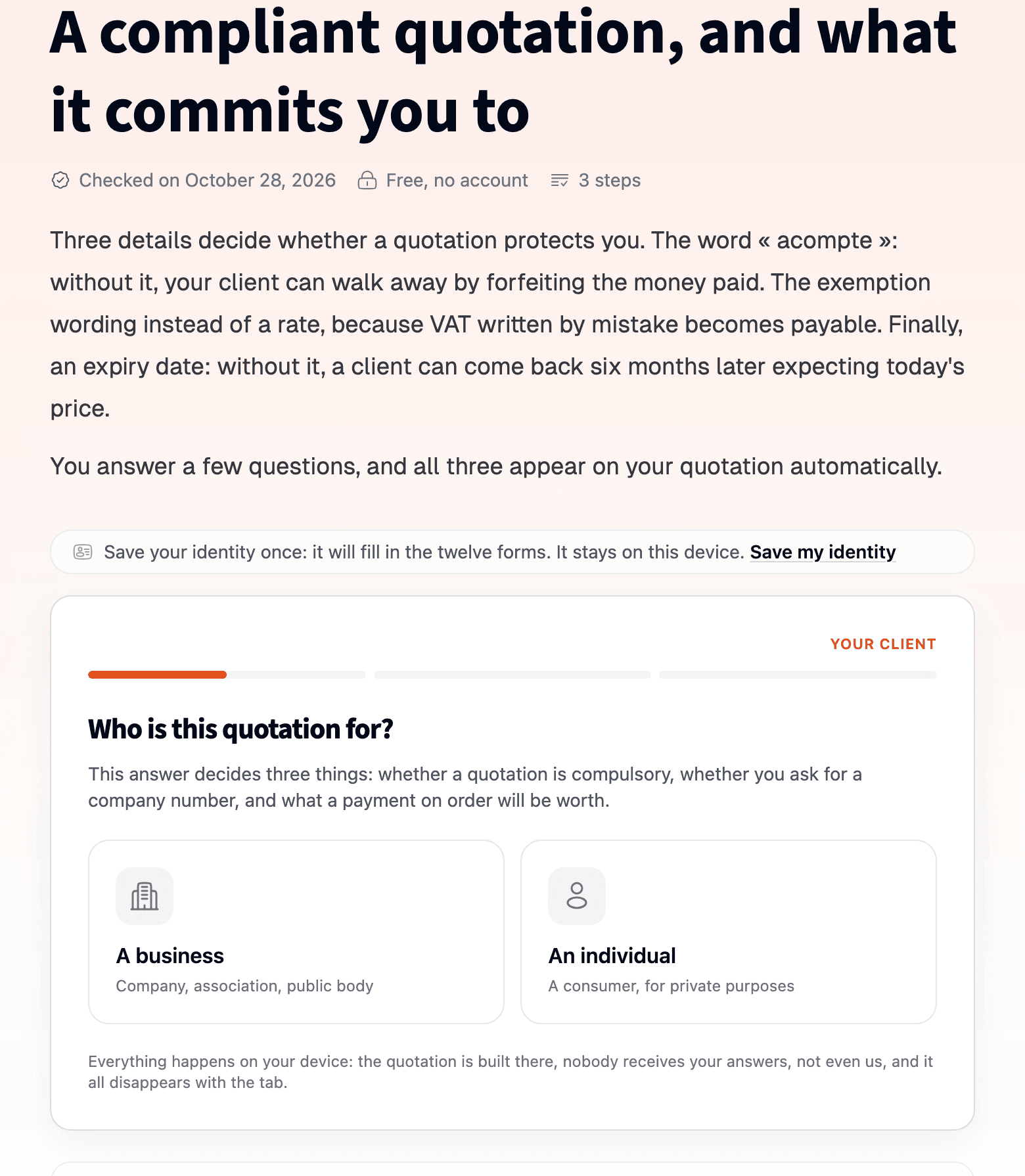
- The deposit due on signing, for example 30% of the fixed price, using the French word « acompte » (with « arrhes », the client can walk away by forfeiting the money paid);
- An expiry date, or a client can come back six months later expecting the old price.
Under the French VAT exemption, your quote carries no tax line, only the statement required by article 293 B of the French tax code. It reads « TVA non applicable, article 293 B du CGI » until 31 December 2026.
From 1 January 2027, the VAT rules move to a new code, and the statement becomes « TVA non applicable, article L. 233-3 du CIBS ».
Be careful not to write a VAT rate by mistake. VAT written on an invoice becomes payable, even if you are exempt.
Our quotation template adds the mandatory details, the deposit, the expiry date and the right VAT statement for the date. All you have to do is fill in your lines.
When and how should you raise your rates?
Your first price isn't set in stone. Three signs tell you it's time to raise it:
- Your diary is full several weeks ahead;
- Almost every quote is accepted, without any discussion;
- Your costs have gone up, with new software, insurance or higher contributions.
Start with new clients. They see your rate with nothing to compare it to, and you quickly find out whether it works.
For existing clients, give written notice one or two months ahead, with the date of the change. A quote that is already signed keeps its price to the end.
If you do only one thing after reading this, fill in the How much to charge calculator with the income you want to keep. The figure it gives is your minimum. Below it, you are working for less than your goal.
And if you don't yet know what to offer, start with our article on what to sell when you go self-employed. A price is much easier to set on a clear offer.
Frequently asked questions
How do you work out your day rate when you start out self-employed?
Start from the net income you want to keep each month. Add your costs, your contributions and your tax, then divide by the days you will actually bill in the year.
At 2026 French rates, keeping €2,200 a month in a liberal profession takes at least €177 a day. It's €294 if you bill only three days a week.
Should you charge by the day or a fixed price?
A fixed price when the result is clear (a website, a logo), by the day when the job is long or loosely defined.
For a fixed price, multiply the days you expect by your day rate, then add a margin for revisions and surprises, for example 20%.
What do you say to a client who finds your price too high?
Don't lower the price for nothing. Remove part of the work, offer payment in two instalments, or let the client go politely.
Can you raise your prices for an existing client?
Yes, for future jobs. Give them written notice one or two months ahead, with the date of the change.
A quote that is already signed keeps its price: the increase only applies to new quotes.
