Every year end, the same question comes up among French auto-entrepreneurs. What changes on 1 January, and will I have to redo my numbers?
Good news for 2027: your turnover ceilings, VAT thresholds and contribution rates stay the same. What changes is your paperwork. As an auto-entrepreneur in 2027, you face four changes on 1 January, and e-invoicing in September.
So let's see which ones really affect you, and what the 2027 budget, still being debated in Parliament, could add.
The 2027 changes at a glance
Only one change affects everyone, the new APE code. The others only apply to some micro-entrepreneurs, so find your rows first:
| Change | Date | Who is affected | What you need to do |
|---|---|---|---|
| End of the annual VAT return | 1 January 2027 | Those who charge VAT | Note April and 4 May 2027 |
| Contributions withheld by platforms | 1 January 2027 | Those paid through a platform | Nothing, except for your direct clients |
| New APE code | 1 January 2027 | Everyone | Check your future code on sirene.gouv.fr |
| New rules for combining work and a pension | 1 January 2027 | Those who work while drawing a pension | Ask your pension fund what applies to you |
| E-invoicing and e-reporting | 1 September 2027 | Every micro-business | Have chosen an approved platform |
If you charge VAT, the CA12 goes away
Do your invoices carry the "TVA non applicable" (VAT not applicable) mention? You are under the VAT exemption scheme, and nothing changes for you. Skip to the next section.
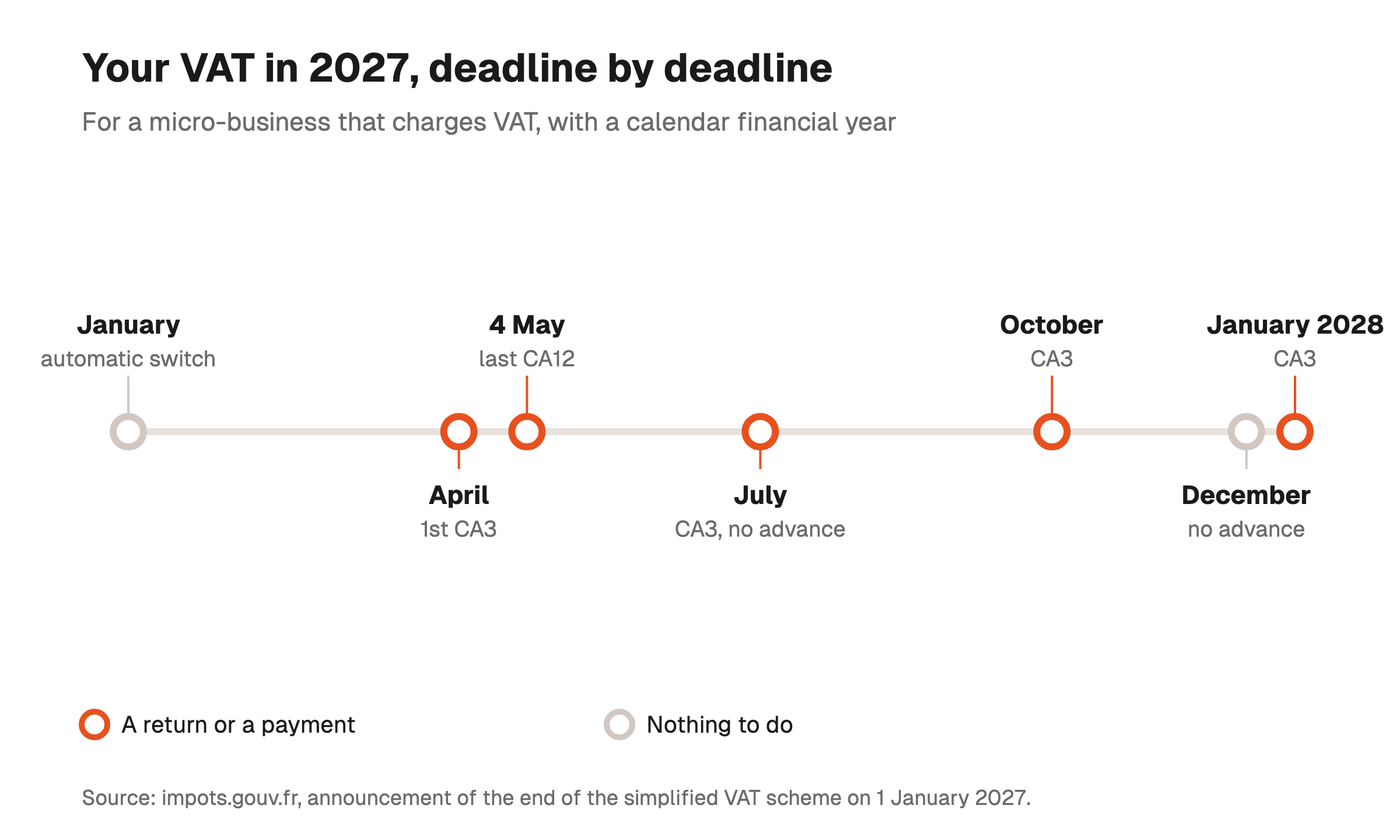
Do you charge VAT? Until now, you filed it once a year on a form called the CA12. You also made two advance payments, in July and December.
Article 38 of France's 2025 Finance Act abolishes this scheme, known as the simplified scheme, on 1 January 2027. You will file your VAT every quarter, on the quarterly return called the CA3, and the advance payments go away. The switch happens without any action on your part.
In spring 2027, two returns come back to back. The first CA3, for January to March, is filed in April. The last CA12, for 2026, is still due by 4 May 2027, according to the calendar published by impots.gouv.fr.
If a platform pays you, it withholds your contributions
Do you deliver meals, teach lessons or take on gigs through an app that collects the client's money? From 1 January 2027, that platform withholds your contributions on every payout. It then declares and pays them to URSSAF on your behalf.
Voluntary platforms, such as Uber Eats or Les Sherpas, have done this since 1 October 2026. France's 2024 Social Security Financing Act extends the obligation to all the others in 2027. Your rates don't change.
Do you also have direct clients? What you will actually receive and what you still have to declare yourself are covered in our article on contributions withheld by platforms.
Your APE code changes, with nothing to do
The APE code is the five-character code that states your main business activity. It appears on your official documents, and Insee (France's statistics office) assigns it.
The official list of activities behind it dated from 2008. It has been revised, and every business gets a new APE code on 1 January 2027, micro-entrepreneurs included. Insee does it itself, you have nothing to request.
You can already look up your future code on sirene.gouv.fr by typing your SIREN number. According to Insee's press release, the new code gives you no extra right or obligation compared with the old one.
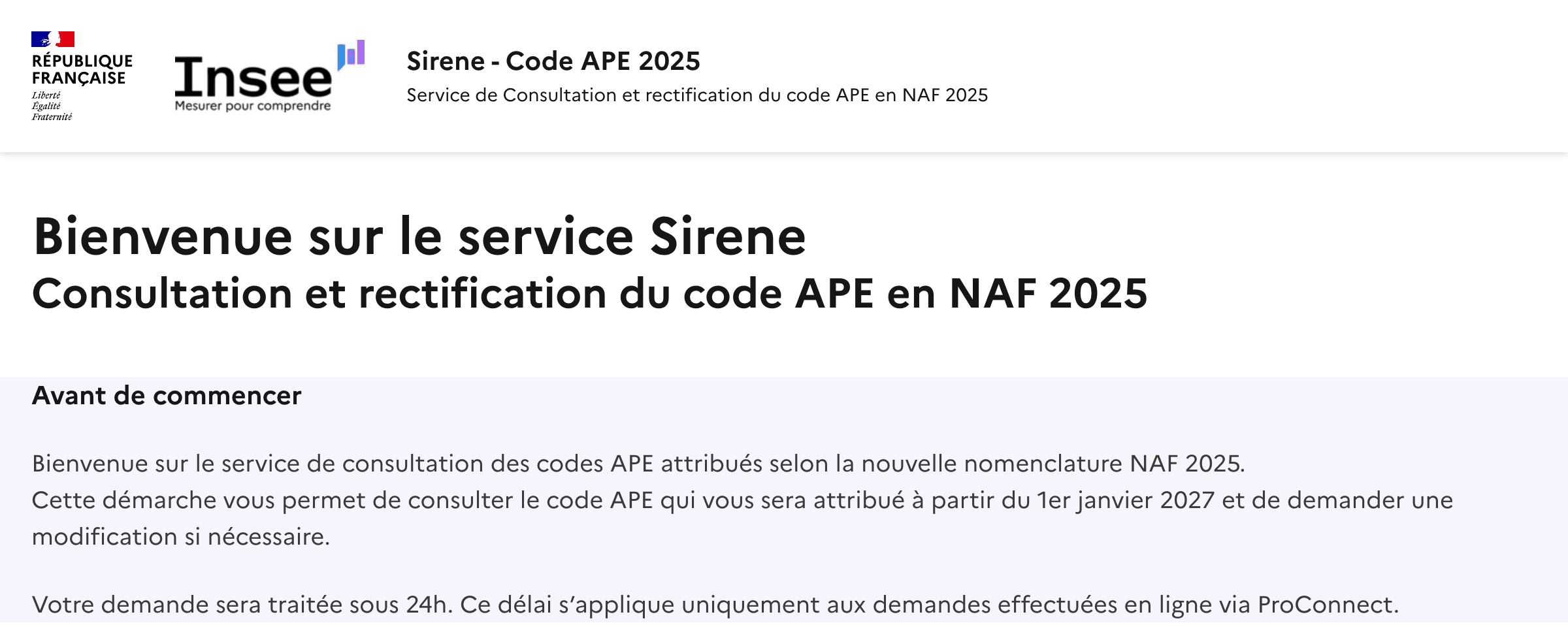
Does the suggested code not match what you do? The same site lets you ask for a correction, online with a ProConnect account (the login professionals use on French government sites) or through a form to fill in. Our APE code correction tool, built on French rules, helps you prepare that request.
A correct code mostly saves you misunderstandings. It is what your bank, your insurer or a client checking your business will read.
If you work while drawing a pension, the rules get stricter
Combining work and a pension means drawing your pension while you keep working, for example by keeping a few clients. France's 2026 Social Security Financing Act changes the rules on 1 January 2027.
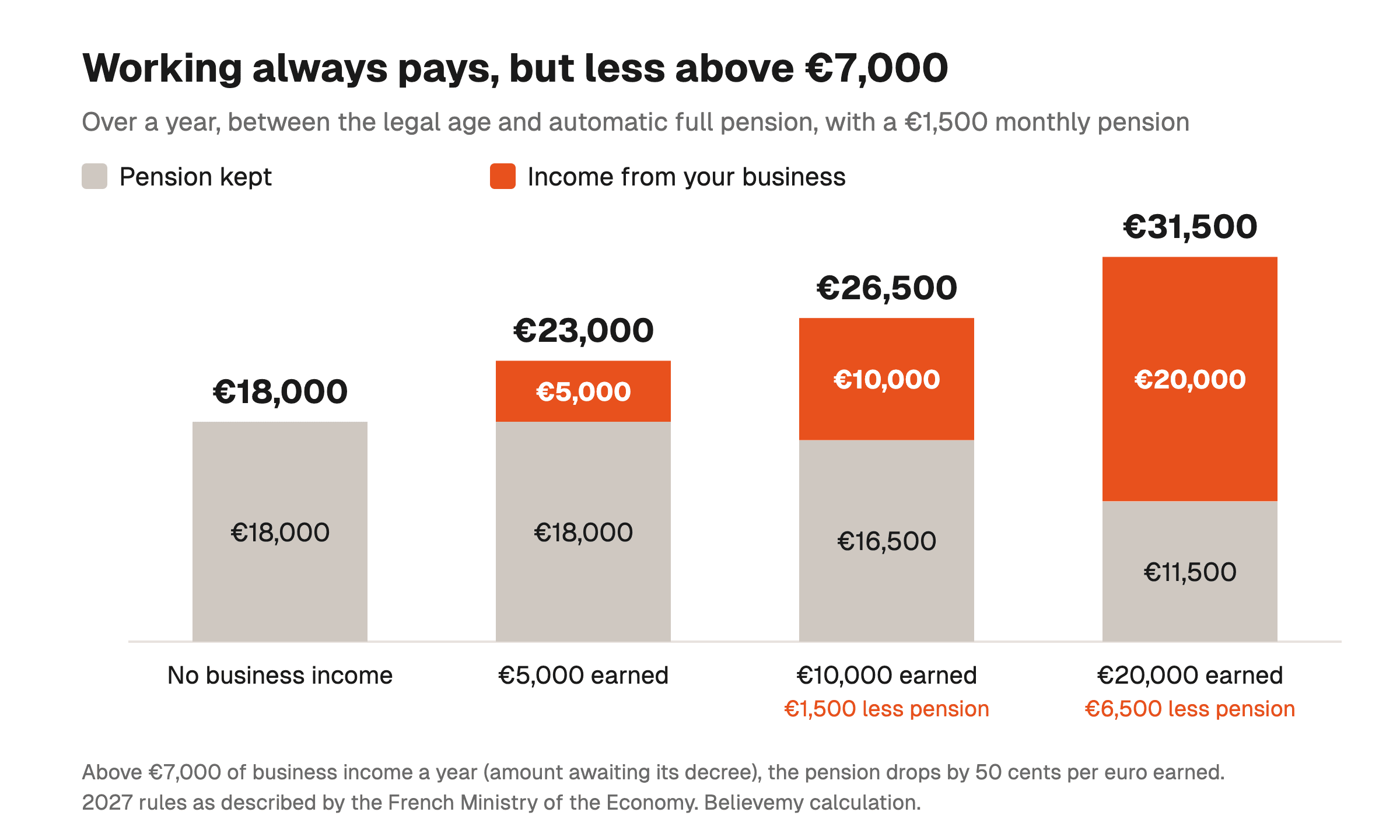
Two ages matter. The legal age is the earliest you can retire, between 62 years and 9 months and 64 depending on your year of birth, according to Service Public. And at 67, you get your full pension whatever happens: that is the age of automatic full pension.
Only your age will count, according to the French Ministry of the Economy:
- Before the legal retirement age, every euro you earn from your business is deducted from your pension;
- Between the legal age and 67, you keep everything up to €7,000 of business income a year, then half of the excess is deducted from your pension;
- From 67, you can combine both with no limit.
The €7,000 figure is still waiting for its implementing decree, according to the same ministry. If you already draw a pension and invoice clients, ask your pension fund whether these rules apply to you.
In September 2027, e-invoicing reaches you too
Since 1 September 2026, you must be able to receive e-invoices. That means having chosen an approved platform (plateforme agréée), an invoicing service certified by the French state that receives and sends your invoices.
From 1 September 2027, micro-businesses will also have to issue their own when they invoice another business based in France.
On the same date, that platform will send part of your sales data to the tax office. This is called e-reporting, and it also covers your sales to individuals and abroad.
The reform's dates get muddled quickly. Our Do I need to switch to electronic invoicing? tool tells you how many days you have left for each obligation, depending on your clients. For the background, here is what e-invoicing changes for a freelancer in France.
What stays the same, and what the 2027 budget could still change
The micro-entreprise turnover ceilings are set for 2026, 2027 and 2028. The VAT exemption thresholds don't change either:
- Services and liberal professions, a €83,600 ceiling and VAT exemption up to €37,500;
- Sale of goods and accommodation, a €203,100 ceiling and VAT exemption up to €85,000.
These are the values set in 2026. The Service Public page on the micro-entreprise tax regime always gives the current amounts.
Update as of 26 October 2026. The 2027 budget is being debated. The National Assembly votes on the first part of the finance bill on 3 November 2026, then the text goes to the Senate.
As tabled, neither this bill nor the social security bill touches the micro-entreprise ceilings, VAT thresholds or contribution rates. The one exception noted in Légifiscal's summary is a reduced rate on July to September 2026 for micro-entrepreneurs hit by the summer 2026 wildfires.
An amendment could still change things before the final law, expected at the end of December. We will update this article at each stage.
For 2027, do two simple things. Look up your future APE code on sirene.gouv.fr, and find the rows that apply to you in the table at the top. And if you charge VAT, put April and 4 May in your diary now 😉
Frequently asked questions
Do the micro-entreprise turnover ceilings change in 2027?
No, the ceilings are €83,600 for services and €203,100 for sales, amounts set for 2026, 2027 and 2028. The VAT exemption thresholds don't move either, at €37,500 and €85,000.
The 2027 budget bill tabled by the government doesn't change them, but it can still be amended before the final vote.
Will my APE code change in 2027?
Yes, Insee assigns a new APE code to every business on 1 January 2027, micro-entrepreneurs included. You have nothing to do, and the code creates no extra right or obligation.
You can look up your future code on sirene.gouv.fr with your SIREN number. If it doesn't match your activity, an online form lets you ask for a review.
Are auto-entrepreneur contribution rates going up in 2027?
No rate increase is planned in the 2027 budget bills tabled by the government. Withholding by platforms, extended to all of them on 1 January 2027, doesn't change your rates either.
When does e-invoicing become compulsory for an auto-entrepreneur?
An auto-entrepreneur must be able to receive e-invoices since 1 September 2026. They will have to issue their own from 1 September 2027 when they invoice another business based in France.
E-reporting, which sends some of your sales data to the tax office, starts on the same date.