


You have been building websites in the evenings for six months, and a former colleague has just ordered one from you. To invoice it in France, you need a micro-enterprise.
One question still holds you back. Can your employer hold it against you?
In the French private sector, starting out without quitting your job is allowed, with no permission to ask for. Even an exclusivity clause cannot block you in the first year. However, you can never compete with your employer, or work on your business during your working hours.
So let's look at what the law allows, what is forbidden even without a clause, how start-up leave works, and the civil service case.
Can you start a micro-enterprise while employed?
Yes. Combining a micro-enterprise with employment is allowed in the private sector, and no law generally requires you to ask for permission.
There are two caveats, set out in the official French page on holding both. A collective agreement can make it subject to your employer's consent, or even forbid it. And in craft trades, working for your employer's clients requires their go-ahead.
The 48-hour weekly ceiling does not apply to you either. It adds up salaried jobs, and your self-employed work does not count towards it. Your tiredness, however, still does 😉
A few activities are closed to the micro-enterprise scheme, whether you are employed or not. That covers activities subject to property VAT, such as estate agents or property dealers, and farming activities attached to the MSA, the farmers' social security fund.
Can an exclusivity clause stop you?
Not in the first year. You often read that you must first check your contract carries no exclusivity clause, as if it closed the door. The official page on holding both itself treats it as an obstacle.
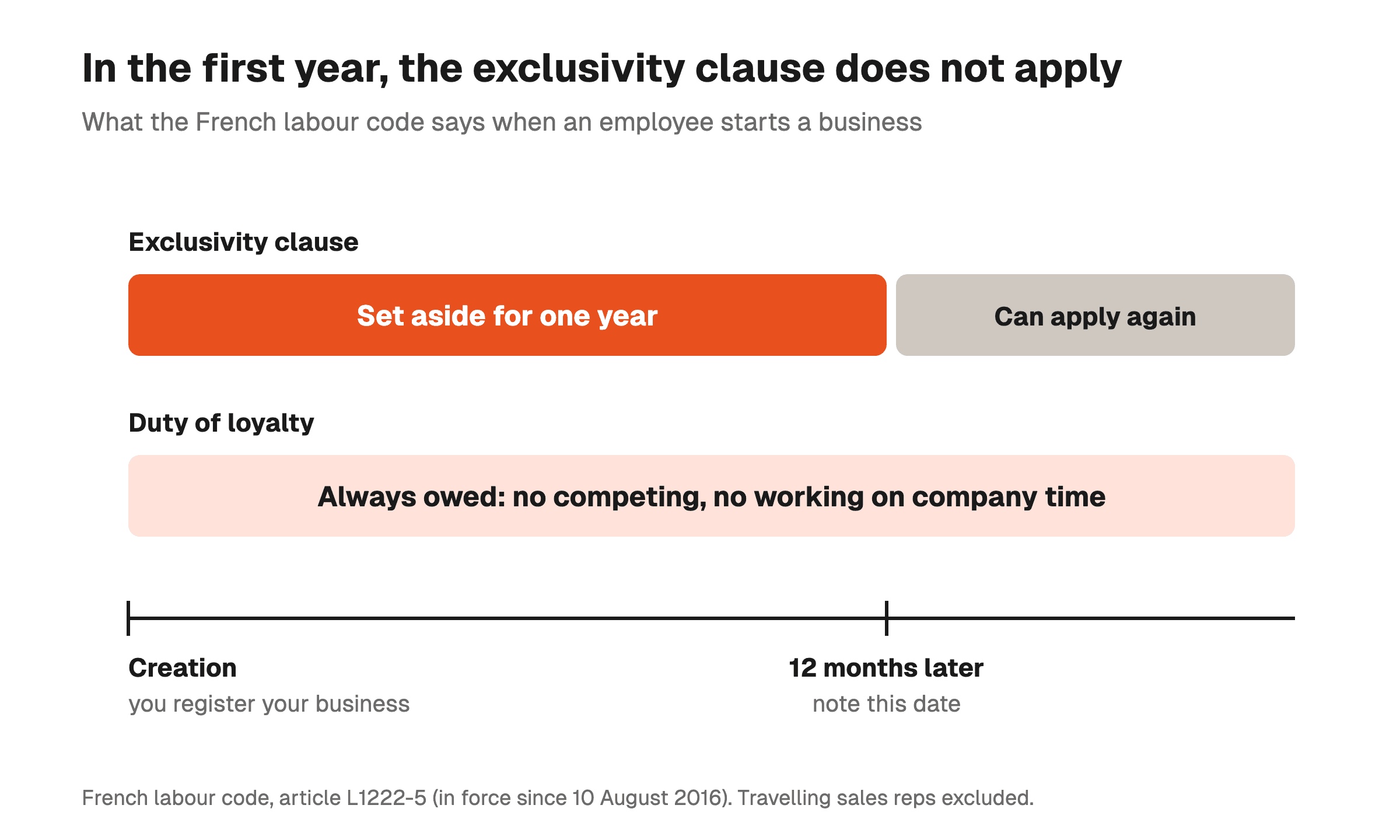
The French labour code says otherwise. Its article L1222-5 has been in force since 10 August 2016. Under it, your employer cannot enforce that clause against you for one year if you start or take over a business. That holds even if your contract or collective agreement says the opposite.
Three details matter for you:
- Travelling sales representatives are excluded, and the clause still applies to them;
- The year gets longer if you take leave to start a business and that leave is extended;
- After twelve months, the clause can apply again, so note that date on the day you register your business.
Part-time, the question barely arises. An exclusivity clause cannot in principle be imposed on you, unless it protects a legitimate interest of the company and your duties justify it.
What stays forbidden, even without a clause?
The duty of loyalty. It applies for as long as your contract runs, even if it says nothing about it, and article L1222-5 points out that it never lifts. It is what costs employees their jobs when they start out without care.
In practice, it forbids three things:
- Competing with your employer, for example approaching their clients or selling the same service;
- Working on your business during your hours, even for half an hour between two meetings;
- Using what belongs to the company, its computer, its email, its files or its know-how.
If you break these rules, you risk dismissal for serious misconduct, or even gross misconduct. Employed by a web agency, you can therefore build websites for tradespeople the agency does not target. Not for its clients.
If your contract contains a non-compete clause, read that too. It will follow you once you leave your job for your own business. To find clients without touching your employer's, read our article on how to find your first clients.
Invoicing your own employer for the work you used to do as an employee is risky. If you still take their orders and they control your work, the relationship can be reclassified as an employment contract. Our Employment reclassification tool, built on French law, helps you gauge that risk.
Do you have to tell your employer?
In the private sector, no law generally requires it. But your contract or collective agreement may, or may make holding both subject to their consent. Read them again before you register your business, as that is the only way to know where you stand.
Our Keeping your job tool asks you a few questions about your contract and your plan. It then tells you what your situation allows, what stays forbidden and the date your first year runs out.
How does leave to start a business work?
If you want time to get going without resigning, the French labour code provides leave or a switch to part-time to start or take over a business. Your company or your industry can set the rules by agreement.
Without an agreement, these rules apply, under articles L3142-113 to L3142-119 and D3142-73 of the labour code:
- Twenty-four months of service with the company, consecutive or not;
- One year at most, extendable by one year;
- A request two months before you leave, by a means that gives it a certain date, stating your activity and the length you want;
- A possible refusal in companies with fewer than 300 employees, after consulting the works council (CSE), if your absence would harm the smooth running of the business.
A refusal must state its reasons, and you can challenge it before the employment tribunal. If your employer does not reply within the set deadline, their consent is deemed given.
During the leave, your contract is suspended and you no longer receive a salary, according to the service-public.fr page on suspended contracts. If you decide not to come back, tell your employer at least three months before the leave ends.
How much will you pay in contributions, and can you get the ACRE?
You contribute to both schemes, each on its own income. Your salary keeps carrying its contributions, and your micro-enterprise pays its own on your turnover.
For health cover, your benefits are paid by the scheme of the activity you had before. As an employee starting out, you are therefore covered by the employees' scheme, unless you choose the other one.
The ACRE, France's start-up relief on contributions, is not automatic. It is reserved for certain situations, such as being a jobseeker or aged 18 to 25. It is also granted if you set up in a priority urban neighbourhood or in a France rural revitalisation zone.
And if you are a civil servant?
Everything is reversed. For a public employee, a private profit-making activity is forbidden in principle, and each exception goes through a formality. Our glossary has a page on it, civil servants and self-employment.
According to the service-public.fr page on public employees holding several activities, there are two ways to start a business:
- A post of 24.5 hours a week or fewer, 70% of statutory hours, where a written declaration is enough;
- A switch to part-time, at least half-time, on a three-year authorisation renewable for one year.
Some side activities, such as teaching, training or selling goods you make yourself, are also allowed with authorisation. They are always carried out outside your working hours.
To begin, read your employment contract tonight, looking for an exclusivity or non-compete clause. Then spend ten minutes on our article on what to sell when you go self-employed, without stepping on your employer's turf!
Frequently asked questions
Can you be an employee and a micro-entrepreneur at the same time in France?
Yes. In the private sector, holding both is allowed without permission, unless your contract or collective agreement says otherwise.
Your business must not compete with your employer and must be carried out outside your working hours.
Does an exclusivity clause stop me starting a micro-enterprise?
Not in the first year. Article L1222-5 of the French labour code prevents the employer from enforcing it for one year against an employee who starts or takes over a business.
Travelling sales representatives are the exception. After twelve months, the clause can apply again.
Do I have to tell my employer I am starting a micro-enterprise?
No law generally requires it of a private-sector employee. Your contract or collective agreement may require it, however, or make holding both subject to their consent.
A public employee always goes through a declaration or an authorisation.
Will I pay contributions twice?
You contribute to both schemes, each on its own income, your salary on one side and your turnover on the other.
Your health benefits are paid by the scheme of the activity you had before, the employees' scheme if you were employed.
Can you take leave to start a business in France?
Yes. Without an agreement in your company or industry, you need twenty-four months of service, and the leave lasts one year at most, extendable by one year.
The request is made two months before you leave. During the leave, your contract is suspended and you are not paid.
