Creating your own website is a very rewarding experience: the feeling of creating something that didn't exist before with your hands on a keyboard has always amazed me. But where to start in web development? That's what this article is all about!
The ABCs of web development
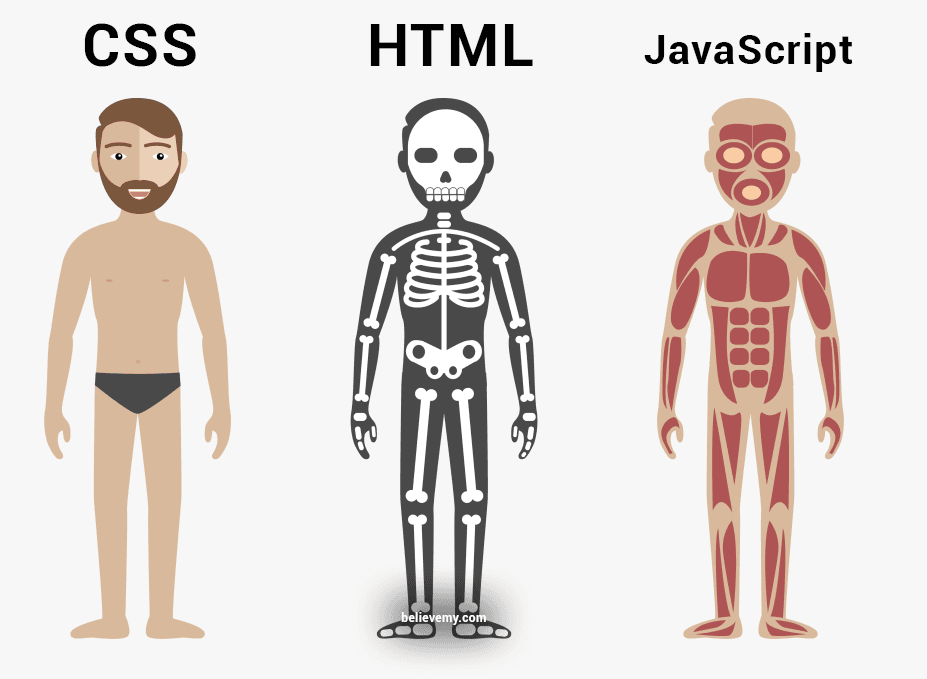
Before you get lost in the jungle of programming languages, you should know that there's one thing every web developer has in common: they all know at least HTML and CSS. It's really the basis of a website, and is to a website what our skeleton is to our body: without it, no website.
HTML allows us to say “Here, I want a paragraph”, “And here, I want my logo to appear”. It gives us the ability to mark up our website, i.e., we'll know where our menu, footer, etc. are located.
CSS, on the other hand, will give our website all its style by giving it colors, formatting and the layout of different elements so that they display perfectly according to our needs.
Next, you'll need to learn how to put your website online so that it can be accessed from any country in the world!
Specialization: front-end vs. back-end
You may have heard them before, or perhaps seen them somewhere. Front-end and back-end are both specializations within the profession of web developer.
In other words, there are two types of developer:
- Front-end developers: They're in charge of page layout and design. They will also ensure that the website is compatible with several different web browsers and devices. They create links, buttons, images, etc. on a website.
- Back-end developers: They take care of the “hidden” part of websites, collecting data from forms, for example, and storing it to enable users to create an account.
Last but not least, full-stack developers: they're good at both front-end and back-end. This category of developers represents the fusion of the other two.
If we were to make a comparison with a car... The front-end developer would create the body. The back-end developer would take care of the engine.
A car without a body isn't a car. But a car without an engine is a pointless shell. It's the same with front-end and back-end developers, neither is more important than the other. It's a matter of personal preference. 😉
Now that you know more about the different types of developers, let's take a look at where to start, depending on whether you want to :
- dealing with interfaces and interactions with the page (detecting a click on a button, for example): front-end
- take care of the information passing through our site, store it and reuse it (to create a blog, for example, we need to store the content of our articles, which is where the back-end developer comes in): back-end
What's next for a front-end developer?
You've just learned HTML and CSS, that's great! But right now, it's essential to learn how to use JavaScript. If you want to become a front-end developer, this programming language will enable you to take all the interactions you can make with your website to the extreme: detect your user's geolocation to display the weather in their city in real time without reloading the page, for example, or retrieve the sale price of bitcoin every second.
In recent years, JavaScript has even become one of the most popular programming languages. There is a huge demand for JavaScript developers on the market, which means that knowing how to use it is a very important asset.
Et si je souhaite me spécialiser encore plus ?
If you want to specialize even further in the front-end sector, then I strongly urge you to learn SASS and SCSS. This is a preprocessor that will enable you to program directly into your style sheets (the files that define your design). Not only will this save you precious time, it will also set you apart from other developers, since it's a very important skill that few take the time to learn.
Finally, I recommend that you learn to use BOOSTRAP. This library will enable you to create designs for your projects extremely quickly, while giving you the possibility of making your site compatible with all devices: computers, televisions, cell phones, smartphones, ...
With this, there's no doubt that you'll have all the cards in your hand.
What's next for a back-end developer?
What's the next step for a back-end developer? If you're looking to move into back-end development, you'll need to learn what we call a server-side language. This is a programming language that is executed on your server (i.e. on the computer that contains your website files) and not on the computer of the visitor currently on your site, unlike JavaScript and the languages used by front-end developers.
The advantage of server languages is that they allow you to perform tasks without the user being able to see or modify anything.
These days, I can only recommend that anyone wishing to become a back-end developer learn PHP and MySQL. It's THE language that will enable you to do anything you set your mind to: blogging, social networking, search engines, sales platforms, the projects are limitless.
And finally... Frameworks
Once you've fully mastered the programming languages we've covered together, depending on whether you prefer front-end or back-end, you may want to move on to the “ultimate” developer step: mastering a framework.
A framework is, as its name suggests, a “framework”. The aim of a framework is generally to simplify the work of software developers (coders, if you prefer), by offering them a “ready-to-use” architecture that means they don't have to start from scratch with every new project.
Frameworks can be compared to sewing patterns. The main advantages are
- code reuse
- standardization of programming
- formalization of an architecture adapted to the needs of each company
Source : 1min30
If you want to learn a framework, here are the most popular ones according to your preferred programming language:
Please note: learning a framework requires a good knowledge of the programming languages on which they are based. If you're struggling with JavaScript, don't go straight for React - you'll break a leg! Take my word for it!
In short, patience is the key to becoming a good web developer. And don't forget to have fun while you're programming, because code is even more fun when you learn it without thinking!
Don't hesitate to share this article if you find it useful, or to help people around you who don't know where to start!