The quote said five days. You are on day nine, the client is chasing you, and your fixed price will not move by a single euro.
The worst part? On your next quote, you will say five days again.
That reflex has a name, the planning fallacy. You underestimate how long a task will take, even though you know the previous ones nearly all ran over.
When you work for yourself, you pay for it twice: in extra evenings of work, and in money, since a fixed price does not stretch with your hours.
So let's look at where it comes from, why even a cautious estimate runs over, and how to price a job properly when you work alone.
What does the planning fallacy look like when you work alone?
It rarely shows up all at once. It hides in estimates made in a hurry, often on the phone with a client:
- You price a fixed-fee job thinking about the work itself, never about the back and forth with the client;
- You promise a delivery date without counting the other jobs on your plate that week;
- You fill your diary to 100%, as if nothing could interrupt you;
- You announce the launch of your offer for September, then push it back twice.
A fixed-fee job planned for five days that takes eight means a day rate that shrinks by more than a third. Nobody points it out, because the invoice stays exactly the same.
The first time I sold a website for a fixed price, I had planned a week. It took me two, mostly for details I had not even imagined 🥲
Where does the planning fallacy come from?
Psychologists Daniel Kahneman and Amos Tversky named it in 1979, in a paper on errors in forecasting.
When we forecast, we look at the project from the inside. We picture the steps one by one, as if everything will go to plan. And we forget to check how long similar projects actually took.
The most quoted example is the Sydney Opera House. According to the 1957 estimates, it was due to open in early 1963 for $7 million. A scaled-down version finally opened in 1973, for $102 million.

Why does even a cautious estimate run over?
In 1994, Roger Buehler, Dale Griffin and Michael Ross asked 37 students at the University of Waterloo, in Canada, when they would hand in their final-year thesis. The answers fed a study that became the reference on the subject.
On average, they predicted 33.9 days, and it took them 55.5. Fewer than a third (29.7%) handed in their thesis by the date they gave.
The researchers had also asked them for a date "if everything goes badly". On average, they said 48.6 days, still short of reality. Fewer than half (48.7%) finished before that date.
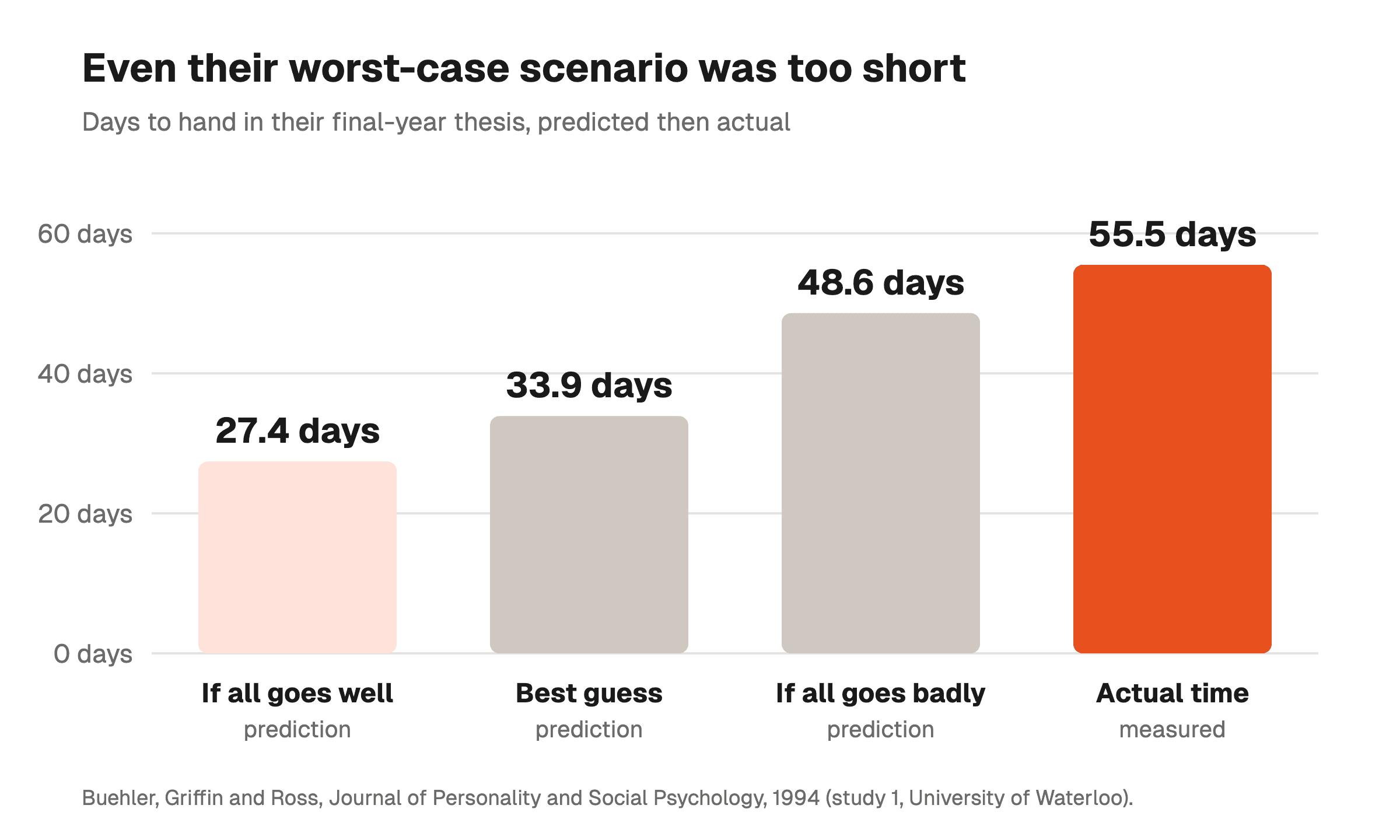
Adding a small "just in case" buffer to your quote is therefore not enough. Even the worst these students could imagine was still too short.
We do not underestimate everything. Pooling the published studies, Michael Roy and his colleagues found in 2005 that tasks under 5 minutes tend to be overestimated.
Beyond 12.5 minutes, underestimation becomes the rule, with 12 tasks out of 14 in their review. According to them, we misremember how long our past tasks took, and we shorten them. Our forecasts therefore start from memories that are already too short.
Why does the planning fallacy cost more when you are self-employed?
The bias affects everyone, but two things make it worse when you work alone:
- Nobody checks your estimates, whereas in a team, someone often compares them with previous projects;
- You often price the job during the call, keen to win it, and a short deadline reassures the client in the moment.
Professionals are not immune. Bent Flyvbjerg and Alexander Budzier studied 1,471 IT projects, with an average budget overrun of 27%.
One project in six even overran its budget by 200% on average, and its schedule by almost 70%. For a freelancer on a fixed fee, every overrun like that comes straight out of their own pocket.
How do you price a job properly when you work alone?
Link your past jobs to the new one
In another experiment from the same 1994 study, 123 students had to predict when they would finish a computer assignment. Some first had to recall their past assignments.
Others also had to explain how those memories applied to the task in front of them. The last group got no instruction at all.
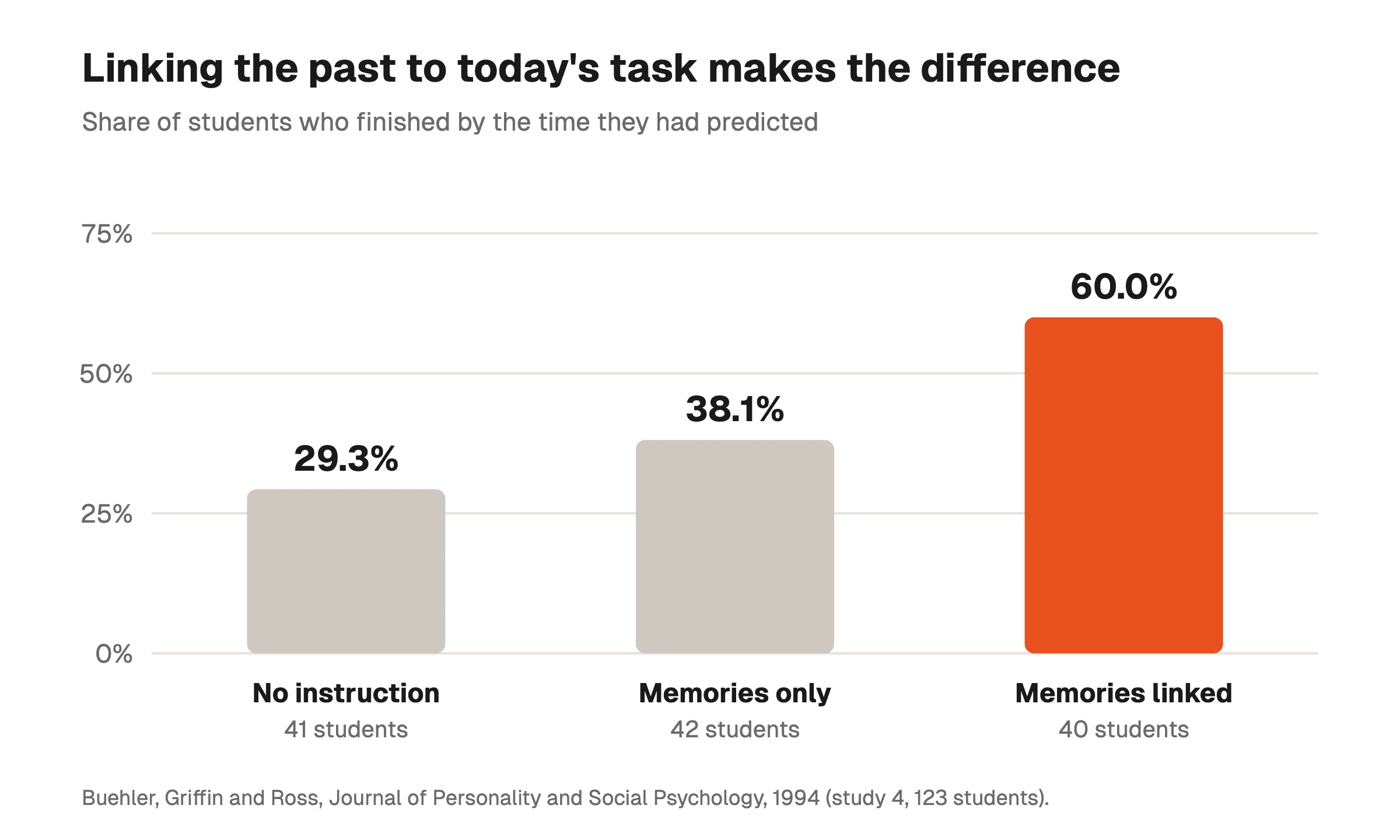
Remembering was not enough: 38.1% finished on time, barely more than the 29.3% with no instruction. Those who linked the past to the task at hand were 60% to finish on time.
Before pricing a website, then, dig out the last one you delivered. How many days did it really take, client exchanges included? Start from that figure rather than from your gut feeling.
Track your hours instead of remembering them
You still need to know how long your past jobs really took. And according to Roy and his colleagues, your memory shortens it.
Log your hours for a few jobs, even in a simple spreadsheet. After three or four, you will have your own figures, far more reliable than your memories. If it is getting started that drags rather than the work itself, the problem may be procrastination.
List every step before you price
Listing the steps of a task makes people predict longer, and often more accurately. Justin Kruger and Matt Evans showed this in 2004, as Torleif Halkjelsvik and Magne Jørgensen point out.
They also cite a study of software projects. Teams that used a checklist underestimated their time by 10% on average, against 38% for the others. Put the things everyone forgets on your list:
- Exchanges and meetings with the client;
- Corrections after their review;
- Going live and the final tweaks;
- The invoice and the reminders.
Once the list is done, our Compliant quotation tool, built on French rules, helps you turn it into a quote with the mandatory mentions. Still keep an eye on the end date, which a very detailed plan can make too optimistic, according to the same two researchers.
Add the buffer your figures justify
Compare your latest estimates with how long the jobs really took. If your jobs take 30% longer than planned on average, add 30% to the next one, and give the client a date based on that figure.
Then multiply those days by the rate from our How much to charge calculator, also built on French rules. To quote that rate without apologising, read our article on how to set your prices when self-employed.
To begin, open your last quote and compare it with the time the job really took. The gap you find is your buffer for the next one!
Frequently asked questions
What is the planning fallacy?
It is the tendency to underestimate how long a task will take, even when you know similar tasks ran over.
Daniel Kahneman and Amos Tversky described it in 1979.
Why do we underestimate how long a task will take?
Because we picture the steps as if everything will go well, instead of looking at how long similar projects took.
Our memory does not help. According to a 2005 review of studies, it also shortens how long past tasks took.
Is the planning fallacy proven?
Yes. In 1994, students who expected to hand in their thesis in 33.9 days on average took 55.5.
Even their "if everything goes badly" forecast, 48.6 days on average, was too short.
How do you avoid the planning fallacy?
Start from how long your past jobs really took, measured rather than remembered, and link that to the new job.
Also list every step before pricing, client exchanges included, then add the buffer your own figures justify.
How much buffer should you add to a quote?
Allow for the average gap between your estimates and how long jobs really took, measured over your latest jobs.
Without figures of your own, a small "just in case" buffer is not enough. In the 1994 study, even the students' worst-case scenario was still too short.