


Your job was cut in September. Part of what you used to do, an AI tool now does in your place. You still have 400 days of unemployment benefit ahead of you, and one idea: going self-employed.
At your first meeting, your France Travail adviser (the French public employment service) asks you a question. Do you want your benefit every month, or part of it in one go?
That choice, keeping the ARE or taking the ARCE, shapes your first year. One follows your income month by month, the other pays you a lump sum in two instalments.
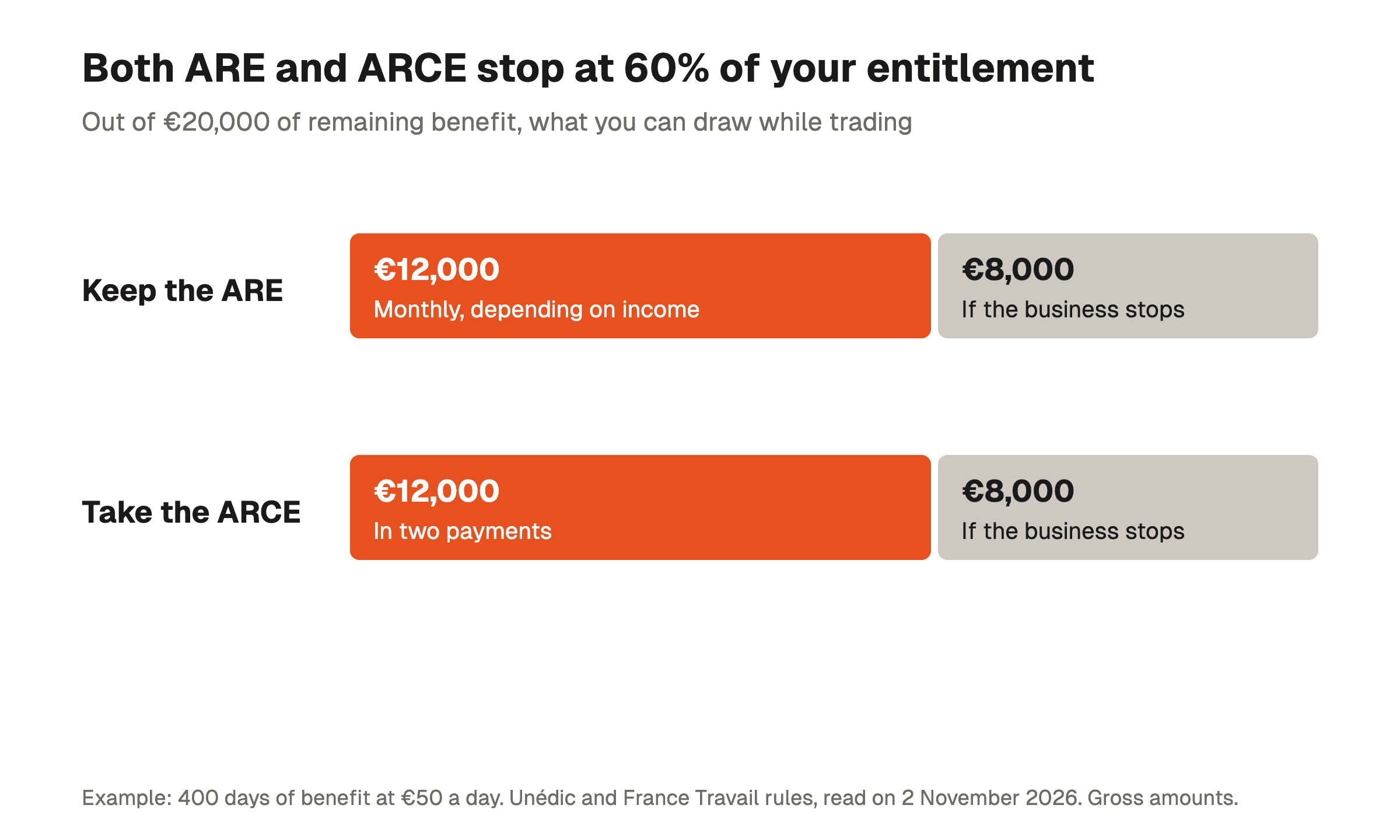
Since 1 April 2025, both options share the same limit. As long as your business keeps trading, you receive at most 60% of the balance of your entitlement. The next 40% only comes back if you stop.
Let's look at what each one pays, how to choose, and in what order to do the paperwork, even if you have never set up a business.
What is the difference between the ARE, the ARCE and the ACRE?
Three almost identical acronyms, three different French schemes. Mixing them up can cost you an entire benefit.
| Scheme | Who pays it | What it is |
|---|---|---|
| ARE, the back-to-work allowance | France Travail | Your unemployment benefit, paid monthly and reduced according to your income |
| ARCE, the business creation or takeover grant | France Travail | Part of that same benefit, paid as a lump sum in two instalments |
| ACRE, the start-up relief for business founders | The Urssaf | A cut in your social contributions when you start, with no payment at all |
Keeping the ARE and taking the ARCE are mutually exclusive: you pick one or the other. The ACRE, on the other hand, combines with both, and it is compulsory to get the ARCE.
Since 1 January 2026, the ACRE must be requested from the Urssaf within 60 days of your business start date. It is refused if you have already had it in the previous three years.
Its value dropped for businesses started from 1 July 2026. Our ACRE calculator, built on French rules, works out what it saves you.
French unemployment insurance rules change often. These ones were checked on 2 November 2026 with the Unédic, France Travail and Service-public.fr. Before deciding, reread the amounts on your own notice of entitlement.
How much do you receive if you keep the ARE?
If you keep the ARE, you stay registered with France Travail. Each month you declare the turnover you have collected, even when it is zero, and France Travail works out your benefit in three steps:
- It deducts the standard allowance for your activity, 71% for selling goods, 50% for other commercial and craft activities, 34% for liberal professions;
- It subtracts 70% of the resulting income from your benefit for a full month;
- It divides the result by your daily benefit, which gives the number of days paid, rounded to the nearest whole number.
Take a benefit of €50 a day, so €1,500 for a 30-day month. You are a graphic designer working as a liberal profession, and you collect €1,500 this month.
France Travail counts €990 of income and deducts 70% of it, so €693. It pays you 16 days, or €800, instead of €1,500. The 14 unpaid days push back the end of your entitlement by as much.
Your benefit and your income combined cannot exceed your former gross salary, according to the Unédic factsheet on combining benefit and income. If you do not know your income for the month yet, you receive 70% of your benefit provisionally, adjusted once a year.
Since 1 April 2025, this combination stops once you have received 60% of the balance of your entitlement on the day you started. Payments then end, even if your income is low.
There are two ways out. With no income at all since starting, you can ask the regional joint board for an exceptional extension. If the business stops or goes dormant, payment of the next 40% can resume.
How much does the ARCE pay, and when?
The ARCE pays you 60% of the balance of your entitlement on the day your business starts, according to the Unédic factsheet on the ARCE. France Travail deducts 3% for your supplementary pension. If your contract ended before 1 July 2023, the rate drops to 45%.
With our 400 days at €50, the balance of your entitlement is worth €20,000. The ARCE comes to €12,000, or €11,640 once the 3% is deducted.
This lump sum arrives in two halves of €5,820. The first is paid when the business starts, the second six months later, on two conditions:
- You are still running the business for which you requested the grant;
- You are not in a full-time permanent job, a condition added for businesses started since 1 April 2025.
The ARCE is subject to CSG and CRDS social levies, and it counts towards your taxable income, according to France Travail's 2026 guide. Nor does it earn any pension quarter validation, unlike the ARE, according to Service-public.fr.
If the business stops, you recover the balance of your entitlement, minus the ARCE already paid. After both instalments, that means the 40% not yet paid, after a waiting period equal to the days of benefit the second instalment represented. You must re-register within three years of your entitlement opening, plus its length.
In the end, both options give you access to the same share of your entitlement while you are trading.
Keep the ARE or take the ARCE: how do you choose?
The real difference is the pace. Let's go back to our 400 days at €50, as a liberal profession, with three scenarios over a year, in gross amounts.
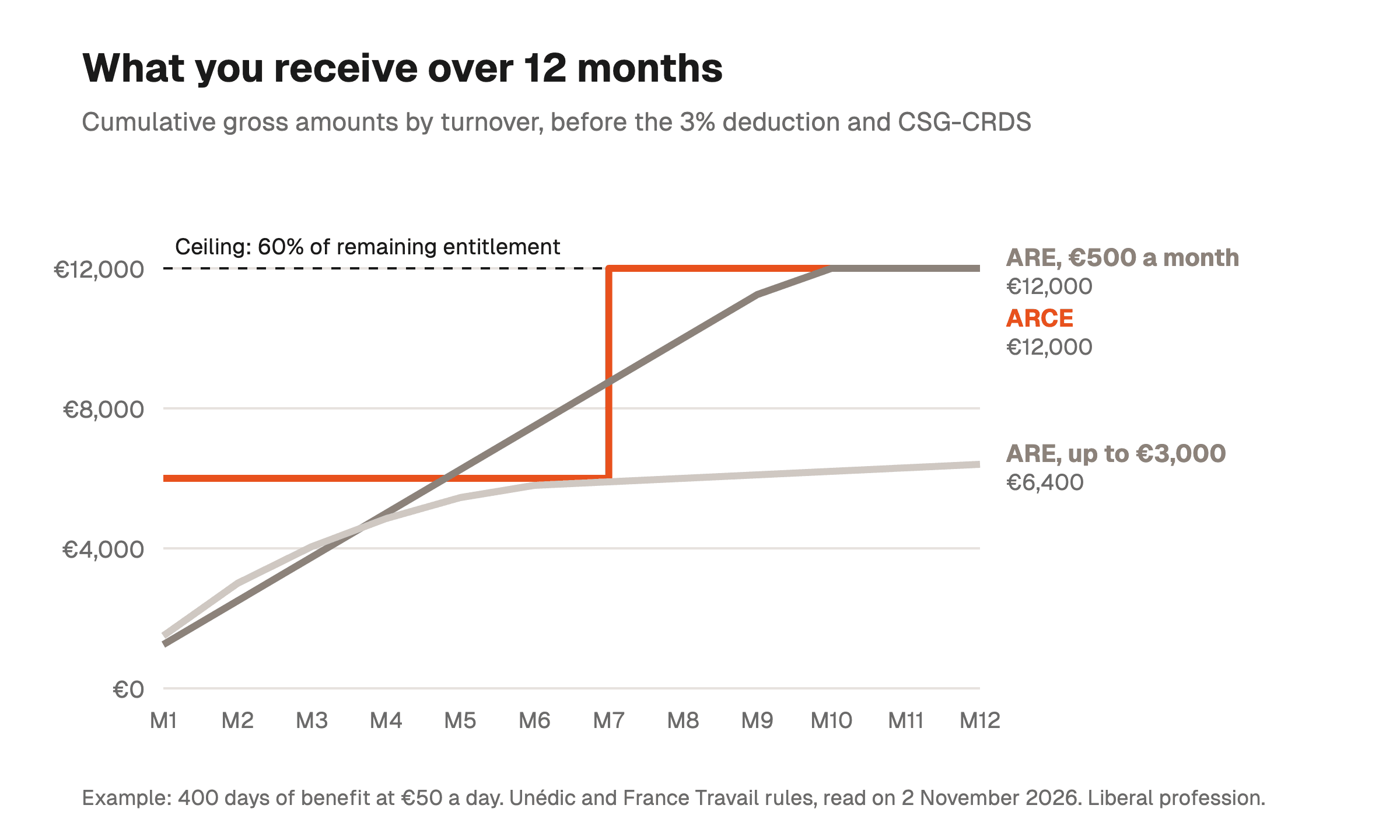
With turnover of €500 a month, the ARE pays you €1,250 every month. It reaches the €12,000 ceiling in the tenth month, as much as the ARCE, with a monthly safety net on top.
If your turnover climbs to €3,000 a month, the ARE drops quickly. You receive €6,400 over the year, against €12,000 with the ARCE. The balance of your entitlement waits, in case your income falls back.
Here is the option that usually fits, depending on your situation.
| Your situation | Rather |
|---|---|
| Your income will start slowly or irregularly | Keep the ARE |
| You need to invest from day one (equipment, stock, training) | Take the ARCE |
| You expect to invoice quickly and a lot | Take the ARCE |
| You want to keep earning pension quarters | Keep the ARE |
| A full-time permanent job could come up within six months | Keep the ARE |
If in doubt, ask your adviser to work out both options, notice of entitlement in hand. An hour's meeting beats a badly funded year!
In what order should you do the paperwork?
The timing matters as much as the choice. One step in the wrong order can close the ARCE to you for good:
- Wait for your contract to end and register with France Travail before starting. A business started while you are still employed gives no right to the ARCE;
- Tell your adviser about your project before declaring any income. If you are already combining the ARE with earnings, the ARCE is no longer possible;
- Set up your micro-enterprise on the INPI one-stop shop;
- Request the ACRE from the Urssaf within 60 days of your start date. Our ACRE application tool helps you fill in the form;
- Submit your ARCE application with your registration certificate and your ACRE approval, or declare your turnover at each monthly update if you keep the ARE.
Step 4 is the most expensive trap. No ACRE, no ARCE, and the 60-day clock runs while you are putting your file together.
To begin, note the end date of your contract and your remaining days of benefit. Then book a meeting with your adviser, before setting anything up.
Frequently asked questions
Can you combine the ARE and the ARCE?
No. Keeping the ARE and taking the ARCE are mutually exclusive, and choosing the ARCE stops your monthly benefit.
The ACRE, a cut in contributions granted by the Urssaf, does combine with both. It is even compulsory to get the ARCE.
How much is the ARCE?
60% of the balance of your entitlement when the business starts, minus 3% for the supplementary pension, if your contract ended on or after 1 July 2023.
It is paid in two halves, at the start and then six months later. With a balance of €20,000, that comes to €11,640 in total.
How long can you keep the ARE as a micro-entrepreneur?
Until the end of your entitlement, up to 60% of the balance of your entitlement on the day you started. This rule has applied since 1 April 2025.
Each unpaid day pushes back the end of your entitlement. The combination also cannot exceed your former gross salary.
What happens if my business stops after the ARCE?
You recover the balance of your entitlement, minus the ARCE already paid. After both instalments, you get back 40% of your entitlement.
It is paid after a waiting period equal to the days of benefit the second instalment represented, provided you re-register with France Travail.
Do you need the ACRE to get the ARCE?
Yes. The ARCE requires the ACRE, which must be requested from the Urssaf within 60 days of the business start date since 1 January 2026.
Miss that deadline and the ACRE is lost, and the ARCE with it.
