Every spring, the same ritual. You go back through twelve months of invoices to fill in your annual VAT return, then you check it against the two advance payments you already made. Its official name, which few people remember, is the CA12.
That ritual is ending. The annual VAT return is abolished on 1 January 2027 by article 38 of France's 2025 Finance Act. Micro-entrepreneurs who charge VAT will file every quarter instead, on a form called the CA3, and the advance payments go away.
So let's see whether you are affected, what replaces the CA12 and which 2027 dates to put in your diary. You don't need to be an accountant to follow along, promise.
Who will have to file VAT every quarter?
It all depends on your invoices. If they carry the "TVA non applicable" (VAT not applicable) mention, you are under the VAT exemption scheme. You don't charge VAT, you don't file it, and the reform changes nothing for you.
You are affected if you charge VAT. That happens when you gave up the exemption, or when your turnover went over one of these thresholds:
- Services and liberal professions, €37,500 over the previous year, or €41,250 within the current year;
- Sale of goods and accommodation, €85,000 over the previous year, or €93,500 within the current year.
These are the amounts set for 2026, and the Service Public Entreprendre page on the VAT exemption always gives the current values. Don't mix them up with the micro-entreprise turnover ceilings. You can perfectly well keep the micro status and charge VAT.
Not sure where you stand? Our VAT threshold calculator, based on French rules, gives you the date from which you charge VAT, from your turnover.
Going over the threshold in 2027 or later? You will move straight to the quarterly CA3, since the simplified scheme will no longer exist. You will never file a CA12.
What replaces the annual VAT return
The whole simplified VAT scheme (régime simplifié d'imposition), the one that let you file only once a year, goes with the CA12. Everyone who used it moves to the standard scheme (régime réel normal), the one that runs on the CA3 (form no. 3310-CA3, filled in online from your professional account on impots.gouv.fr).
For a micro-entrepreneur, that means one CA3 per quarter. Monthly filing is only compulsory above €1,000,000 of turnover over the previous year, or €1,100,000 within the current year. A micro-entreprise can't reach those amounts.
You have nothing to do. The DGFiP (the French tax administration) switches you over itself, based on the turnover in your last CA12. If you never filed one, the quarterly scheme applies by default.
Would you rather file every month? A request through the secure messaging of your professional account is enough. The change starts with the next calendar quarter.
Payment works differently too. With the CA12, you made two advance payments in July and December, based on the previous year's VAT. The balance was settled the following spring.
With the CA3, you pay the actual VAT for the quarter, when you file. The total for the year doesn't change, only when you pay it.
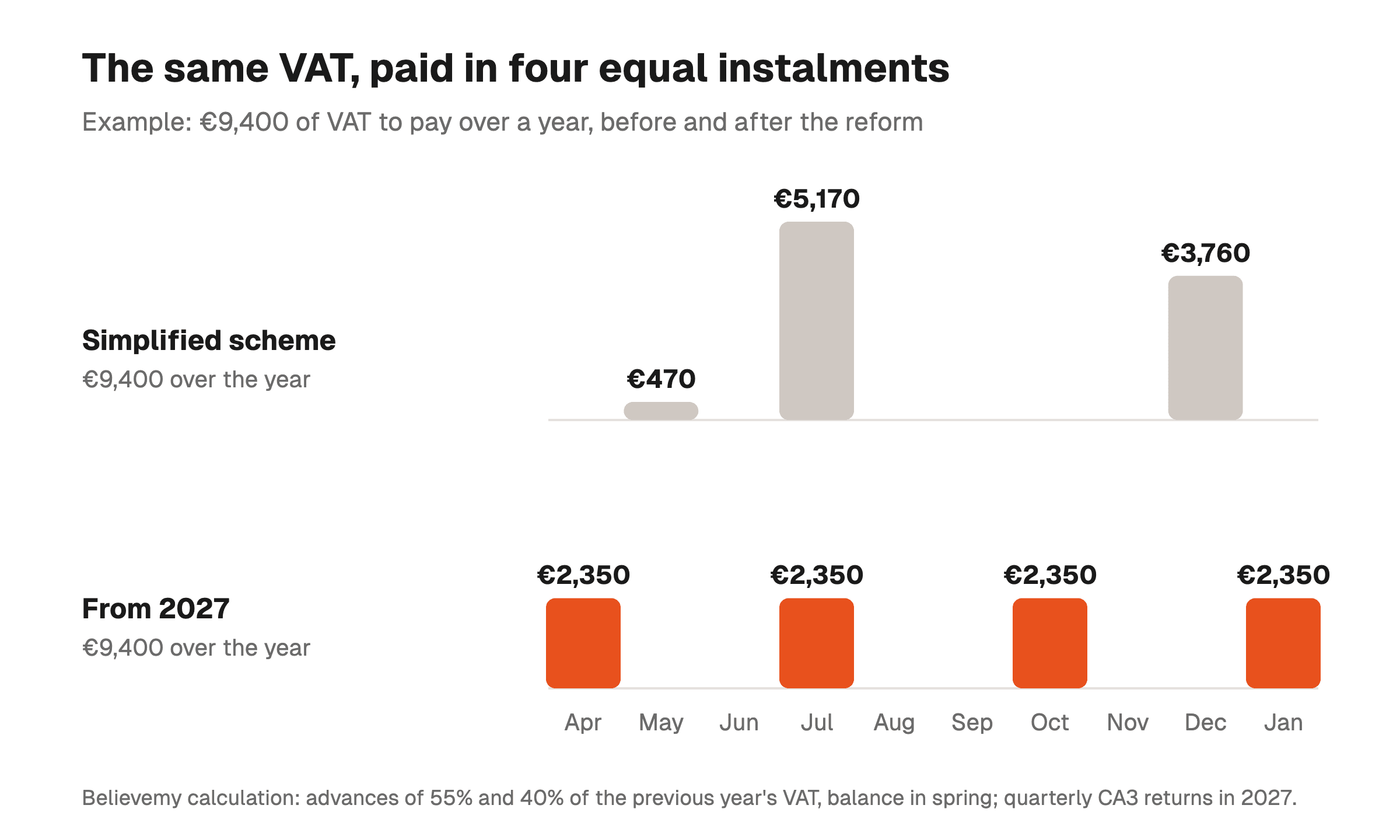
Take a developer who invoices €12,500 excluding VAT per quarter, at 20% VAT. She collects €2,500 of VAT, and her purchases for the quarter cost her €150 in VAT. Her CA3 makes her pay the difference, €2,350, four times a year.
The 2027 calendar, return by return
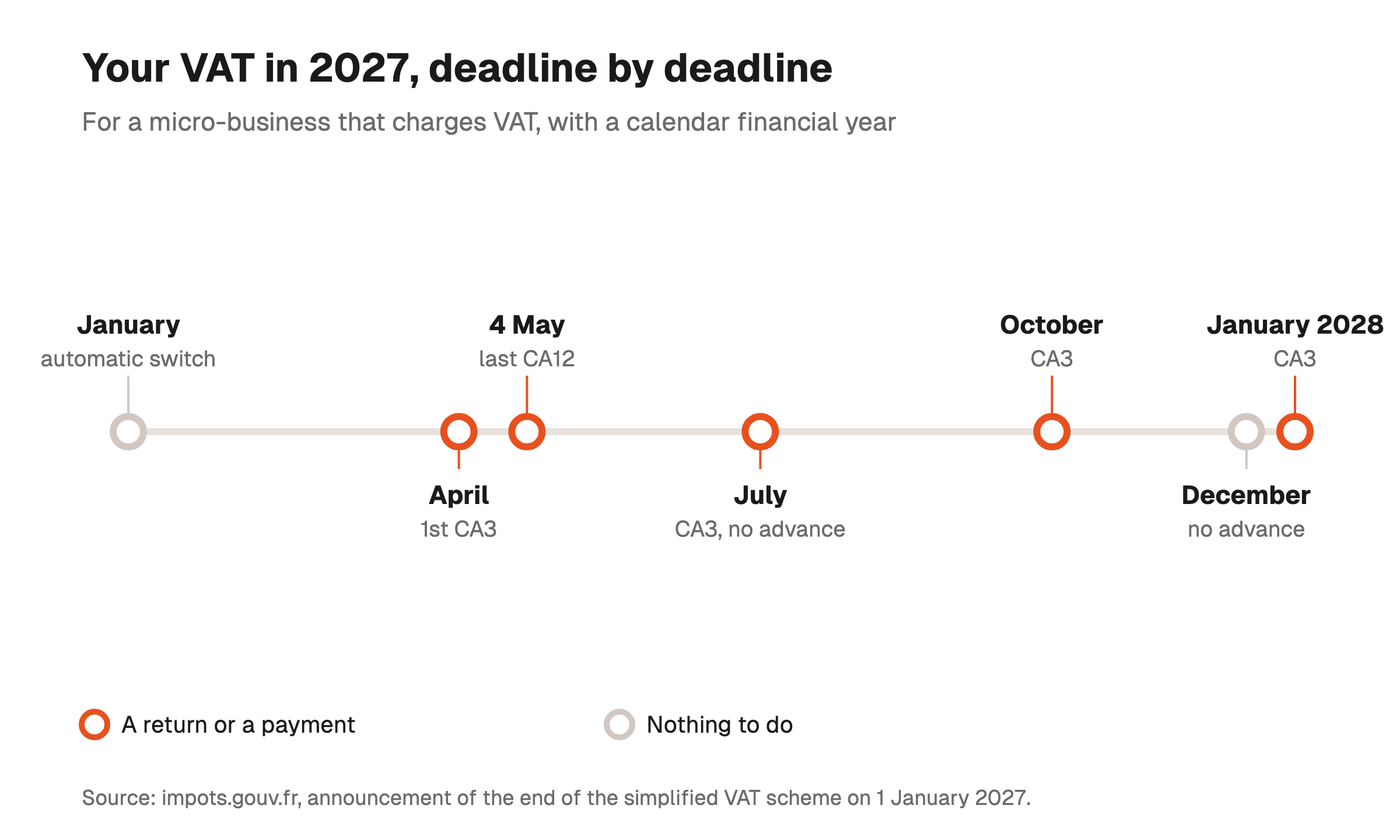
In a micro-entreprise, the financial year follows the calendar year. Here is what to expect, based on the calendar published by impots.gouv.fr on 22 September 2026:
- In January 2027, the switch happens without you;
- In April 2027, your first CA3, covering January, February and March;
- By 4 May 2027 at the latest, your last CA12, covering the whole of 2026;
- In July 2027, the CA3 for the second quarter, and no advance payment;
- In October 2027, the CA3 for the third quarter;
- In December 2027, no advance payment either;
- In January 2028, the CA3 for the fourth quarter.
Spring is the tricky part. For a few weeks, the old and new systems overlap.
Don't skip the last CA12. In April, you file your first CA3, and you might think the whole old scheme is gone. Your 2026 CA12 is still due by 4 May. Also keep your December 2026 invoices out of your first CA3.
What quarterly filing changes in how you work
A once-a-year return forgave a bit of mess. You rebuilt the year in one go, often the night before the deadline. Every three months, that gets old fast.
I remember a whole evening spent hunting for the invoice of a subscription paid in February. It was sitting in my inbox, of course (under a subject line I would never have thought to search for 🥲).
Three habits will save you that kind of evening:
- File every purchase invoice the day you receive it, because without it you can't reclaim the VAT it carries;
- Set the VAT aside every time a client pays, in a separate account, since it goes to the tax office at the end of the quarter;
- Note who your client is when you invoice, business or individual, in France, in the European Union or elsewhere.
That last point matters if you work for clients abroad. A business client based in another EU country doesn't pay French VAT. It accounts for the VAT in its own country, which is called the reverse charge.
Those sales still appear in every CA3, and every month in your European services declaration.
One last change, from 1 September 2027. Your e-invoicing platform will send your sales data to the tax office, which is called e-reporting. Under the quarterly scheme, that data goes out once a month.
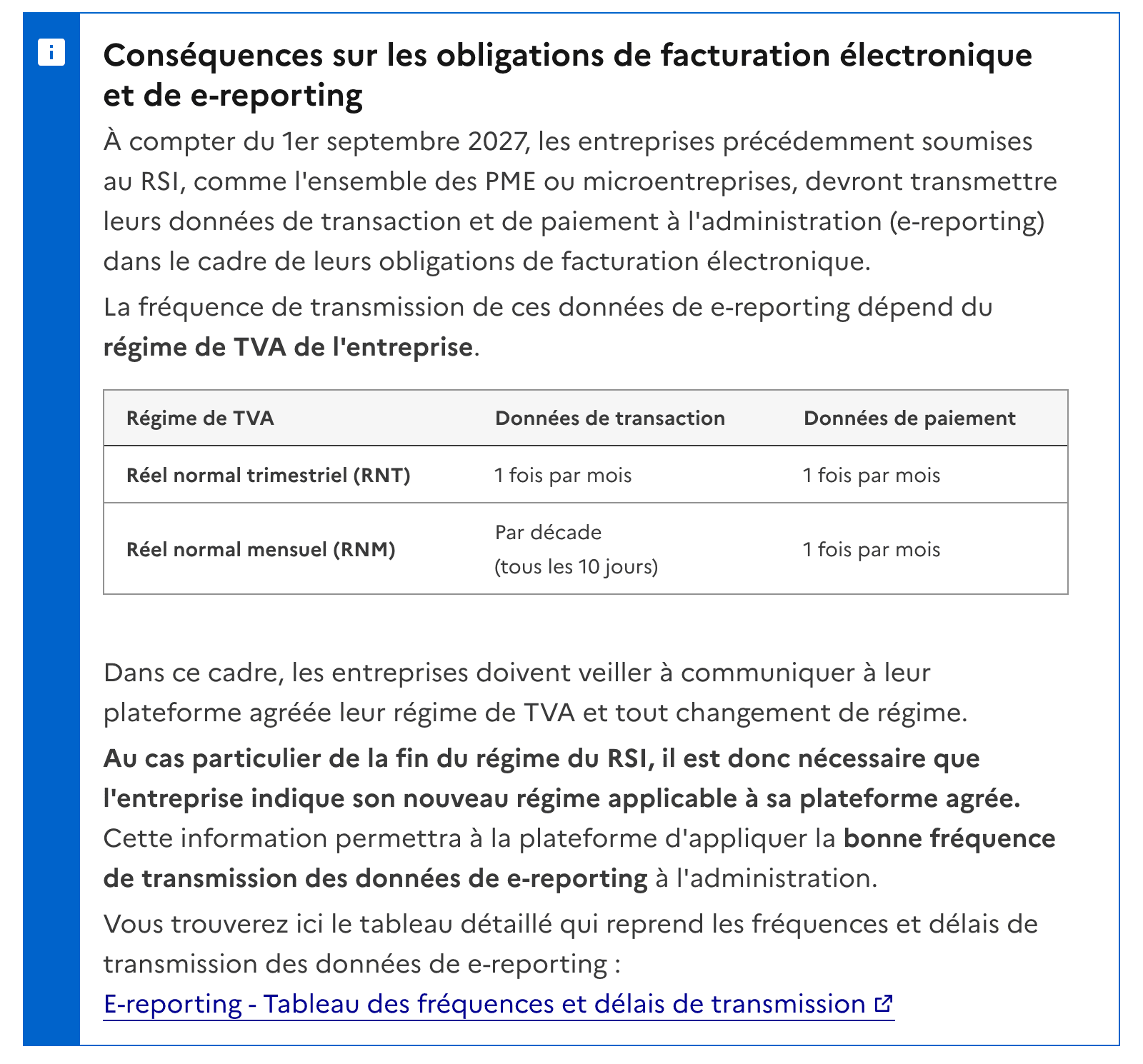
So impots.gouv.fr asks you to tell your approved platform (plateforme agréée) about your new VAT scheme, so it sends data at the right pace. The e-reporting frequency table covers every case. And if the topic is still fuzzy, here is what France's e-invoicing mandate requires from you, and when.
If you charge VAT, remember two dates: April 2027 for your first CA3, 4 May for your last CA12. Everything else happens without you, so you might as well start filing your invoices by quarter from January.
Frequently asked questions
Is the annual VAT return (CA12) abolished for every auto-entrepreneur?
It is abolished on 1 January 2027 for everyone who charges VAT under the simplified scheme. A micro-entrepreneur under the VAT exemption scheme doesn't file a CA12, and the reform changes nothing for them.
If they go over the exemption threshold in 2027 or later, they move straight to the quarterly CA3 return.
Do I need to do anything to switch to quarterly VAT returns?
No, the French tax administration makes the switch itself. It relies on the turnover in the last CA12 filed, and applies quarterly filing to micro-entrepreneurs.
To file monthly instead, a request through the secure messaging of the professional account on impots.gouv.fr is enough.
When is the last annual VAT return due?
For 2026, the last CA12 must be filed by 4 May 2027 at the latest. The first CA3, covering the first quarter of 2027, is filed in April 2027. The two returns therefore come only a few weeks apart.
Are the July and December 2027 VAT advance payments due?
No, no advance payment is due in July or December 2027 when the financial year follows the calendar year, which is the case in a micro-entreprise. VAT is paid with each CA3, on the actual amount for the quarter.