On Monday, a client asks you for a logo "by the end of the week". The work fits in a day. On Friday evening, you are still tweaking the third version.
Had they said "Tuesday evening", you would probably have finished on Tuesday evening.
This has a name, Parkinson's law. Work expands to fill all the time you give it. When you work alone, nobody sets that time for you, and your jobs stretch out without you noticing.
The remedy you read everywhere, setting yourself deadlines, is far less proven than people think. So let's look at where this "law" comes from, what the research really says, and how to stop it taking over your weeks.
What does Parkinson's law look like when you work alone?
You never see it all at once. It creeps into the time nobody counts:
- A job with no precise date takes up the whole week, when it fitted in two days;
- The revisions never end, because nothing says when it is good enough;
- Your side project moves forward "when you have time", so hardly ever;
- A day with no meetings slips away between emails and small admin tasks.
On a fixed-price job, every extra day lowers what you earn per day. The client, meanwhile, pays the same price.
One day, a client cancelled a one-hour meeting. I spent the hour I had gained reformatting a spreadsheet that nobody ever read again 🥲
Where does Parkinson's law come from?
It comes from an article by British historian Cyril Northcote Parkinson, published in The Economist on 19 November 1955. Its first sentence became famous, "work expands so as to fill the time available for its completion".
The rest of the piece is a satire of the British civil service. Parkinson describes how the staff of two ministries kept growing even as their duties shrank.
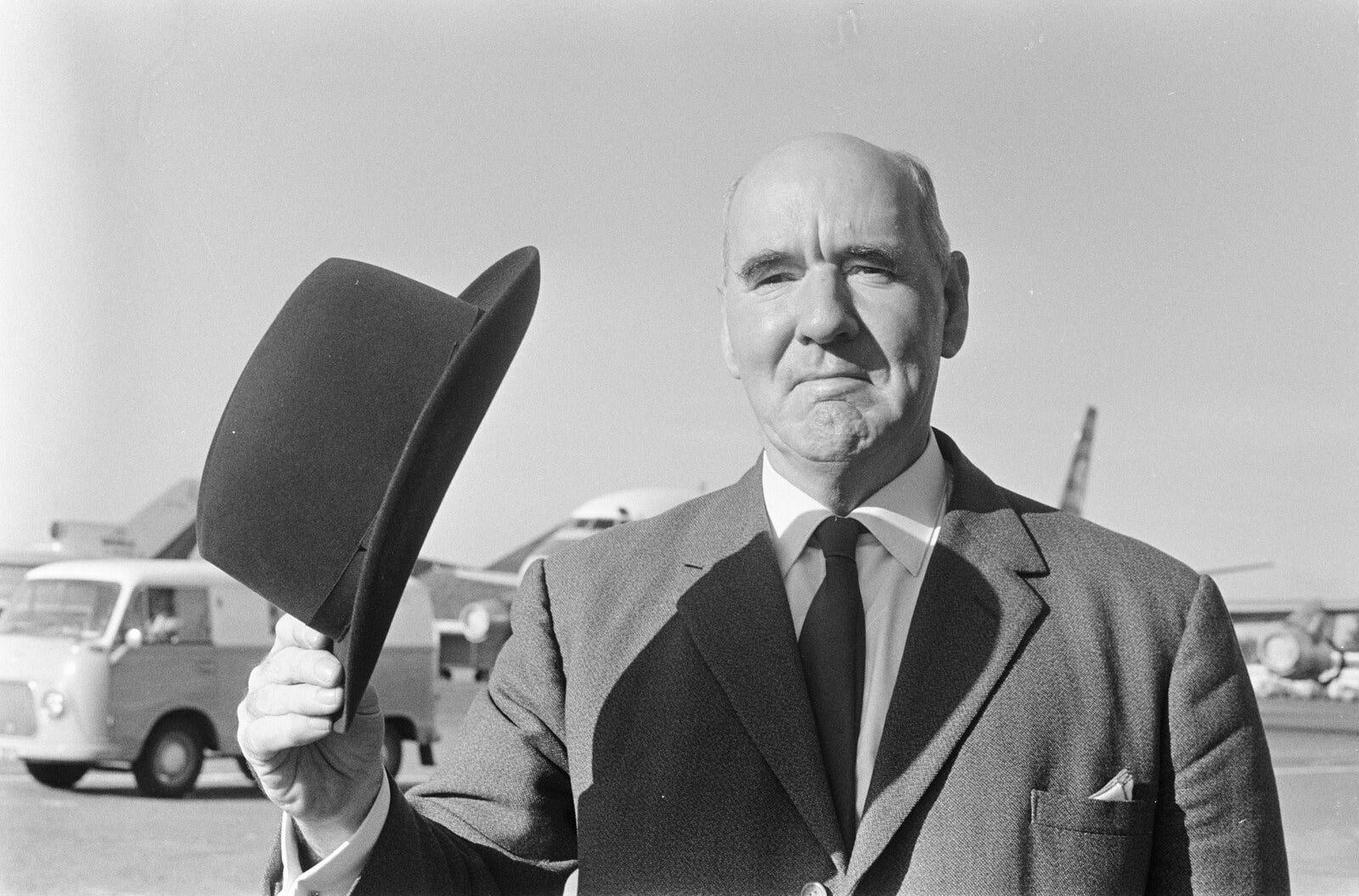
Do not mistake his "law" for a scientific discovery. Parkinson takes the joke as far as a mathematical formula. An administration's staff would grow by between 5.17% and 6.56% a year, whatever the workload.
So it was a joke. But the sentence rang so true for so many people that psychologists eventually put it to the test.
Does work really stretch out when you have more time?
In 1999, three American researchers, Laura Brannon, Paul Hershberger and Timothy Brock, published an experiment on the subject. Students had to rate four sets of photos of faces.
Just before the third set, some of them were told the fourth one was cancelled. Those students dawdled over the third set, compared with students who thought they still had one set to go.
The researchers found the same effect in two exact repeats, then in a variant with a different task. The time freed up did not turn into progress, it slowed down the work in hand.
For you, the lesson is practical. A cancelled meeting or a job finished early gives you nothing until you have decided what to do with the time gained.
Does setting yourself deadlines work?
It is the most common advice against Parkinson's law. It rested mainly on a 2002 study by Dan Ariely and Klaus Wertenbroch, cited nearly 1,000 times according to Retraction Watch.
It claimed that regular deadlines, imposed from outside, made people work better. Deadlines people set for themselves came a close second.
That study no longer stands. The journal Psychological Science retracted it on 2 September 2026, at the request of Klaus Wertenbroch himself.
Before that, a replication with 124 participants had found almost no effect of deadlines. The researchers behind the Data Colada blog also found signs of tampering in the original data.
The authors of that replication, Kyle Hyndman and Alberto Bisin, had already run their own experiment. Students had two weeks to hand in three paid tasks, with or without deadlines along the way.
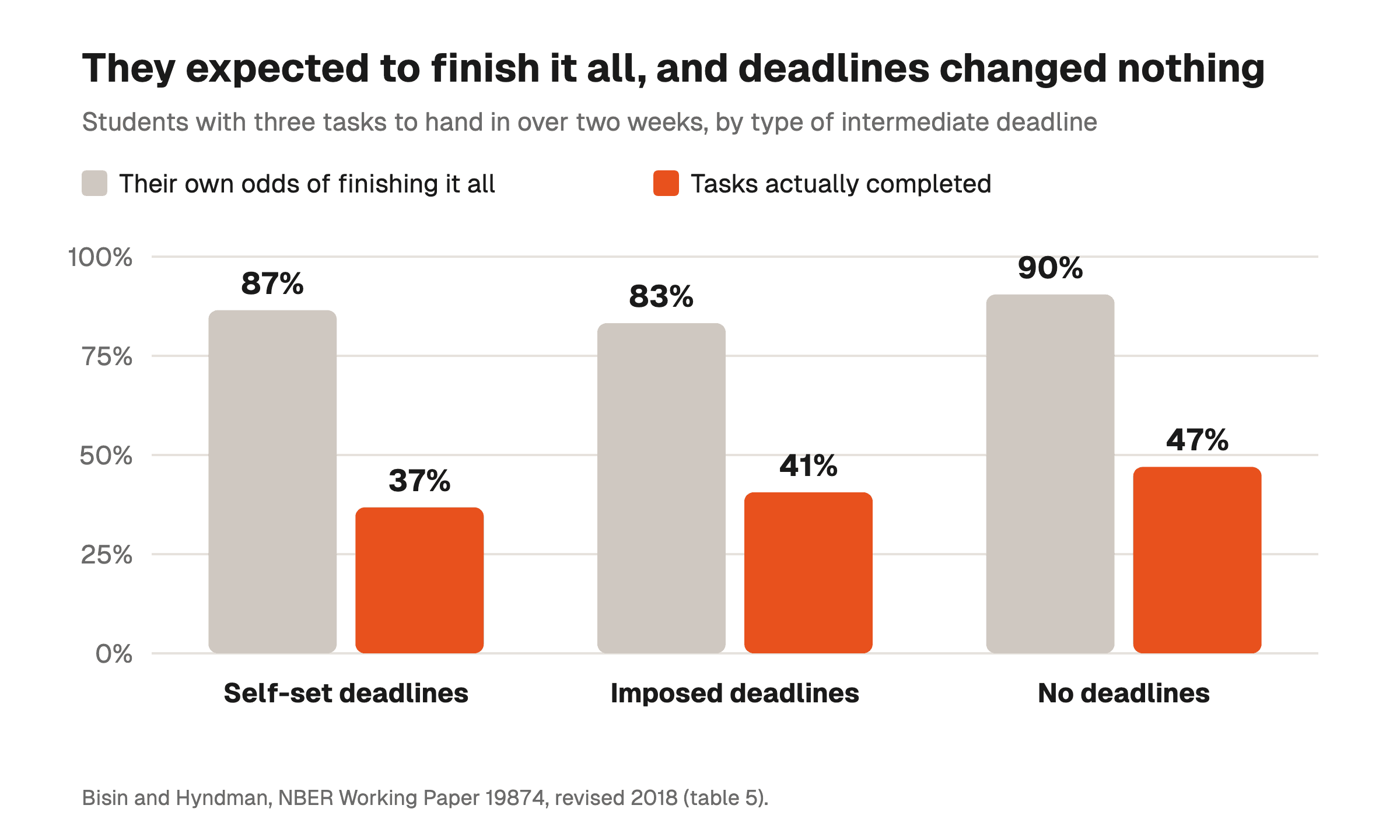
They expected to finish everything, putting their odds between 83% and 90%. They completed only 37% to 47% of the tasks, and the groups with deadlines did no better than the one with none.
Yet many people ask for these deadlines. In the 2026 replication, 93% of the participants given the choice set themselves a binding deadline for their first two tasks. According to Hyndman and Bisin, the trap lies elsewhere: people wait for the date, then find out too late that the task was harder than expected.
You may recognise the planning fallacy, which makes us underestimate how long almost everything takes. A date alone does not protect you, it only gives you a moment to notice you are late.
How do you stop a job stretching out when you work alone?
Give it a budget of hours, not just a date
A date says when to deliver, not how long to spend on it. A fixed price already holds the answer. Divide it by your day rate, and you know how many days the job can take you.
Our How much to charge calculator, built on French rules, works out that rate from what you want to earn. Write the budget of hours at the top of the task, and check where you stand each evening.
Start early, even with a small piece
The trap Hyndman and Bisin describe is discovering the real difficulty the day before the deadline. Get going on the job the day you accept it, even for half an hour.
You will know straight away whether it fits your budget. And if the first step is what holds you back, our article on procrastination when self-employed gives simple ways to get started.
Decide what to do with freed-up time before it slips away
As the face-photo experiment shows, freed-up time seeps into the task in hand. So keep a short list of tasks ready to start.
When a meeting is cancelled or a job ends early, pick the first item on the list straight away. You do not give the current task the chance to spread out.
Write down what "done" means before you start
A job with no finish line stops when the time runs out. Note from the outset what you will deliver, and how many rounds of revisions are included.
It is also what belongs in a quote, as our article on setting your prices when self-employed explains. And if you keep reworking an offer that does not sell, look instead at sunk costs.
To begin, take the job you are working on and write down its budget in hours. By tonight you will know whether it is stretching out!
Frequently asked questions
What is Parkinson's law?
It is the idea that work expands to fill all the time available to do it.
British historian Cyril Northcote Parkinson put it forward in 1955 in The Economist, in a satirical article about the civil service.
Is Parkinson's law scientifically proven?
It started as a joke. But in 1999, an experiment showed that students who had a task taken away slowed down on the task in hand.
The effect was found again in two exact repeats and in a variant.
Does setting deadlines help you procrastinate less?
Not necessarily. The most cited study on the subject, by Dan Ariely and Klaus Wertenbroch in 2002, was retracted in September 2026.
In another experiment, students with deadlines did not complete more tasks than those without.
How do you fight Parkinson's law when you work alone?
Give each job a budget of hours, on top of its date, and start it as soon as you accept it.
Also keep a list of tasks ready for freed-up time, and write down in advance what "done" means.