


You picked an approved platform in late August to receive your invoices. Two months later, you read that French MPs voted to lift the obligation for micro-enterprises.
Should you cancel? No.
The e-invoicing exemption for French micro-entrepreneurs, voted on 3 November 2026, vanished the next day when the Assemblée nationale rejected the budget. Senators tabled it again on 21 November. Until the 2027 finance law is enacted with it, your obligations stay exactly the same.
So let's look at what MPs voted and why that vote no longer counts. Then at what the senators propose, and what to do with your platform, even if you know nothing about accounting.
What MPs voted on 3 November
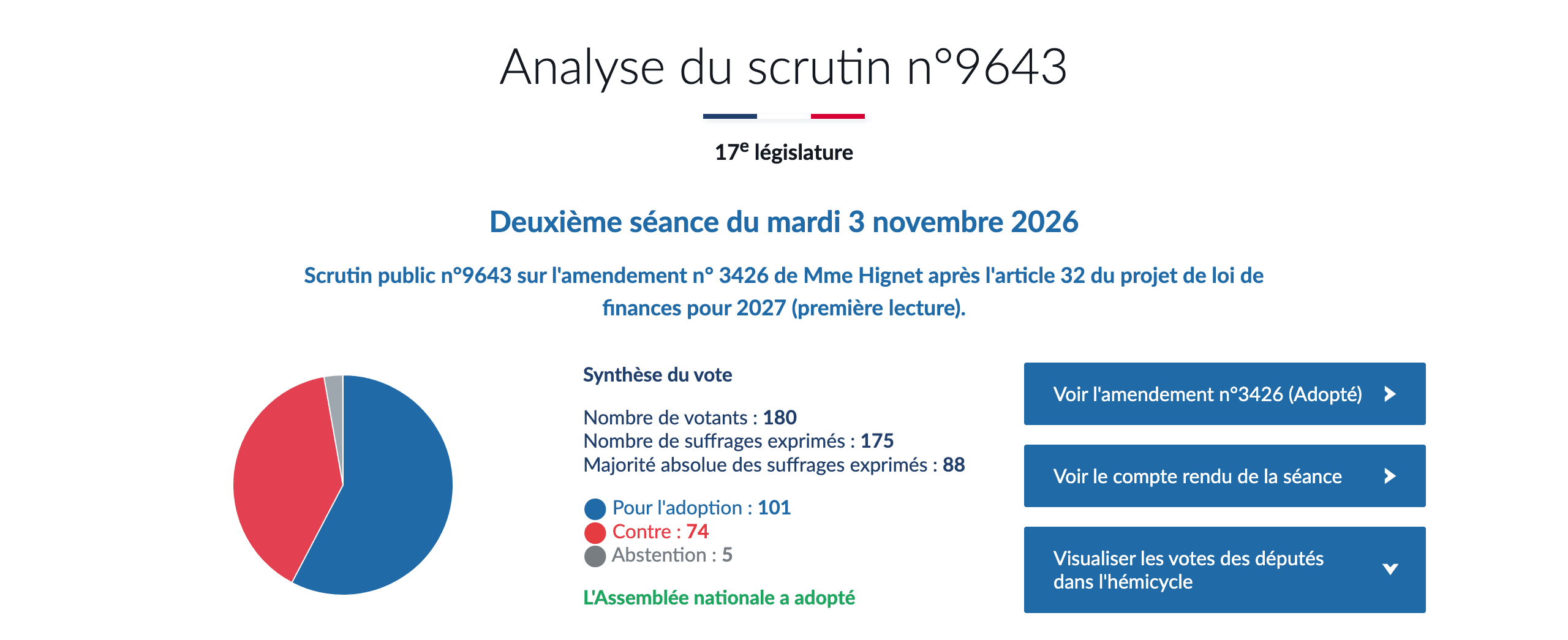
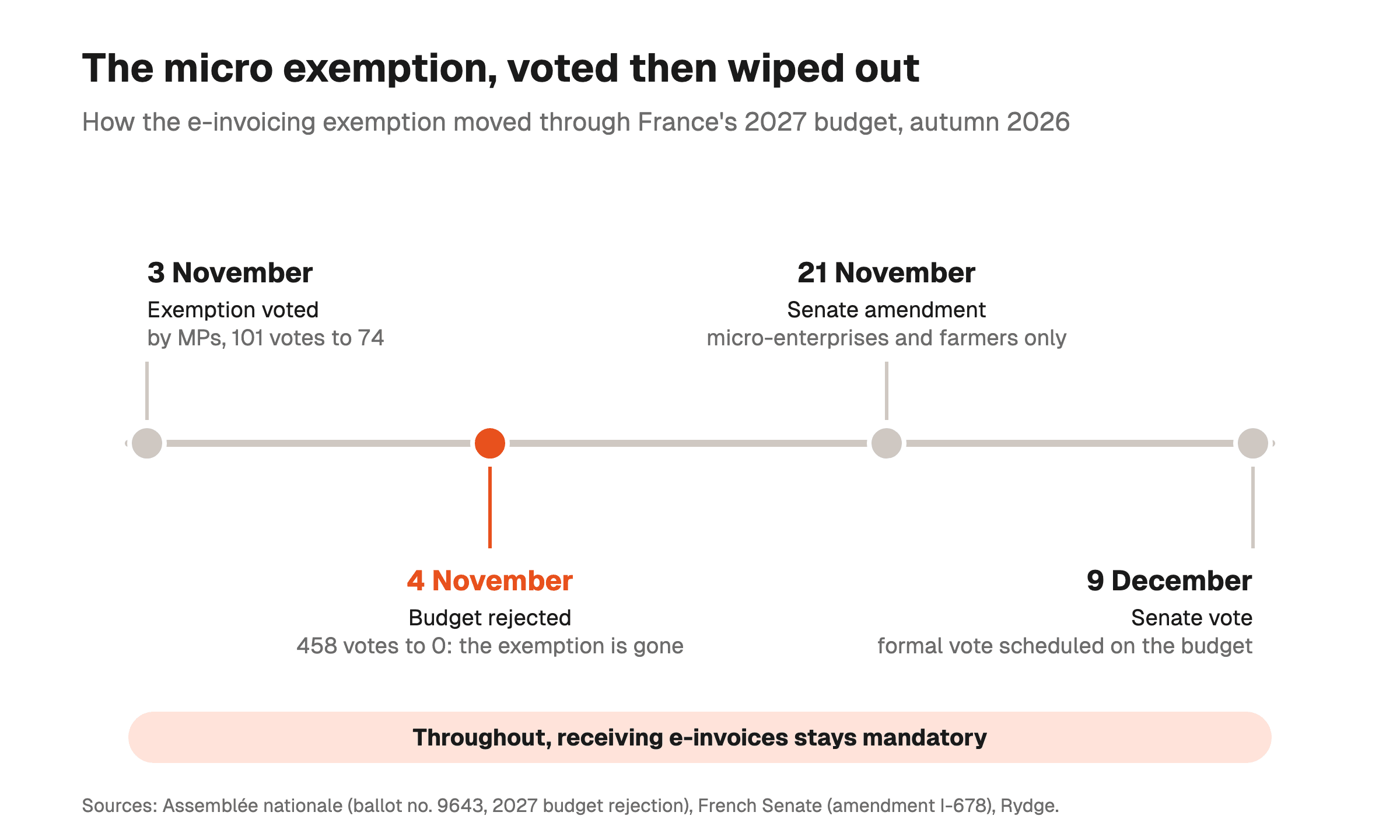
On 3 November 2026, the Assemblée nationale adopted amendment no. 3426 tabled by MP Mathilde Hignet (La France insoumise). The public ballot no. 9643 shows 101 votes for and 74 against, with 5 abstentions out of 180 voters.
The text lifted the reform's obligations for three kinds of businesses:
- micro-enterprises, as defined by the 2008 law: fewer than 10 employees and at most €2 million in turnover, which covers almost every micro-entrepreneur;
- SMEs, up to 250 employees;
- farmers, whatever their size.
It covered issuing invoices as well as receiving them, and sending sales data to the tax authority. It set no end date.
The "moratorium until a free public service exists" only appears in the explanatory statement, which explains the text but has no legal force. Adopted as written, the exemption would have lasted until another law removed it.
Why that vote no longer has any effect
The next day, 4 November, MPs rejected the first part of the budget, the revenue part, by 458 votes to 0. The e-invoicing amendment sat in exactly that part.
According to the Assemblée's notice on the rejection, the whole bill is then treated as rejected at first reading. The Senate receives the government's original text, without any of the amendments MPs voted.
Think of an annotated draft thrown in the bin. The notes go with it. Its ideas can come back, as long as someone writes them again.
What the senators propose
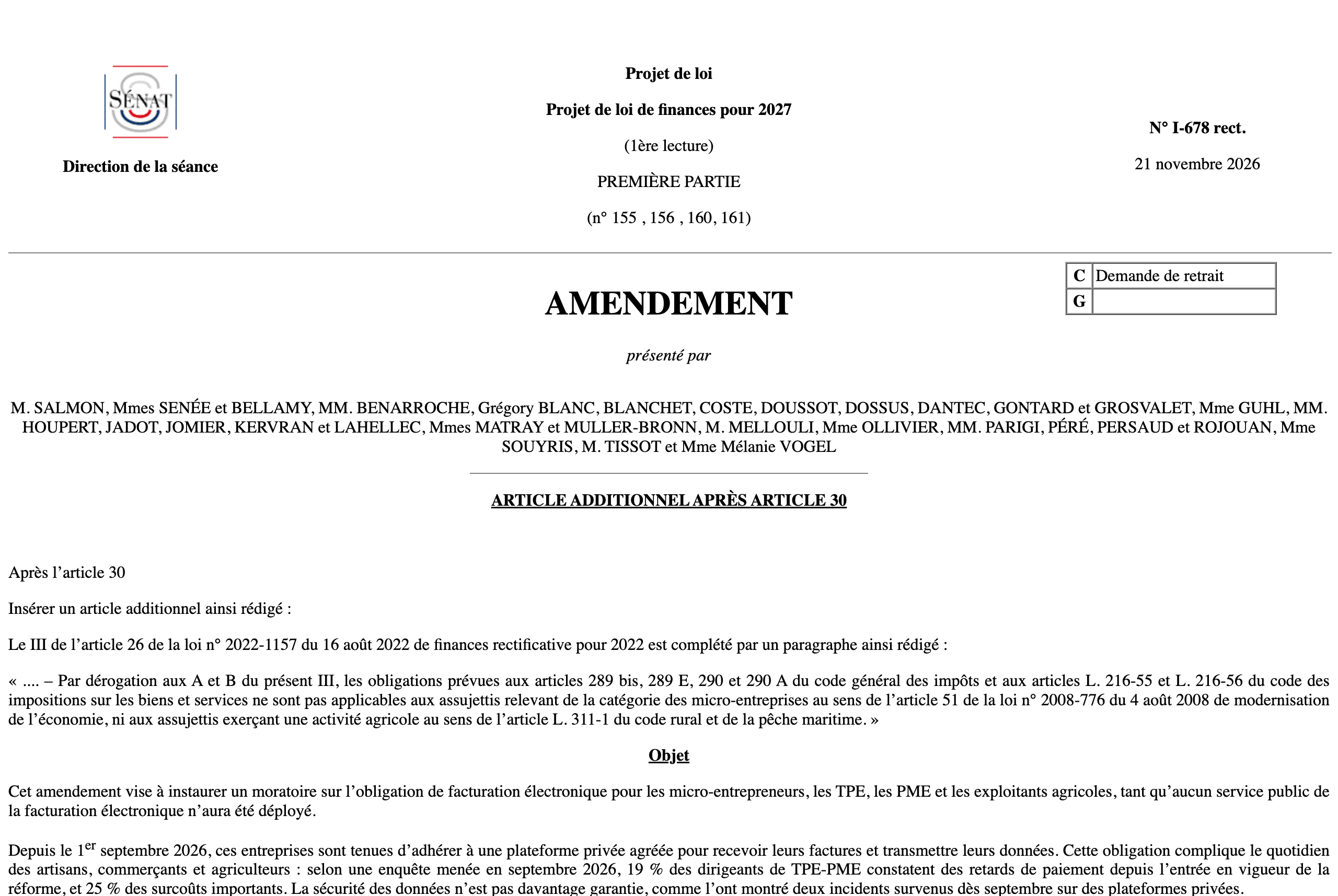
On 21 November 2026, senators Salmon, Senée and Bellamy tabled amendment no. I-678, with other co-signatories. It takes up the exemption voted by MPs, with one difference: SMEs are no longer included.
Only micro-enterprises and farmers would be exempted. Their arguments, taken from the explanatory statement:
- the dropped public portal, a free tool for everyone that the State promised before giving it up in October 2024;
- the 2026 finance law, which removed every reference to that portal from the tax code;
- Chorus Pro, the public platform already used to invoice government bodies, which shows a public service is possible;
- security, with two incidents at private platforms as early as September 2026.
The authors also cite a September 2026 survey. 19% of small business owners said they had seen payment delays since the reform.
The statement does not name who ran that survey. And the figure covers all small businesses, not just micro-entrepreneurs.
As of 23 November 2026, the amendment is marked "awaiting financial admissibility". The Senate must first check that it complies with the rules on public revenue and spending. If declared inadmissible, it would not even be debated.
The government opposes the exemption. At the Assemblée, public accounts minister David Amiel defended the free or nearly free offers of private platforms over a single tool paid for by taxpayers, according to Ouest-France.
The obligations that apply until anything is voted
Until the 2027 finance law is enacted with an exemption, the reform's timetable does not change. For a micro-entrepreneur, it comes down to two dates.
| Date | What is mandatory | For you |
|---|---|---|
| 1 September 2026 | Receiving your suppliers' e-invoices through an approved platform | Mandatory, even under the VAT exemption scheme |
| 1 September 2027 | Issuing e-invoices to your business clients, and sending the data of your other sales | Mandatory, unless an exemption is voted by then |
The VAT exemption scheme does not take you out of scope: not charging VAT does not mean you are not liable to it. The details by type of client are in our guide to the 2026 e-invoicing mandate.
To find your own deadlines in two minutes, our French-law tool Do I need to switch to electronic invoicing? answers based on your situation.
What should you do with your platform in the meantime?
The 3 November vote made many freelancers believe the obligation was gone. It still applies, and four steps are enough to lose nothing:
- Keep your approved platform. Your large suppliers, such as a hosting company or a phone operator, already issue e-invoices: without a platform, their invoices land nowhere;
- Avoid a one-year commitment. A monthly plan, or a free offer limited to receiving, covers the obligation without tying you in if the law changes;
- Keep preparing for September 2027. Updating your invoice template and your clients' details is useful whatever happens;
- Wait for the final text before changing your plans. Only an enacted law changes your obligations, not a vote in the chamber.
If you invoice private individuals as well as business clients, also look at e-reporting, the sales data transmission planned for 2027. The exemption would cover it too, but nothing is settled.
The next dates in Parliament
The Senate examines the budget from 20 November to 8 December 2026. Its formal vote is scheduled for 9 December. If amendment I-678 is adopted, it goes into the Senate's text.
It will then have to get through the joint committee, where seven MPs and seven senators write a common text. The government can also push through a version that leaves it out.
Parliament has until 17 December 2026 to decide, under Article 47 of the Constitution. After that, the government can bring the budget into force by ordinance, without a vote.
In short, nothing changes for you before the 2027 finance law is enacted. Keep your platform, and come back to read the final text once it is published 😉
Frequently asked questions
Are French micro-entrepreneurs exempt from e-invoicing?
No. The exemption MPs voted on 3 November 2026 disappeared on 4 November, when the first part of the budget was rejected.
Senators tabled it again on 21 November 2026. It will only apply if the 2027 finance law is enacted with it.
Can I cancel my approved platform?
No. Receiving e-invoices has been mandatory since 1 September 2026 for every business liable to VAT in France, micro-entrepreneurs under the VAT exemption scheme included.
If you are unsure, choose a monthly plan or a free offer limited to receiving.
What would the senators' amendment change?
Amendment I-678, tabled on 21 November 2026, would exempt micro-enterprises and farmers from the e-invoicing and data transmission obligations.
It sets no end date. Unlike the text MPs voted on 3 November, it no longer covers SMEs.
When will we know whether the exemption is adopted?
The Senate plans its formal vote on the budget for 9 December 2026. The final text is then settled in the joint committee, followed by a vote in both chambers.
Parliament has until 17 December 2026 to decide. Beyond that, the government can adopt the budget by ordinance.
