You have an idea for software you could sell on subscription, and everyone keeps telling you AI will make that model pointless. Why pay every month for a tool an agent can code in an afternoon?
In February 2026, investors believed it. Close to a trillion dollars of stock market value vanished from software companies in a single month.
The Stripe SaaS Index looks at something other than share prices: the money customers actually pay. Published by Stripe Economics on 10 September 2026, it tracks around 72,000 non-AI software companies every week. Their takings were growing by more than 30% year on year at the time of the study.
So let's see what this index measures, and what it tells anyone building their own software alone (even without being a developer). We'll also look at its blind spots, which stop it from being unconditionally good news.
What was the "SaaSpocalypse"?
A SaaS (software as a service) is software you use online and pay for on subscription, like Notion or Canva. It's the most common way to sell a tool on the internet.
In late January 2026, the markets got scared. If AI agents can write software quickly and almost for free, who will keep renting theirs? Software company shares plunged, and the press named the episode the "SaaSpocalypse".
According to Stripe, the loss reached nearly a trillion dollars by early February, and perhaps two trillion counting the following weeks. By the date of the study, share prices had climbed back to roughly where they were before the fall.
In February, I lost count of the messages asking me whether it was still worth launching a subscription product 🥲
What does the Stripe SaaS Index measure?
Stripe processes payments for hundreds of thousands of online businesses. Its economists isolated the software companies, left out those whose product is built on AI, and track what their customers pay them each week.
The index always compares the same companies from one week to the next. Imagine following the takings of the same bakeries in a neighbourhood, ignoring the ones that open or close in the meantime. You measure the health of the shops that already exist.
Because it's weekly, it picks up a turning point well before listed companies publish their quarterly results. The original study, "The SaaSpocalypse was more like a RenaiSaaS", is signed by economist Ernie Tedeschi.
Stripe says so itself. This index doesn't replace an income statement. It can't see payments made outside Stripe, costs or margins. It measures demand, not profitability.
What do the numbers say?
The first figure is the most striking. Year on year, these companies' takings were up more than 30%, matching or beating the highs of summer 2023. If you're hesitating to launch, it means customers haven't stopped paying for their software.
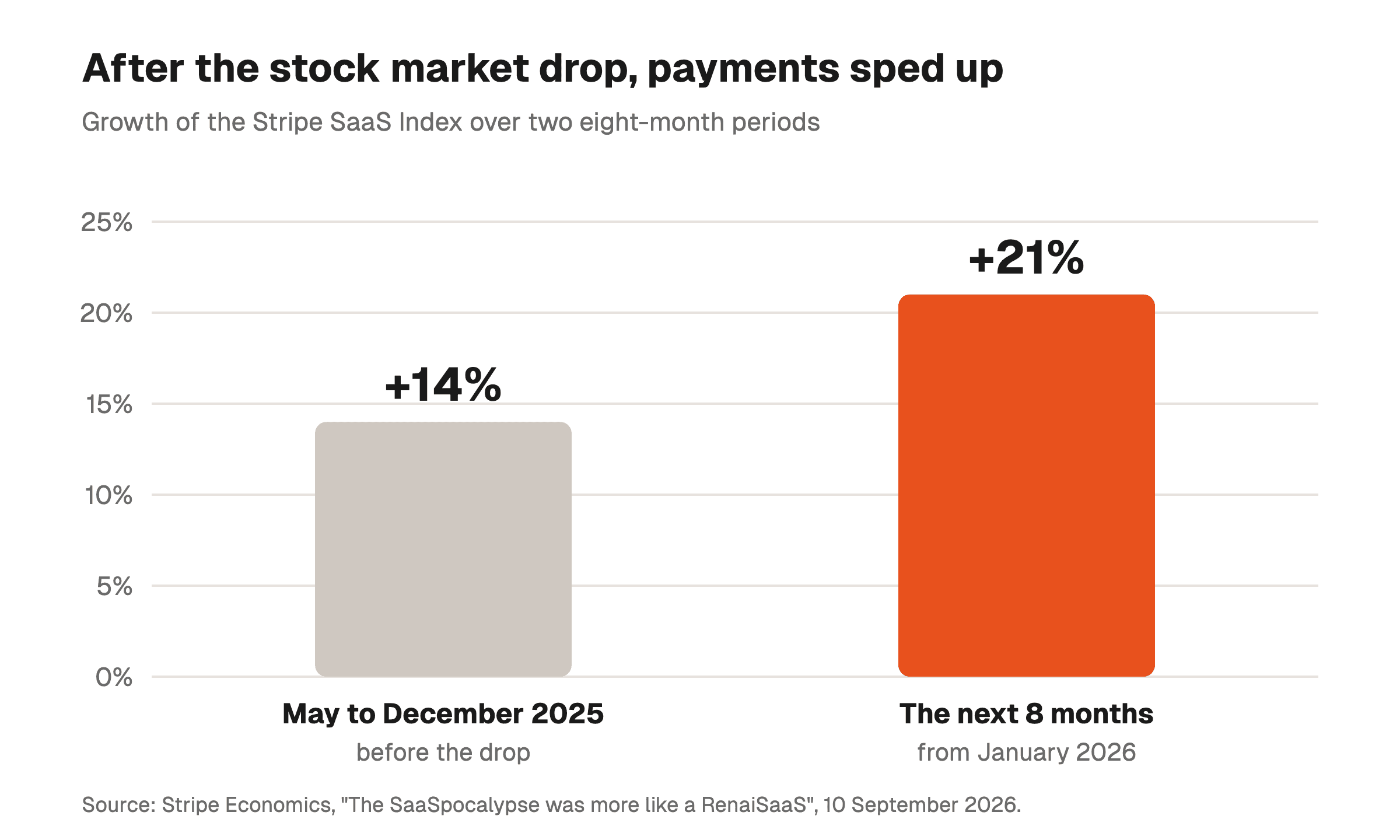
Stripe also compares two eight-month periods. From May to December 2025, the index rose 14%. Over the same length of time from January 2026, it rose 21%. Growth sped up while the stock market was collapsing.
Another figure gets quoted a lot, and it's easy to misread. The index sits 4% above its trend from before the fall.
"4% above trend" doesn't mean "4% growth". Stripe extended the pre-October 2025 curve as if nothing had happened. Where that curve predicted 100, the actual index is at 104.
Then there's the nuance many readers of the study skipped. Stripe also calculated a median index, which gives every company the same weight, small or large.
But that one tells a different story. The typical company really did slow down from late 2025, then bounced back, but only to its earlier trend. A handful of winners are pulling the average up.
Why are young companies growing fastest?
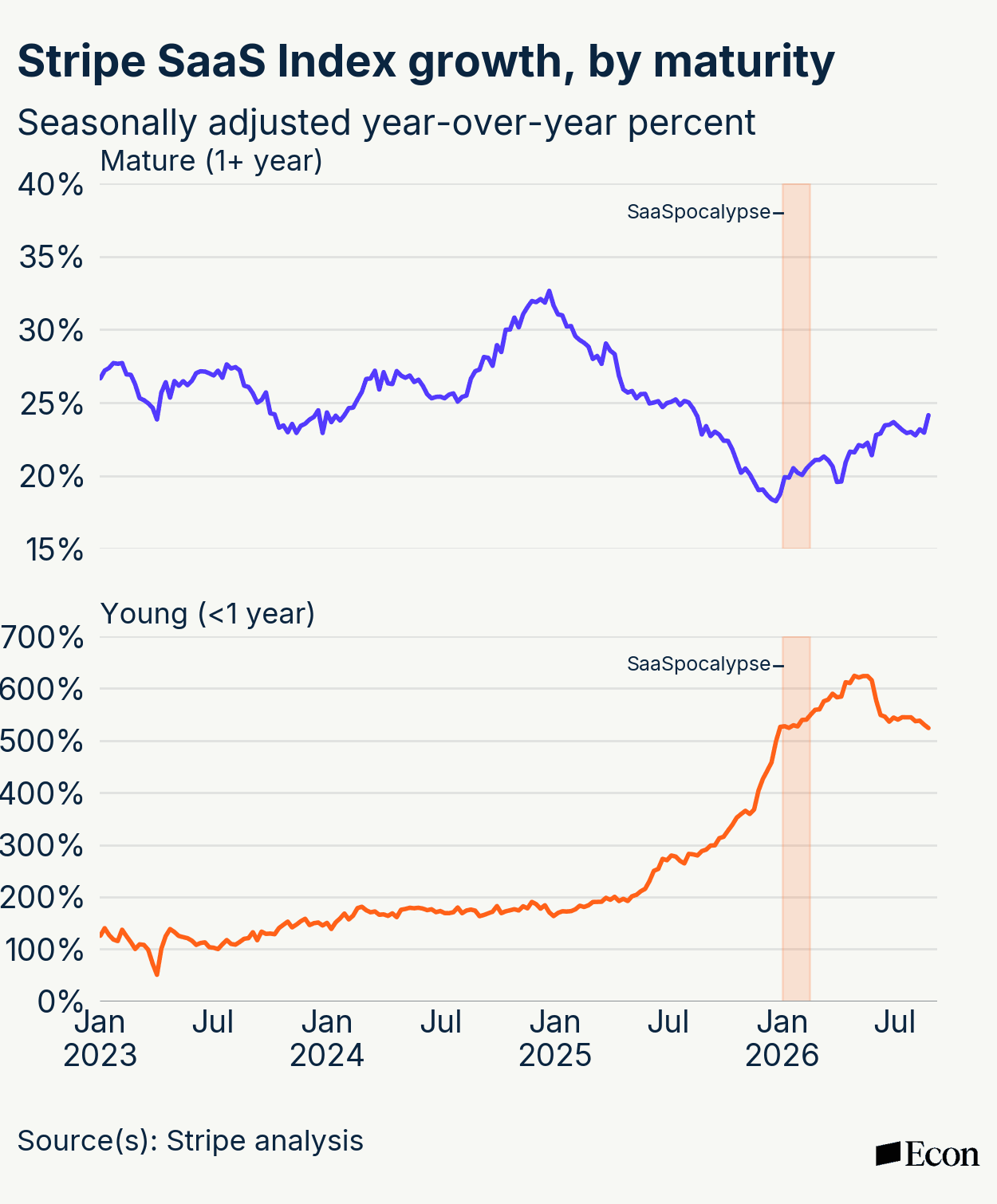
Stripe splits companies into two groups. Young ones received their first payment on Stripe less than a year ago. Mature ones have been there longer.
Young companies have been accelerating since mid-2025, and the stock market fall didn't slow them. Their growth eases a little towards the end of the period studied, but it still beats its 2025 pace.
Mature companies had been slowing since late 2025, before the panic even started. That slowdown stopped during the fall, and their growth went back to roughly its mid-2025 level.
On Stripe's charts, young companies' annual growth tops 500%. Don't treat that as a target. A company going from €200 to €1,200 in monthly takings has grown 500% in a year. Starting from almost nothing inflates the percentage mechanically.
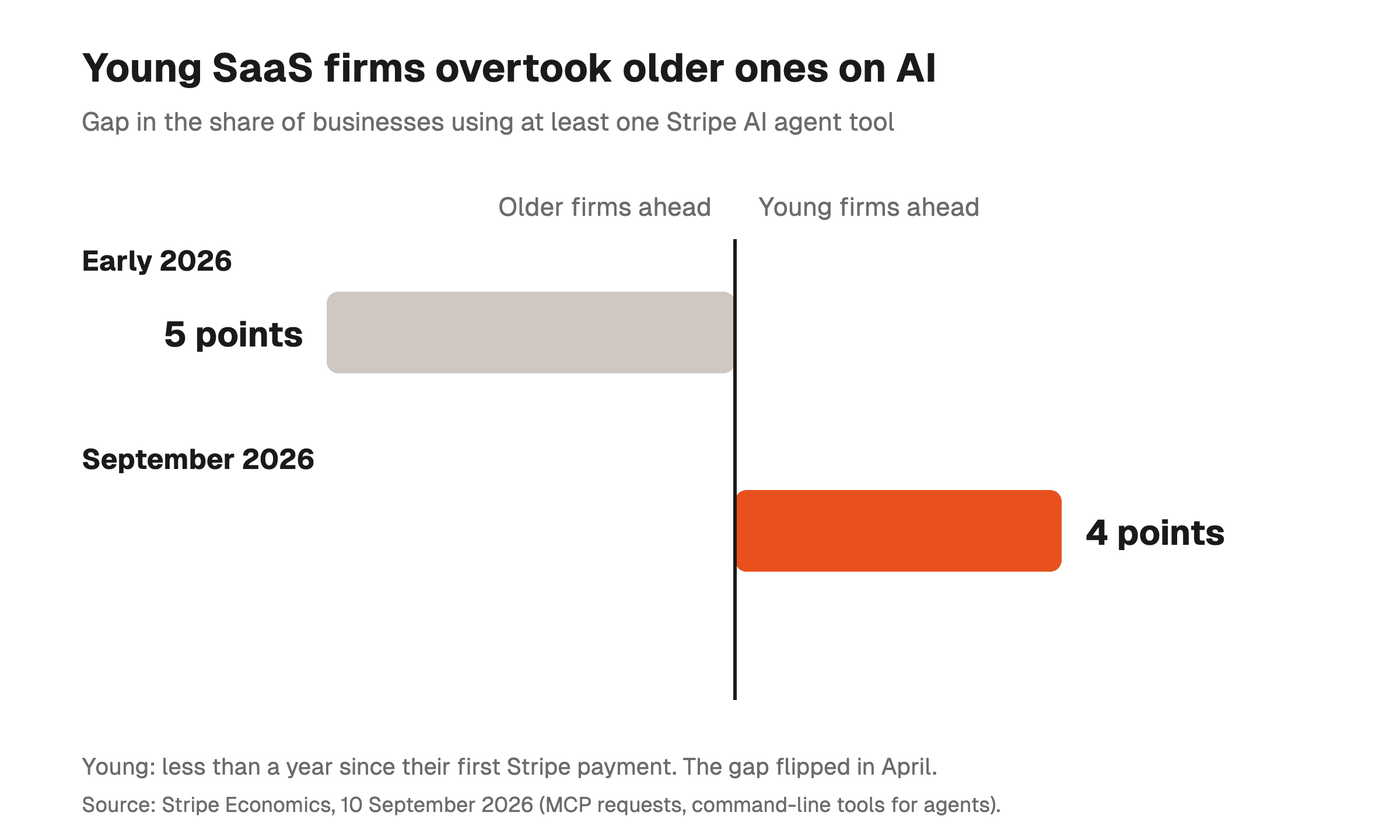
For Stripe, AI could explain part of this gap. The company can't see everything, but it spots MCP requests (the protocol that lets an AI agent plug into a service). It also sees calls from command-line tools for agents, such as Claude Code or Codex.
In early 2026, mature companies were 5 points more likely to send at least one of these signals. The gap closed, then flipped in April. At the time of the study, young companies were 4 points ahead.
The fastest-growing companies are also the fastest to adopt agents. For you, that's rather reassuring. AI benefits first those who use it to build, and a micro-SaaS launched alone is one of them. If you want to learn to code with an agent, our Claude Code course starts from scratch.
Stripe's blog points the same way. According to its post on platforms, those launched in January 2026 are more likely than any earlier group to hit a million dollars in payments in the same time.
Why isn't this unconditionally good news?
Stripe itself is cautious. Ernie Tedeschi writes that strong revenue doesn't prove the stock market was wrong. The fall could still show up in revenue in the medium term. The American site SaaStr pointed out several blind spots.
Companies that close drop out of the calculation
The index only compares companies it finds two weeks in a row. A company that winds down isn't counted as a 100% loss. It simply leaves the calculation.
It's like a class average calculated without the pupils who dropped out during the year. Yet if AI replaces software, it will mostly do so by reducing the number of products, which this index can't see.
These aren't the companies that crashed on the stock market
The 72,000 companies tracked mostly sell self-serve. The customer signs up alone and pays by card. Listed giants sell annual contracts negotiated by sales teams and paid by bank transfer.
Very little of that money goes through Stripe. The index says small software companies are doing well. It says nothing about the large ones, whose share prices made up most of the fall.
A price rise counts as growth
The index measures money collected, not customers. Many software companies raised their prices or added a paid AI tier in late 2025 and in 2026.
SaaStr notes that a company can grow revenue by 20% while losing users, as long as the price per account rises faster. That works for a year or two, not forever.
Outside the United States, momentum is weaker
The regional sub-indices paint very different pictures:
| Region | What the index shows |
|---|---|
| United States | Clear acceleration during the fall, growth back to 2024 levels and then above |
| Europe | Acceleration during the fall, then back to the pace of late 2024 and early 2025, still above trend |
| United Kingdom | Peak in summer 2025, cooling since, slightly above trend |
| Rest of the world | Same peak in summer 2025, slightly below trend |
If your customers are in Europe, that's the line that concerns you. It's decent, nothing more, far from the American euphoria making the headlines.
What should you do with these numbers when building software alone?
Four decisions follow from the study and its limits:
- Separate customer numbers from price. If your revenue is rising mainly because you raised your prices, you're living on borrowed time. Track paying subscribers separately, and check how many you need with our How many subscribers for your SaaS tool (built on French tax and social security rules);
- Serve one specific trade. Healthcare software sped up sharply during the fall, even though AI use there was similar to other sectors. SaaStr sees room left in regulated, under-equipped trades. Our guide on finding what to sell when you go self-employed helps you pick that trade;
- Become essential day to day. Eric Noeth, a partner at the investment firm Advent quoted by Stripe, suggests a test: if the customer's business keeps running the day they switch your tool off, you're replaceable. If it stops, you're not;
- Plan for slower growth outside the US. Build your targets on the European pace, not on American records.
None of this requires waiting for Stripe's next study. Customers keep paying for software that saves them time, and that's even truer when you build it with AI rather than against it 😉
Frequently asked questions
What is the Stripe SaaS Index?
It's an index published by Stripe Economics on 10 September 2026. It tracks the payments received by around 72,000 non-AI subscription software companies every week, always comparing the same companies.
It measures demand, not profitability. It can't see margins or payments made outside Stripe.
Is subscription software threatened by AI?
Not in the short term, judging by real payments. At the time of Stripe's study, non-AI software companies' takings were up more than 30% year on year, despite the stock market fall of early 2026.
Stripe acknowledges the effect could come later, and the index doesn't count companies that close.
Why are young software companies growing faster?
They start from a lower base, which inflates their percentages. Stripe also sees a link with AI. In September 2026, companies less than a year old were 4 points more likely than older ones to use its tools for agents.
In early 2026 it was the other way round, with mature companies 5 points ahead.
Does the Stripe SaaS Index count companies that close?
No. The index only compares companies it finds two weeks in a row, so a company that closes leaves the calculation instead of counting as a loss.
If AI makes software products disappear, this index won't show it directly.