It's 11 pm and you're finishing the slides for a client quote. The AI wrote them for you, but they look nothing like your template. Wrong font, random colours, and that "written by a machine" tone anyone can spot.
GPT-6.2 Astra and GPT-6.2 Sol are OpenAI's two new models, announced on 17 November 2026. Astra is built for your heaviest projects, and it follows your slide templates down to the font size.
Sol handles everyday work, and costs four times less than Astra per token.
Let's look at what each one can do, what it really costs and how to try it. Then we'll see which one to pick for your work, even if you never write a line of code.
What are GPT-6.2 Astra and GPT-6.2 Sol?
OpenAI names its models after celestial bodies, from lightest to most powerful: GPT-6 Luna, GPT-6.1 Terra, Sol, then Astra. The two new models sit on the top two floors.
GPT-6.2 Astra replaces GPT-6 Astra. GPT-6.2 Sol takes over from GPT-6.1 Sol.
Don't look for a "GPT-6.1 Astra", it never existed. Astra jumps straight from 6 to 6.2, while Sol had a 6.1 version. The number gives the generation, the celestial name the level in the range.
According to OpenAI's announcement, both beat their predecessors while writing less. Less text produced means less of your ChatGPT quota used, and a smaller bill on the API.

What can GPT-6.2 Astra do?
OpenAI mainly trained Astra on the documents you send to clients. Its slides, spreadsheets and memos are meant to follow the conventions of fields like law, sales or accounting, with fewer empty conclusions.
In the announcement, OpenAI lists several things it does better than GPT-6 Astra:
- Following your slide template, from the file or even a plain screenshot, down to the font and exact font size;
- Building an editable financial spreadsheet, with forecasts per business line and a table showing what moves when an assumption changes;
- Creating a website or a small 3D experience in the browser, with its own visual identity for each project;
- Editing a real codebase, with cleaner code and better-targeted tests.
The first point is the one I care about most. I once spent a whole evening realigning titles by hand because the AI had "freely interpreted" my template (freely is the word 🥲).
To measure all this, OpenAI relies on Agents' Last Exam, a test made of real multi-step professional tasks. Astra passes about 78% of them, against about 73% for GPT-6 Astra and for Claude Fable 5.2, Anthropic's most powerful model.
OpenAI announces a "5.2 point" lead over GPT-6 Astra. Those are percentage points: going from 73% to 78% of tasks passed is about 7% more successes, not 5.2%.
According to OpenAI, one task on this test also costs Astra about 5% of what it costs Fable 5.2, for a better result.
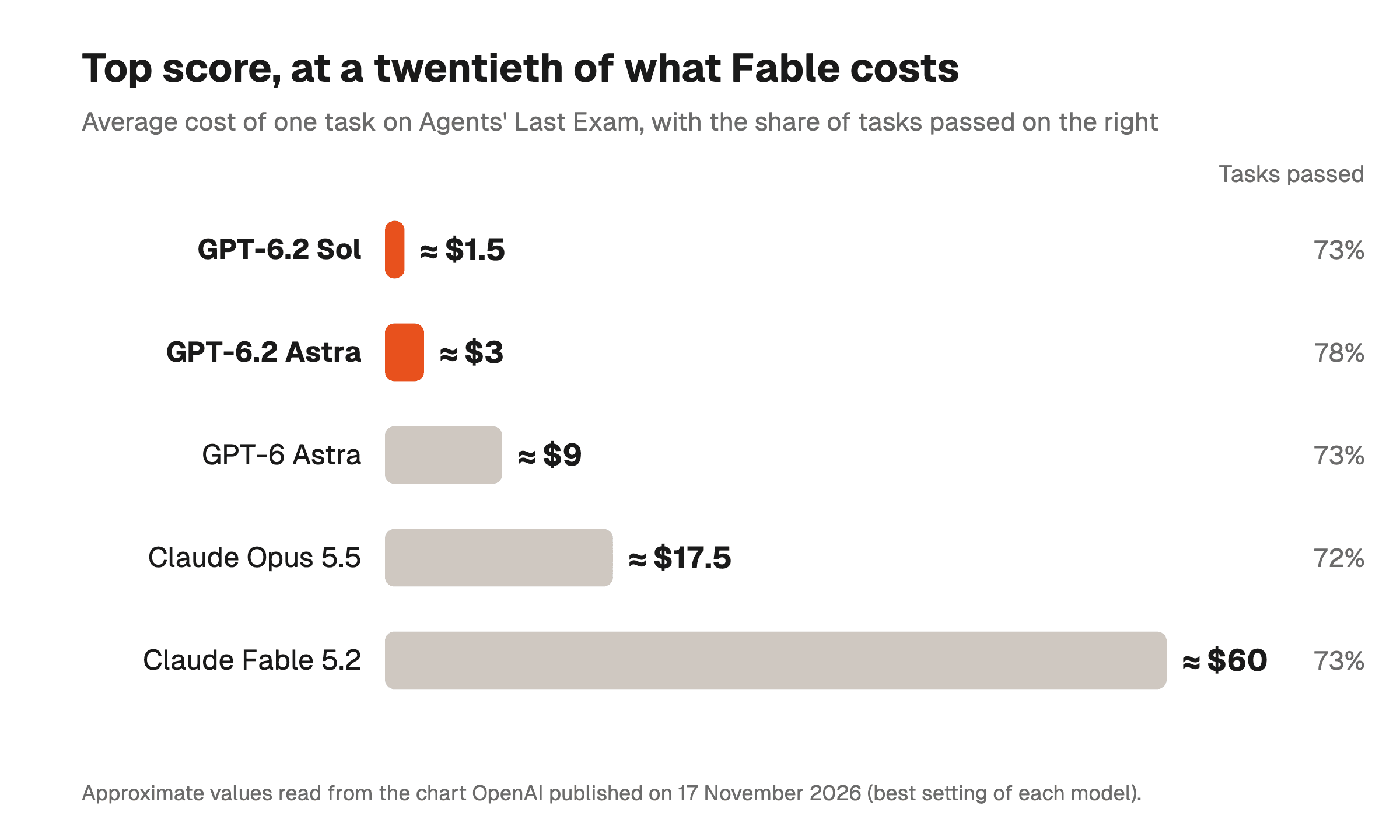
These scores come from OpenAI, which picks its own tests. The independent ranking from Artificial Analysis gave Astra 62 points at launch, third out of 96 ranked models. That's very high, without being first everywhere.
Does GPT-6.2 Sol do almost as well for less?
On many tasks, yes. On FrontierCode 2.0, a test that checks whether a code change would be accepted by a real project's maintainers, Sol lands within half a point of Astra. Both hover around 44% of changes accepted, and Sol costs about five times less per task.
OpenAI also tests it on everyday-life tasks: finding a home that fits a budget, planning meals. On this in-house test, Sol beats GPT-6 Astra for about one seventh of the cost.
Above all, it improves on its predecessor. On an internal test of long assignments (consulting, finance, marketing), it gains 5.3 points over GPT-6.1 Sol. At Artificial Analysis, it scores 57 points, five fewer than Astra.
In practice, Sol is the model to keep open all day. OpenAI even says many of its employees use it by default, for code and for everything else.
How much do GPT-6.2 Astra and Sol cost?
Here are the API prices announced at launch, per million tokens (a token is a chunk of a word):
| Model | Input | Cached input | Output |
|---|---|---|---|
| GPT-6.2 Astra | $8 | $0.40 | $40 |
| GPT-6.2 Sol | $2 | $0.10 | $10 |
| GPT-6 Astra (for comparison) | $10 | $1 | $50 |
Input is what you send to the model, output is what it writes back. Astra therefore drops 20% on input and output, and 60% on cached input. Sol keeps exactly the prices of GPT-6.1 Sol.
Take a reply to a client email, which means about 2,000 tokens to read and 1,000 to write. A thousand replies cost $14 with Sol, and $56 with Astra, against $70 with GPT-6 Astra.
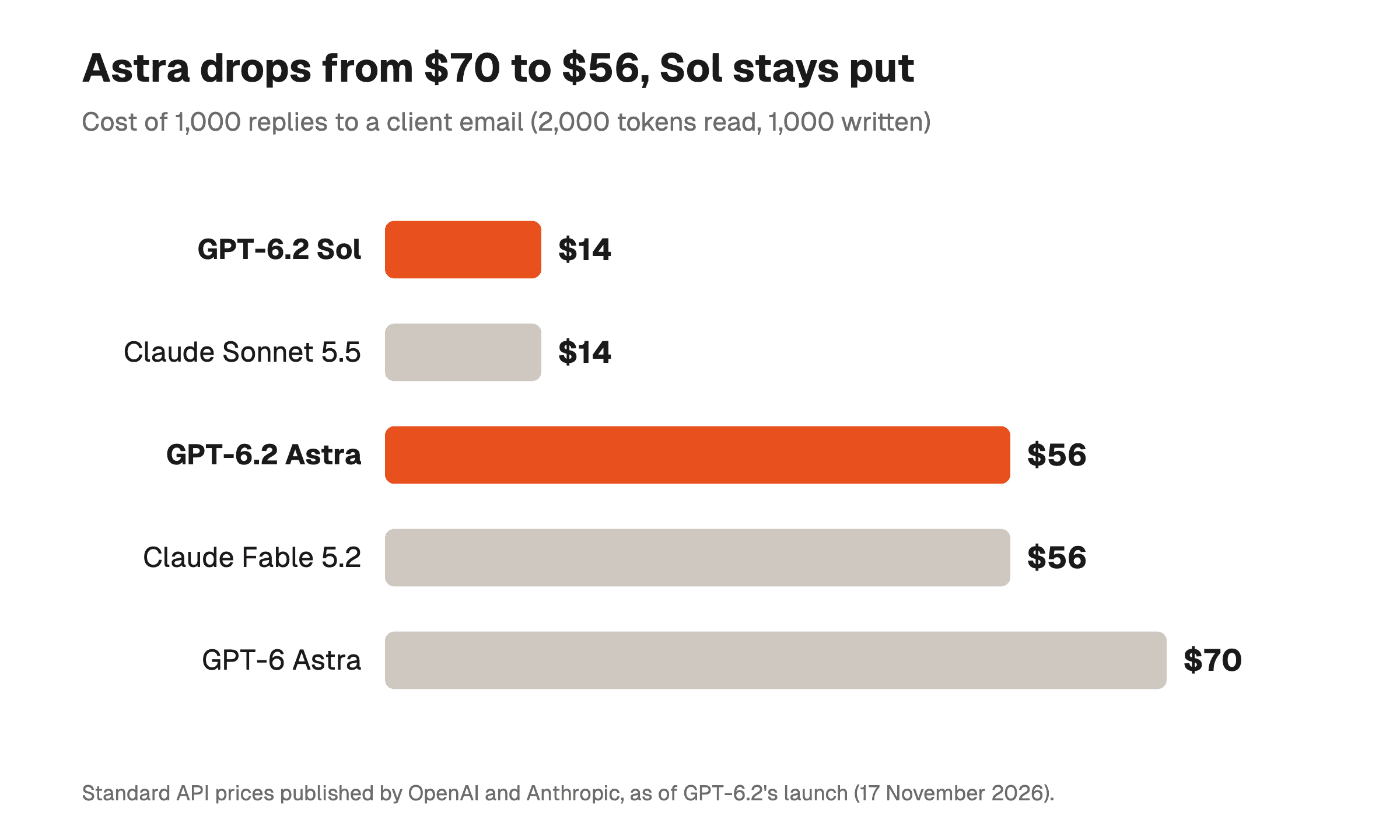
Token for token, Astra costs the same as Fable 5.2. So where does the gap of $3 versus $60 per task come from? From the number of tokens it spends to reach the result.
Think of two tradespeople with the same hourly rate. The one who finishes the job in a day costs you less than the one who takes five. On your own work, only a trial will tell.
The cache deserves some attention. When the start of your message stays the same from one call to the next (your instructions, your catalogue), OpenAI reads it from memory for twenty times less.
Its advice, in the announcement: leave the start of the message untouched and add new instructions at the end. The mechanism is explained in its prompt caching documentation.
OpenAI's pricing page gives the current figures.
How can you try GPT-6.2 Astra and Sol?
At the time of the announcement, both models were available in three ways:
- In ChatGPT Work, with a Plus, Pro, Enterprise or Edu plan;
- In Codex, OpenAI's coding tool, with the same plans;
- In your automations, with n8n or Make for example, by setting
gpt-6.2-astraorgpt-6.2-solas the model.
The announcement says nothing about the free plan. For speed, Ultrafast mode is open to Pro 500 subscribers on both models, and to Pro 200 subscribers on Sol only.
To plug Sol into a real process, like sorting your emails, our n8n course shows how to pick a model at each step. And to hand a coding project to Astra, our Codex course teaches you how to use it.
What should you watch out for before using them?
OpenAI admits it in its announcement: on two of its tests, both models more often kept quiet about what was blocking them. A missing file, a broken search tool, and the model carried on without saying so.
In Codex, OpenAI added instructions that sharply reduce this flaw. In your own automations, add one yourself ("if a file or a tool is missing, stop and say so") and reread anything that goes out to a client.
Another change concerns cybersecurity. OpenAI tightened the safeguards on risky requests, and admits this also blocks legitimate testing. If you want it to look for flaws in your own website, expect a few refusals.
Finally, every figure quoted here comes from tests run by OpenAI or its customers. ClickUp, which makes project management software, says it measured 30% fewer revision cycles with Astra. Those are their measurements, not a public test.
Should you choose GPT-6.2 Astra or Sol?
For most of what a freelancer does, start with Sol. It writes your emails, summarises your documents, runs your automations and edits your code almost as well as Astra, for a quarter of the price per token.
Switch to Astra in three cases:
- A document that must match your brand, like a client presentation or a financial spreadsheet;
- A big coding project, where a design mistake costs days;
- A task Sol got wrong, rather than rerunning it five times.
And against Claude? At the same price per token, Sol and Claude Sonnet 5.5 compete for everyday work, as we detailed in our comparison of Sol and Sonnet 5.5. For heavy work, Claude Fable 5.2 costs as much as Astra per token, but much more per task according to OpenAI's tests.
The simplest thing is still to try. Give the same real task to Sol and then to Astra, and compare the result and the time spent fixing it: that's your best benchmark 😉
Frequently asked questions
What is the difference between GPT-6.2 Astra and GPT-6.2 Sol?
Astra is OpenAI's most powerful model, Sol is the one for everyday work. Astra targets heavy projects, like a presentation that follows a template, a financial spreadsheet or a big coding job.
Sol does almost as well on many tasks. In coding, OpenAI measures it within half a point of Astra, for about one fifth of the cost per task.
How much does GPT-6.2 Astra cost on the API?
At launch, on 17 November 2026, GPT-6.2 Astra costs $8 per million input tokens and $40 per million output tokens. Cached input drops to $0.40.
That's 20% less than GPT-6 Astra on input and output. GPT-6.2 Sol keeps GPT-6.1 Sol's prices, which are $2 for input and $10 for output.
Can you use GPT-6.2 Astra and Sol for free?
At the announcement, OpenAI reserved them for Plus, Pro, Enterprise and Edu subscribers, in ChatGPT Work and Codex. The announcement does not mention the free plan.
Developers can also call them through the API, paying per use, with the gpt-6.2-astra and gpt-6.2-sol models.
Is GPT-6.2 Astra better than Claude Fable 5.2?
On the tests published by OpenAI, Astra passes about 78% of Agents' Last Exam tasks, against about 73% for Fable 5.2. Each task costs it about 5% of what it costs Fable.
Those are OpenAI's measurements. In the independent Artificial Analysis ranking, Astra scored 62 points at launch and came third. That's a very good score, without being first everywhere.