You start a big refactor in the morning, the kind of code reorganisation that touches dozens of files. By noon your quota is gone and half the work is still sitting on your desk.
That is exactly the scenario Opus 5.5 wants to make rarer. Anthropic's new top-tier model, released on Tuesday 22 September 2026, does the same work as Opus 5 with fewer tokens.
And each of those tokens costs less. Anthropic sums it up in one number: 40% less per task than Opus 5.
Another figure has been doing the rounds since the announcement: 60%. Here is where these numbers come from, what the published scores are worth, and what can still slow you down.
What changes compared with Opus 5
Opus 5 came out on 24 July, two months earlier. That has become Anthropic's cruising speed on the Opus line.
Opus 5.5 opens the new Claude 5.5 family. According to Anthropic, it reaches the level of Fable 5.1, its bigger and pricier model, on most work.
| What moves | Opus 5 | Opus 5.5 |
|---|---|---|
| Input tokens (per million) | $5 | $4 |
| Output tokens (per million) | $25 | $20 |
| Cache reads (per million) | $0.50 | $0.20 |
| Cache writes (per million) | $6.25 | $5 |
| Output speed | baseline | more than 30% faster |
| Cost of a typical task | baseline | about 40% lower |
The writing style changes too. Anthropic reworked how the model writes: less jargon, the important part up front, and writing rules followed more closely.
On paper, that sounds like a detail. In practice, it means reading the conclusion on the first line instead of hunting for it in forty lines of reasoning, twenty times a day.
20%, 60%, 40%: who is comparing what
Three percentages come with this launch, and none of them measures the same thing. Mix them up and you get your budget wrong.
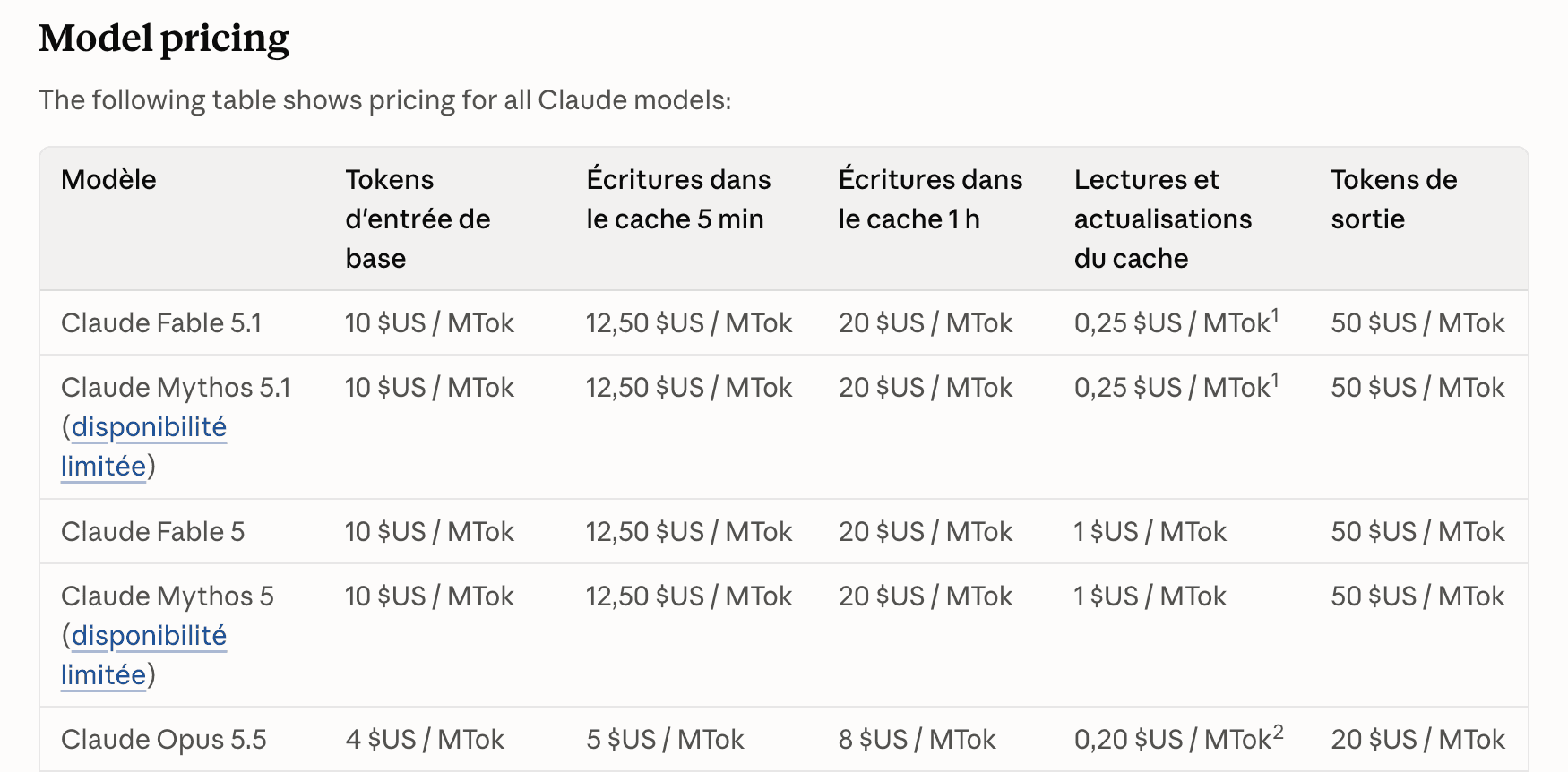
20% is the drop in the list price. Input tokens go from $5 to $4 per million, output tokens from $25 to $20.
60% is the drop on cache reads, which fall from $0.50 to $0.20 per million. If the idea is new to you, here it is in two sentences.
When an AI agent sends back the same repository and the same instructions on every turn, that already processed context is no longer billed at full rate. That is prompt caching.
According to Anthropic, cache reads make up most of the cost of coding and agentic work. So this is the line that matters most for your bill, far more than the list price.
40%, finally, is the combined effect on a typical task, measured by Anthropic at default settings. Tokens cost less, and Opus 5.5 needs fewer of them to reach the same result.
Your bill depends on how you use the model. A script sending short requests with no reused context will mostly see the 20%. An agent looping over your codebase will get closer to the 40%.
Where does the margin come from? Anthropic says the model needs less compute to serve. It is cheaper to run, and that saving shows up in the price.
It also shows up in speed: output is more than 30% faster than with Opus 5.
To fine-tune your cache, Anthropic's prompt caching documentation breaks down every billing line.
A small detail for the curious: on Opus 5.5, a cache read costs 5% of the input price, against 10% on most other models.
On par with Fable 5.1, and this time the numbers are out
Anthropic does more than make the claim. The announcement comes with a full table of benchmarks, the standardised tests that grade every model on the same exercises. Our glossary explains the idea in its entry on evaluation.
| Test | Opus 5.5 | Fable 5.1 | Opus 5 |
|---|---|---|---|
| Terminal-Bench 4.0 (coding in a terminal) | 66.4% | 55.8% | 52.3% |
| FrontierCode v1.1 (code changes that would be merged) | 54.4% | 50.3% | 48.0% |
| CursorBench 4.0 (vague tasks across several files) | 57.8% | 51.8% | 46.6% |
| GDPval-AA v2.1 (office work across 44 jobs, index: higher is better) | 1846 | 1735 | 1708 |
| OSWorld 2.0 (using a computer, partial scoring) | 81.8% | 80.7% | 74.0% |
| Humanity's Last Exam (with tools) | 67.7% | 65.6% | 63.6% |
The clearest jump is in coding inside a terminal. On Terminal-Bench 4.0, Opus 5.5 gains 14 points over Opus 5 and more than 10 over Fable 5.1.
A gap in points does not read as a percentage. Going from 52.3% to 66.4% is 14.1 points, or about 27% more tasks solved. Anthropic reports a margin of error of around 2.6 points on this score.
One example says more than the scores. Anthropic asked Opus 5.5 and Fable 5.1 to rewrite HAProxy, software that spreads web traffic across several servers, from C into Rust.
Both rewrites passed nearly all of the project's regression tests, the ones that check nothing broke. Opus 5.5 finished in 9.5 hours instead of 12, at 51% lower cost.
Anthropic itself tones its table down. At this level, the company writes, benchmark margins say less and less about real-world differences.
In its own use, the gap with Fable 5.1 looks smaller than the scores suggest. In other words, the measurement that counts happens on your side.
Replay five real requests on both models, then compare:
- The time between sending the request and getting the full answer.
- The number of back-and-forths before you get something usable.
- The tokens used across the whole exchange, not just the first answer.
Allow half an hour. This small test runs on your files, your conventions and the way you write prompts, which no leaderboard will ever do for you.
In a terminal, it is easy to run with Claude Code, which we teach step by step.
Cybersecurity and biology: when another model answers for it
Anthropic considers Opus 5.5 comparable to Mythos 5.1 in biology and cybersecurity. It therefore inherits safeguards close to those on Fable 5.1.
These safeguards do not turn your requests down.
When a filter fires, the request quietly moves to another model: Opus 4.8 for most cybersecurity tasks, Opus 5 for biology and frontier AI model development.
Finding and fixing bugs in your own code still works on Opus 5.5, as part of normal development.
The catch is that there is no error message. Your tool keeps answering, just with a less capable model. If you simulate attacks (penetration testing) or analyse compiled programs, test your use cases before moving a production tool over.
For defensive security teams, the Cyber Verification Program will open to Opus 5.5 in the coming weeks. It will have three access tiers, each more permissive than the last, up to the Mythos models.
On the biology side, academic labs, startups and pharmaceutical companies can already apply to the Life Sciences Verification Program.
Before release, the model was also assessed by outside organisations, including METR and Frontier Design. Anthropic describes it as more resistant than Opus 5 to prompt injection.
It is also the best-scoring model to date on Anthropic's automated behavioural audit, a battery of thousands of simulated scenarios that checks whether a model stays inside the limits it is given.
Anthropic wants to slow down, just not with this model
Opus 5.5 is the first release since the essay Dario Amodei, Anthropic's CEO, published a week earlier: "We Must Pace the Frontier".
The idea: set the pace of AI progress so that safety practices stay one step ahead of what models can do.
Do not expect Opus 5.5 to be held back, though. Anthropic presents it as a major step up from Opus 5, and 14 points gained on Terminal-Bench in two months back that up.
The slowdown mostly targets what comes next: models able to automate AI research themselves. For those, Anthropic writes that its current measures may not be enough on their own, and wants public policy to play a bigger role.
In the short term, nothing changes for you. The next models are where this position will really be tested.
Three changes to check in your integrations
If you call Claude from your own code, three changes deserve a test before you switch to the claude-opus-5-5 identifier.
- Thinking can no longer be turned off. On Opus 5.5, thinking mode, where the model reasons before it answers, cannot be disabled. Anthropic's documentation covers the change.
- History can no longer be rewritten. On API accounts created since 31 August 2026, you cannot edit earlier turns of a conversation to extract Claude's reasoning. This protection, already live on Fable 5.1, now covers Opus 5.5.
- The text changes shape. If your automations split answers at a precise spot, the new style can break them. It is a good moment to move to structured outputs, which keep a fixed format.
On subscriptions: more room in the five-hour window
If you use Claude through a subscription rather than the API, the per-token price does not affect you directly. A model that needs fewer tokens for the same task does, however, eat less of your usage limit.
Anthropic adds two extras at launch. Five-hour limits go up on the Pro, Max and Team plans, and subscriptions get a limit reset you can keep aside and trigger whenever you choose.
Save it for refactor day.
To pick a plan, we break down the differences between Claude Pro, Max and Team. Official values are on Anthropic's pricing page.
Sonnet 5.5 and Haiku 5.5 are coming: which one to pick
Anthropic expects Sonnet 5.5 and Haiku 5.5 in the coming weeks, with many of the same gains in performance, efficiency and safety. The split across the range stays the same.
- Opus for hard tasks: large refactors, code migrations, debugging that means keeping several files in your head.
- Sonnet for everyday work, where speed matters as much as finesse.
- Haiku for volume: sorting messages, extracting data, repeating the same task thousands of times.
In the meantime, Opus 5.5 is available on the API, in the Claude apps, and on Amazon Web Services, Google Cloud and Microsoft Azure.
Frequently asked questions
How much does Claude Opus 5.5 cost?
Anthropic charges $4 per million input tokens and $20 per million output tokens, 20% less than Opus 5. Cache reads drop to $0.20 and cache writes to $5.
Fast mode, up to 2.5 times quicker in Claude Code and on the Claude Platform, costs $8 for input and $40 for output.
Is Opus 5.5 really 60% cheaper than Opus 5?
Only on cache reads. On a typical task, Anthropic measures a 40% saving, because tokens are both cheaper and fewer.
Against Fable 5.1, billed at $10 for input and $50 for output, Opus 5.5 is 60% cheaper per token, though.
Is Opus 5.5 better than Fable 5.1?
Anthropic puts it on par for most work, and ahead on the published tests: 66.4% against 55.8% on Terminal-Bench 4.0, for example.
The company adds that the gap looks smaller in real use. The most reliable check is still to replay five of your own requests on both models.
Why does Opus 5.5 answer some cybersecurity questions less well?
Because another model may be answering in its place. When its safeguards fire, most cybersecurity tasks go to Opus 4.8, with no error message.
Fixing bugs in your own code still works. Defensive security teams will soon be able to request wider access through the Cyber Verification Program.
When are Sonnet 5.5 and Haiku 5.5 coming out?
Anthropic expects them in the weeks following the release of Opus 5.5 on 22 September 2026, with many of the same improvements.
Sonnet targets everyday tasks, Haiku high-volume repeated work such as sorting messages or extracting data.