You start a big rebuild of your app on a Tuesday morning. By 3 pm, Claude tells you your Fable allowance is used up until next week. The job sits there, half migrated.
Claude Fable 5.2 is the new version of Anthropic's most powerful model, announced on 9 November 2026. It costs 20% less than Fable 5.1 on the API and responds up to 30% faster. For the launch, Anthropic is also giving away one to three free resets, valid until 8 March 2027.
Let's see who gets these resets and how to use them well. Then we'll look at what Fable 5.2 is worth, and whether it earns its place next to Opus 5.5, even if you don't code every day.
What is Claude Fable 5.2?
Fable is the top tier of the Claude range, built for the heaviest technical work. Fable 5.2 replaces Fable 5.1, released in September 2026.
It comes in two copies. Claude Mythos 5.2 is exactly the same model, with looser safeguards on cybersecurity and biology. It's reserved for organisations accepted into Anthropic's verification programmes.
To find your way around the range, from lightest to most powerful: Haiku 5.5, Sonnet 5.5, Opus 5.5, then Fable 5.2. Anthropic recommends starting with Claude Opus 5.5 for most tasks, and only moving up to Fable for the most ambitious work.
In practice, according to Anthropic's announcement, Fable 5.2 improves at coding, reasoning and reading images. Its safeguards also block legitimate requests less often than Fable 5.1's did, without loosening up on dangerous ones.
Who gets the free resets?
A reset gives you back, in one go, the allowance you've spent on Fable this week. Anthropic hands them out based on your plan and how long you've subscribed, according to its help page on the launch offers.
On the Max and Ultra plans, and on premium seats of Team plans, the number depends on the date of your first paid bill:
| Subscription length on 9 November 2026 | Free resets | Use before |
|---|---|---|
| Less than six months | One | 8 March 2027, 11:59 pm Pacific time |
| Six to twelve months | Two | 8 March 2027, 11:59 pm Pacific time |
| More than twelve months | Three | 8 March 2027, 11:59 pm Pacific time |
In UK time, the deadline falls on 9 March 2027 at 7:59 am. Any reset you haven't used by then is lost.
Subscription length counts from your very first bill, even if you cancelled and came back in between. A subscription taken out through the App Store counts from its first store bill.
The Pro plan gets a different, shorter offer. From 9 to 16 November 2026, Fable is included in its limits, up to half of the weekly allowance. It also gets a single reset, which expires on 17 November 2026 at 7:59 am, UK time.
You needed a paid subscription in place before 9 November 2026 at 6 pm, UK time. An account opened after that gets no reset, and the free plan gets nothing.
How does a reset work?
It acts on both of your counters at once. On the weekly limit, it clears only what Fable models have used. On the five-hour limit, if your account has one, it resets everything, other models included.
Anthropic gives a worked example. You've used 80% of your weekly limit, 50% on Fable and 30% on other models. After the reset, your counter shows 30%.
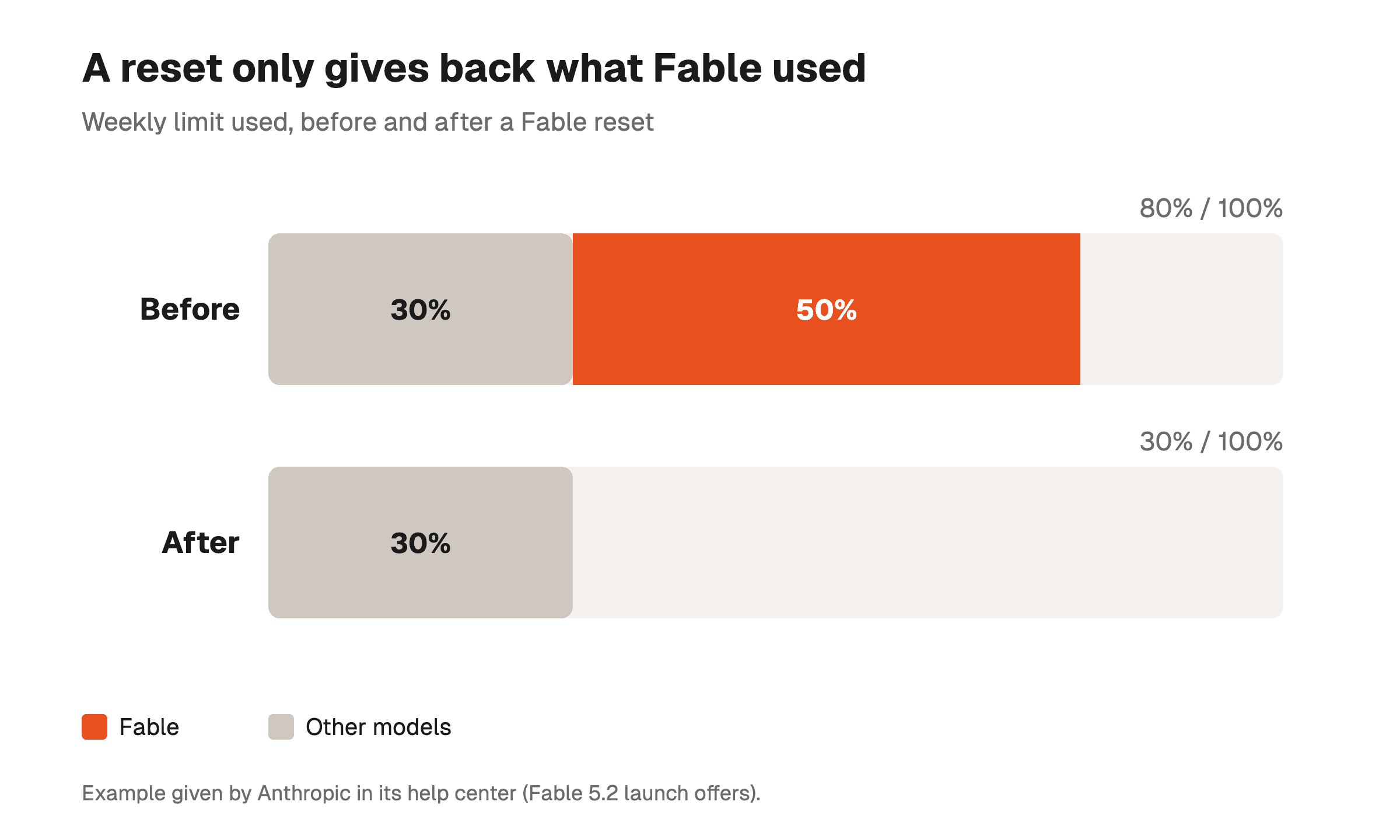
It doesn't raise your limits, though. The cap of 50% of the week on Fable stays where it is. You get back what you had already spent, nothing more.
To use one, open Settings, then Usage, in Claude. The resets section shows the "Reset for free" button and each reset's expiry date. Your allowance comes back straight away.
A reset you've used can't be undone. And if you cancel or downgrade before using it, it's gone.
Nothing forces you to wait until you're blocked. But a reset is worth the most when your Fable counter is nearly full: keeping it for the week of a big job is the smart move. Still, set yourself a reminder in early March (knowing me, I'd have kept it "just in case" until it expired 😉).
How much does Claude Fable 5.2 cost?
On the API, Fable 5.2 launched at $8 per million tokens read and $40 per million written. Fable 5.1 cost $10 and $50, according to Anthropic's pricing page, which also gives today's prices.
Context that has already been processed, the part your tool sends back on every turn, drops from $0.25 to $0.20 per million. A coding session that rereads the same project all day benefits directly.
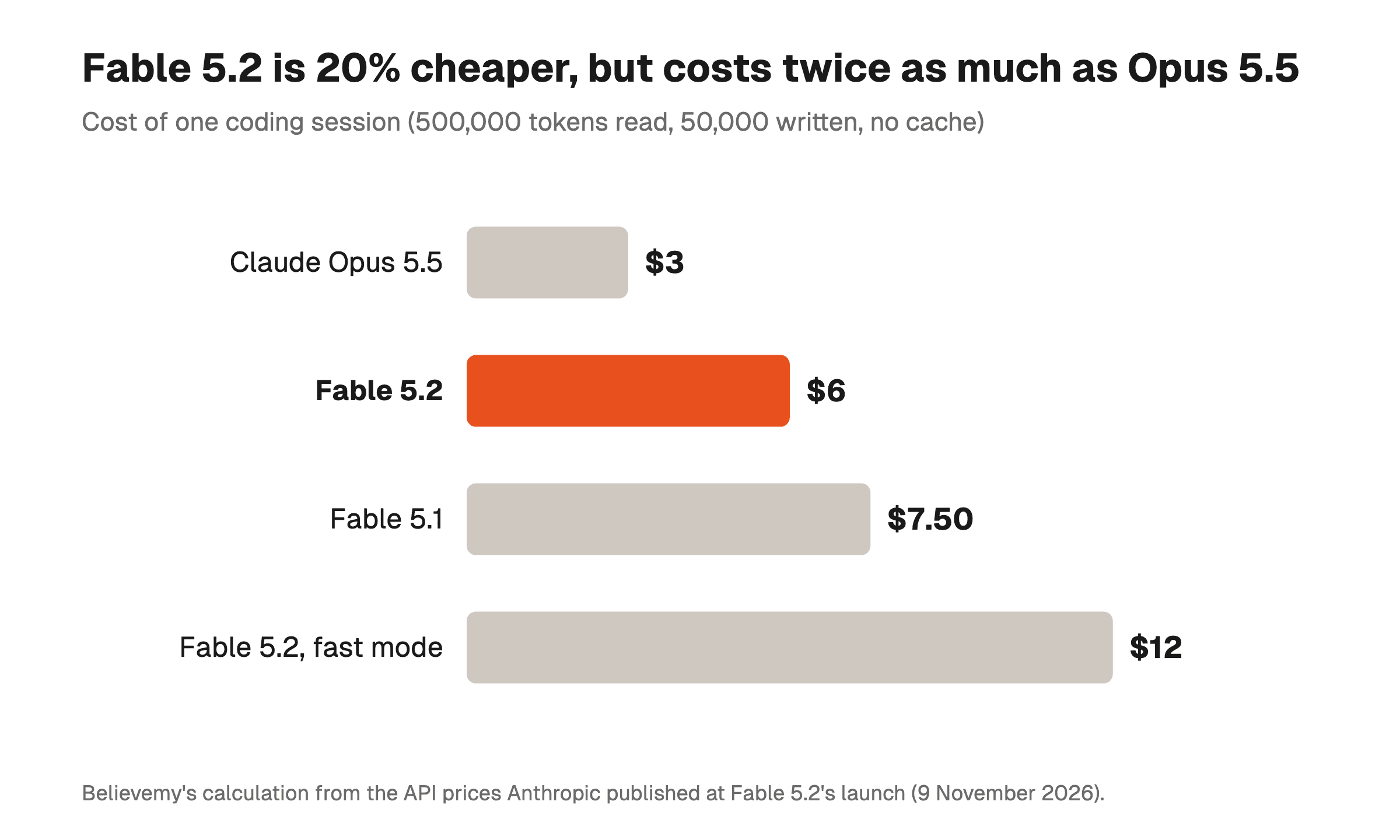
The cut doesn't make Fable a cheap model. At launch, Claude Opus 5.5 cost $4 and $20 per million. Fable 5.2 is still twice as expensive per token.
Fable 5.2 also comes with a fast mode, which writes up to 2.5 times faster. It costs double: $16 per million read, $80 per million written. It's available in Claude Code and on the API.
And on subscriptions? Max and Ultra include Fable in their limits. On Pro, once the free week is over, Fable is paid for with usage credits, billed on top of the subscription.
How does it compare with Opus 5.5?
The test that speaks most to developers is called FrontierCode 2.0. It checks whether the code changes a model proposes would be accepted by the maintainers of real open-source projects.
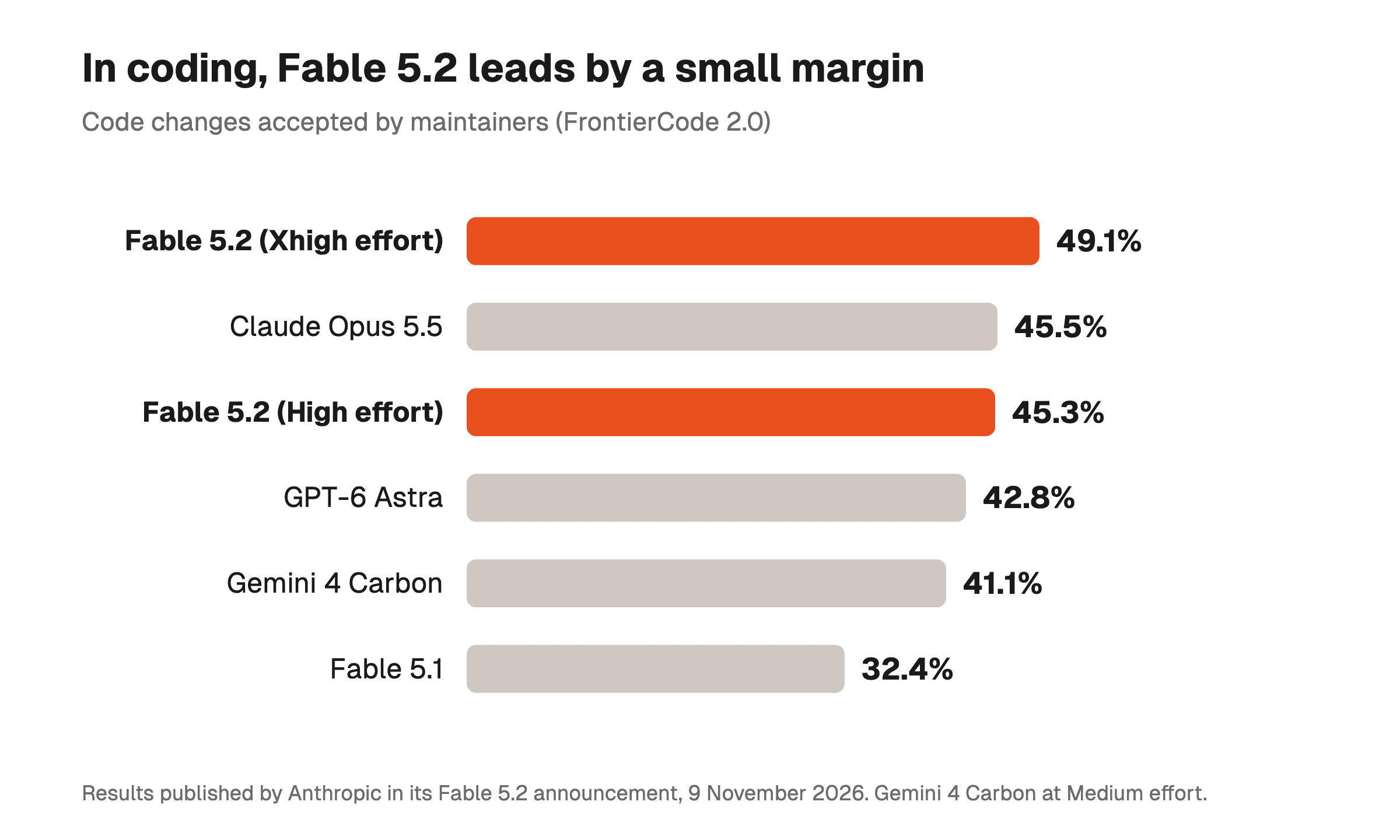
With thinking effort at its highest, Fable 5.2 reaches 49.1% of changes accepted, the best score Anthropic has published on this test. Opus 5.5 tops out at 45.5%.
Fable 5.1 scored 32.4%. Going to 49.1% is 16.7 points more, or about 52% relative improvement. Against Opus 5.5, however, the gap is only 3.6 points.
The most useful number is elsewhere. Set one notch lower, at High effort, Fable 5.2 scores 45.3%, level with Opus 5.5 at its maximum. According to Anthropic, it does so for about half the cost per task, because it thinks for less time to reach the same result.
On other tests, the gap grows wider. Here are three results published by Anthropic, as a percentage of tasks completed:
- Remote Labor Index, jobs usually handed to freelancers, with 41.3% against 21.3% for Opus 5.5;
- AutomationBench, office tasks to automate, with 51.4% against 42.5% for Opus 5.5, but behind Gemini 4 Carbon at 53.9%;
- OSWorld 2.1, operating desktop software, with 89.3% against 87.2% for Opus 5.5.
Anthropic also describes two projects run before the release. A team of AI agents rewrote an internal service from Python to Rust. It now starts about 26 times faster. One engineer had a complete operating system built in eight days, using more than 1,000 sub-agents.
These are internal demonstrations, not public tests. Mostly, they show that Fable 5.2 holds up on work lasting several days without losing its way.
Should you switch to Claude Fable 5.2?
It all depends on what you give it, and on your plan.
- On Max or Ultra, Fable 5.2 is included. Try it on your next big job, and keep your resets for busy weeks;
- On Pro, use the free week to test it on a real task, then go back to Opus 5.5 if the credits cost you too much;
- Through the API, the model ID is
claude-fable-5-2, and High effort often gives you Opus 5.5's result for less per task.
For an invoice to check, a client email or a web page, Opus 5.5 is more than enough. Fable 5.2 makes sense for the migration that's been dragging on for months, or the audit no other model finishes.
No need to change everything, then. Keep Opus 5.5 as your default, and bring out Fable 5.2 the day a job deserves it.
FAQ
How many free Fable resets will I get?
On the Max and Ultra plans, Anthropic gives one, two or three resets. The number depends on how long you'd subscribed on 9 November 2026, with a step at six months and another at twelve.
They must be used before 9 March 2027 at 7:59 am, UK time. The Pro plan gets a single one, valid until the morning of 17 November 2026.
Does a Fable reset raise my limits?
No. A reset gives back the allowance already spent on Fable this week, without raising your limits.
It also fully refills the five-hour window, if your account has one. Once used, it can't be undone.
How much does Claude Fable 5.2 cost on the API?
At launch in November 2026, Fable 5.2 cost $8 per million tokens read and $40 per million written, 20% less than Fable 5.1.
It's still twice the price of Opus 5.5, which launched at $4 and $20. Anthropic's pricing page gives today's prices.
Is Fable 5.2 better than Opus 5.5?
On the tests Anthropic published, yes: 49.1% on FrontierCode 2.0 against 45.5% for Opus 5.5, at maximum effort.
Even so, Anthropic recommends starting with Opus 5.5 for most tasks, and keeping Fable for the heaviest technical work.