It is 11 in the morning. You are halfway through a refactor, and Claude tells you that you have hit your usage limit.
The counter resets in a few hours. Your morning does not.
Claude Pro, Max and Team exist to solve that exact problem. They do not buy you smarter answers than the free plan.
The difference comes down to three things: how many messages you get per 5-hour window, access to the Fable 5.1 model and to tools like Claude Code, and, for Team, running several people on one invoice. The models you already get for free are the same on every paid tier.
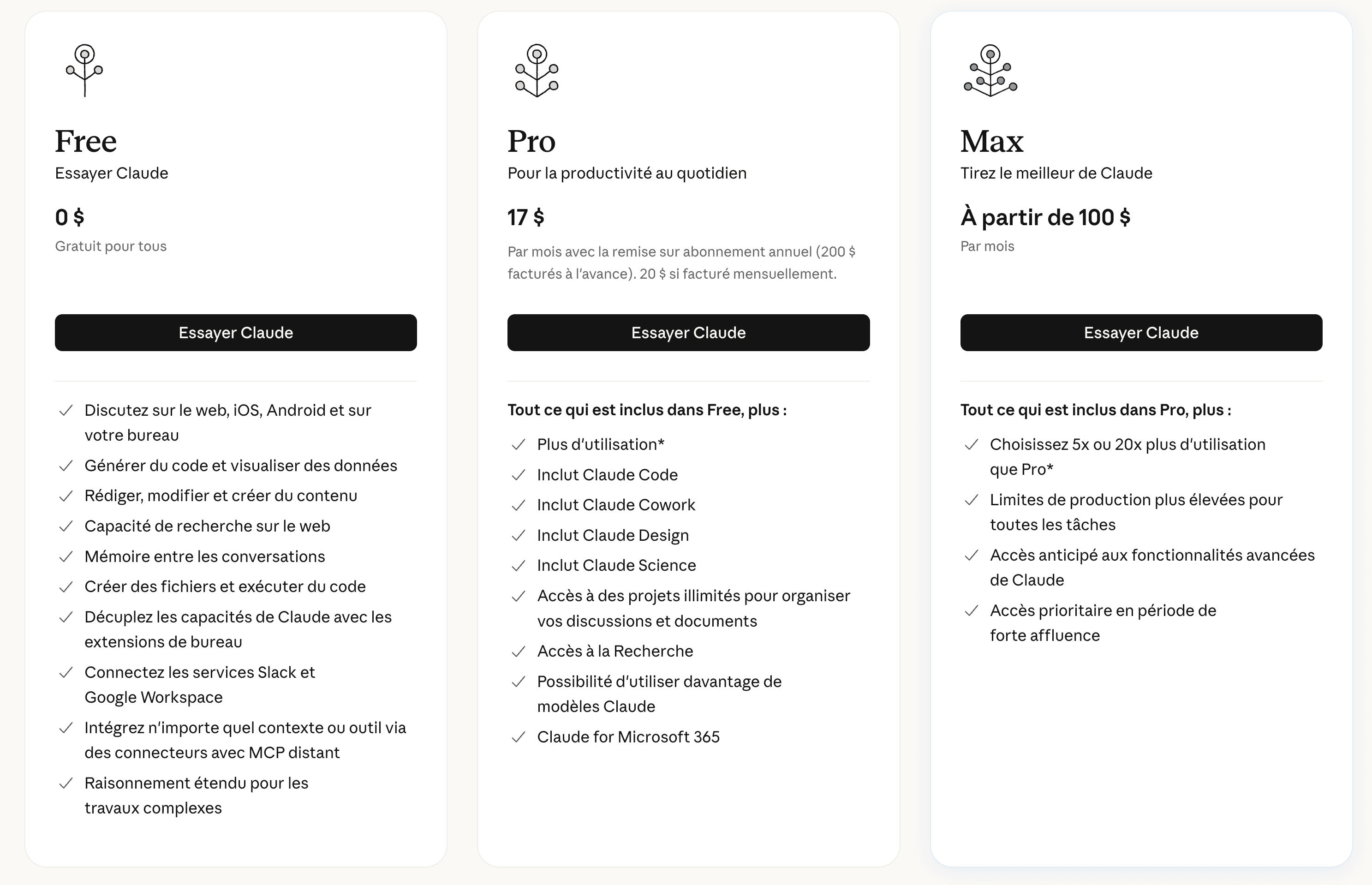
The five Claude plans in one table
Anthropic splits its offer into five levels, from free to quote-only.
The amounts below are in dollars and before tax, as shown on Anthropic's pricing page.
| Plan | Monthly price | Messages per 5-hour window | What it adds |
|---|---|---|---|
| Free | $0 | A few dozen, highly variable | Sonnet, file analysis, web search |
| Pro | $20 (cheaper billed yearly) | Around 45 on short exchanges | Fable 5.1, Claude Code, Research mode, connectors, priority access |
| Max 5x | $100 | At least 225 | Everything in Pro, higher priority, early access |
| Max 20x | $200 | At least 900 | Same features as Max 5x, four times its message volume |
| Team | Per seat, 5 seats minimum | More than an individual Pro | Shared projects, admin console, SSO, single invoice |
| Enterprise | Custom quote | More than Team | Audit logs, SCIM, custom retention, expanded context |
Your bank statement will show more than these amounts. Sales tax or VAT is added on top, and a standard card outside the United States charges a currency conversion fee on a payment made in dollars.
Why "45 messages" does not mean 45 messages
The number quoted for Pro applies to one specific case. Short conversations, a couple of hundred sentences, with a model that is cheap to run.
Step outside that case and the counter drops far faster. Your quota is measured on the total length of the conversation, not on the number of messages.
What burns through it:
- The length of the current conversation, since the whole history is sent back to the model with every message;
- Attached files, as a hundred-page PDF weighs far more than a question;
- The model you pick, since Opus costs more compute than Haiku, and Fable more still;
- The tools you switch on, such as web search, deep research and artifact creation.
Watch out for this reasoning: "Max 20x costs ten times Pro for twenty times the volume, so each message is half the price." That only holds if you really send the 900 messages. Send 45 a day, like a Pro user, and each one costs you ten times the Pro rate.
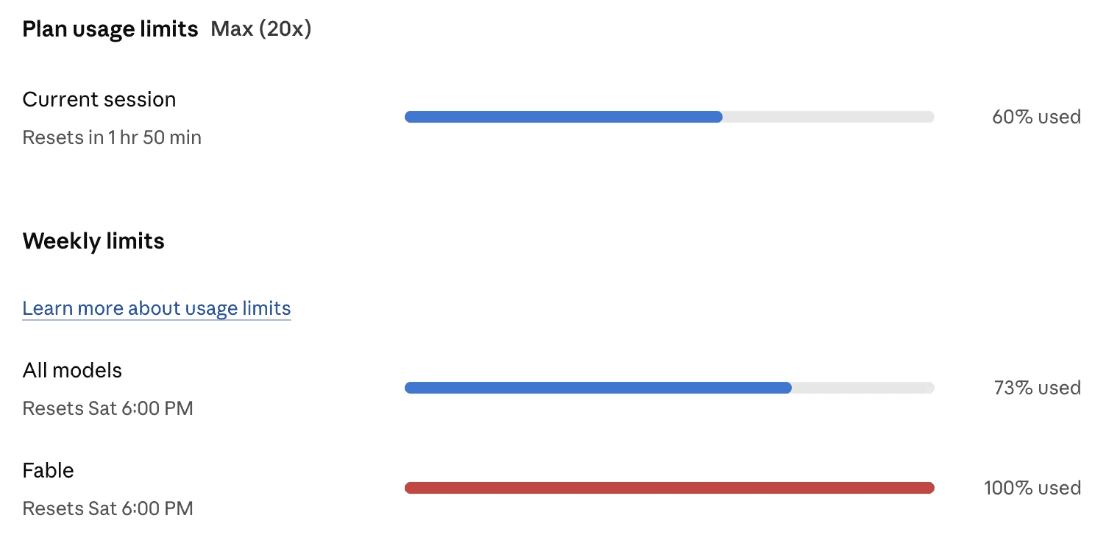
One detail is easy to miss. The 5-hour windows are not the only ceiling.
Weekly and monthly caps sit on top of them. Emptying your quota every single day can lock you out by Friday, even though your 5-hour window has just reset.
Claude Free: where it actually stops you
The free plan is not a crippled demo. You get the web interface, the mobile apps and the desktop app.
You can generate code, analyse documents and images, search the web and talk to Sonnet, the mid-range model. For two or three requests a day, the free plan does the job with no visible compromise.
What is missing comes down to three things:
- The Fable 5.1 model, the heaviest in the range, is paid-only;
- Claude Code, the agent that works inside your terminal, is paid-only too;
- And the quota tops out at a few dozen messages per 5-hour window.
The switching point is easy to spot. If you wait twice in the same day for your counter to reset, you have already lost more time than a month of Pro costs.
Claude Pro: what $20 unlocks
Pro is billed at $20 per month, with a discount for yearly billing. Anthropic promises at least five times the free plan's usage per session.
Beyond volume, four things change how you work:
- Fable 5.1, the most capable model in the range, alongside Opus, Sonnet and Haiku;
- Claude Code, in the terminal and on the web, to hand over whole development tasks;
- Research mode, which chains several web searches and cites its sources;
- Connectors, including Google Workspace and remote MCP servers, an open standard that plugs Claude into your own tools.
You also get extended thinking, which lets the model reason longer on hard tasks, and priority access during busy hours.
Claude Code is by far the biggest gap with the free plan. An agent that reads your repository, writes files and runs commands cannot be replaced by copy-pasting into a chat window. If you are starting from scratch with it, our Claude Code course covers the install and the first workflows.
Claude Max 5x and 20x: volume, not intelligence
Max comes in two tiers, $100 and $200 per month. The advertised multipliers are measured against Pro's limits.
- Max 5x allows at least 225 messages per 5-hour window on short exchanges;
- Max 20x goes up to at least 900 messages in the same window.
Neither one unlocks a model the other tiers cannot reach. The same question asked on Pro and on Max 20x gets the same answer, from the same model. What you pay for is volume, higher priority when the servers are busy, and early access to some features.
The context window, meaning how much text the model keeps in view, is identical on Free, Pro and Max in the web and mobile apps. It is set by default to 200,000 tokens, roughly 150,000 words.
To stop a long conversation from hitting that ceiling, Anthropic summarises the oldest messages as you go, on all three plans.
That 200,000-token ceiling does not apply to Claude Code. On a paid subscription, the tool works with a window extended to 1 million tokens, enough to load an entire codebase rather than a handful of files.
The switching point is about behaviour, not budget. Move to Max when you hit the Pro limit at least three times a week. Before that, you pay five times more for capacity you never reach.
There is no free trial of Max. The only way to test it is to subscribe for a month and then step back down, since individual plans have no lock-in.
Between the two tiers, start with 5x. Max 20x earns its price on Claude Code sessions that run for hours, or when you analyse dozens of documents in a row. Our pieces on how Anthropic has revised its quotas and on the temporary doubling of Claude Code limits show how often these ceilings move.
Claude Team and Enterprise: how many people before it makes sense?
Team: from 5 people up
Team starts at five seats minimum. Below five people the question does not arise, and individual Pro subscriptions are the only option.
The plan offers two seat types, and you can mix them in the same organisation:
- The standard seat gives more usage than Pro, plus the team tools;
- The premium seat adds Claude Code and a much larger quota.
That flexibility is the main argument. Your two developers take premium seats, the other five people take standard seats, and the invoice follows real usage instead of an average.
On the collective side, Team brings an admin console, central billing, a connection to a company directory through SSO, role-based permissions and shared projects. Search can also reach into Slack or Microsoft 365.
The price per seat depends on the seat type and the billing rhythm, with yearly cheaper than monthly. Check it on Anthropic's pricing page before deciding, because it drives the whole comparison against individual Pro plans.
Enterprise, and when it becomes necessary
Enterprise is quote-based. It includes everything in Team and adds what a security team asks for: audit logs, automatic account provisioning through SCIM, data retention controls, a compliance API and a HIPAA-eligible offer.
It also comes with a context window stretched beyond the standard 200,000 tokens, depending on the model. If you are hesitating between Team and Enterprise, you probably do not need Enterprise.
The option nobody compares: the API
All five plans cover usage inside the interface. For anything that runs without you, the API pricing charges per token consumed, with no subscription and no fixed quota.
The Sonnet tier has been listed at $3 per million input tokens and $15 per million output tokens. One million tokens is roughly 750,000 words of English.
The API wins on three specific jobs:
- Automations that run in the background;
- Batch processing of documents;
- An assistant built into your own product, in other words an AI agent.
If you want to build that kind of pipeline without writing code, our n8n course covers exactly this sort of wiring.
The most common setup among freelancers fits on two invoice lines. Pro for daily work in the interface, the API for automations, with a budget that tracks real consumption.
Frequently asked questions
What is the difference between Claude Pro and Claude Max?
Max gives you no model that Pro does not already have. The difference is volume: around 45 messages per 5-hour window on Pro, at least 225 on Max 5x and at least 900 on Max 20x.
You also get higher priority during busy hours and early access to some features, which later reach Pro.
Is the free Claude plan enough to work with?
It is enough for occasional use, two or three requests a day. You get Sonnet, document and image analysis, code generation and web search.
It stops being enough once Claude becomes part of your routine: Opus and Claude Code are paid-only, and the quota tops out at a few dozen messages per 5-hour window.
Is Claude Team worth it for a small team?
Team requires a minimum of five seats. With three or four people the question does not arise, and you need individual Pro subscriptions.
From five regular users up, the price gap against five Pro plans buys shared projects, an admin console, SSO and a single invoice. You can also mix standard and premium seats depending on who does what.
Can you change Claude plan without losing your conversations?
Yes, your history, projects and settings are kept when you move from Pro to Max and when you drop back from Max to Pro. Only the usage limits change.
Anthropic prorates the charge when you switch mid-month, and individual plans carry no lock-in.
Is there a free trial of Claude Max?
No, Max comes with no trial period. The only way to evaluate it is to subscribe for one month on monthly billing, then drop back to Pro if the extra quota goes unused.
Before running that test, count how many times a week you genuinely hit the Pro limit. Under three times, you already know the answer.