Your website is live. You built it over a weekend with ChatGPT, and you're proud of it.
Then a client asks you to move a button. You open the code, and you have no idea where to start. Not without AI, and not even with it, because you don't know what to ask.
So, does learning with AI make you worse? Yes, according to three recent studies, but only when you let it do the thinking for you. People who ask it to explain make progress. People who ask it for the answer retain less.
Let's look at what these studies measured and why effort matters so much. Then, how to use AI to learn faster, whether you are learning code, design or bookkeeping.
What do studies say about AI and learning?
Three teams looked at the question from three different angles. Their results point the same way.
Among developers, 17 points lower on the quiz
In January 2026, Anthropic, the company behind Claude, published an experiment with 52 developers. They all had to learn Trio, a Python code library none of them knew. Half had an AI assistant, the other half did not.
Right after the exercise, a quiz checked what they had understood. The AI group averaged 50%, against 67% for the group without AI. And it wasn't even much faster. It saved two minutes on average, a gap too small to count.
Anthropic speaks of "17% lower". That means 17 points out of 100, from 67% to 50%. Measured against the no-AI group's score, it is actually a quarter fewer correct answers.
The biggest gap was on debugging, meaning finding out why code doesn't work. That is exactly the skill you need on the day the AI gets it wrong.
Among high schoolers, better in practice and worse in the exam
A team from the University of Pennsylvania followed nearly 1,000 Turkish high school students in maths. Their results came out in 2025 in the journal PNAS. Some practised with ChatGPT as is, others with a version set up to give hints rather than answers:
- With ChatGPT as is, practice grades rose by 48%, then grades in the exam without AI fell by 17% compared with students who never had AI;
- With the hint-giving version, practice grades rose by 127%, and the exam stayed at the level of students without AI.
The researchers describe students using AI as a crutch. The day it was taken away, they fell.
In the brain, less activity and forgotten essays
At the MIT Media Lab, 54 participants wrote essays while electrodes measured their brain activity. One group used ChatGPT, another a search engine, and the last nothing at all.
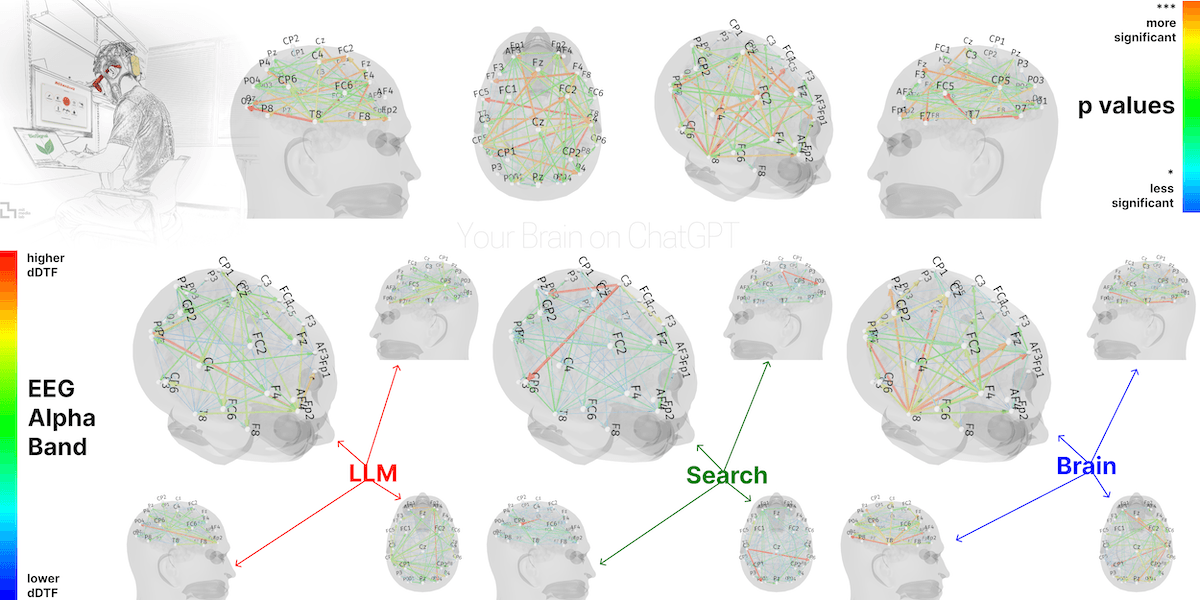
The more work the tool did, the less the brain engaged. The ChatGPT group also struggled to quote a sentence from the essay it had written just minutes earlier.
A word of caution, though. When it was published in June 2025, the study had not yet been reviewed by other researchers, and it covers few people. It says nothing about what happens over years.
Why can AI make you learn less well?
Because learning takes effort. Anthropic's researchers sum it up this way: racking your brain, and even staying stuck for a while, is part of what makes you progress.
In their experiment, the group without AI made more mistakes. It fixed them on its own, and that is probably what made it better at debugging. The AI had spared the first group those mistakes… and the lesson that came with them.
It is like watching a coach do push-ups for you. The session is over quickly, and your arms have learned nothing!
There is also a subtler trap. A Microsoft Research survey of 319 people who use AI at work shows that the more you trust AI, the less you check what it produces.
When you work alone, nobody reviews your work. If the AI slips a mistake into a client's website, you are the one who has to spot it. And we often think we are more skilled than we are. That is the Dunning-Kruger effect, and AI feeds it by giving you the feeling you understood.
Personally, I once caught myself asking Claude again for a regular expression it had written for me the day before. And the day before that 🥲
How do you use AI to learn without getting worse?
The good news from Anthropic's study is that not every AI user failed the quiz. The researchers looked at how each person used it, and two families emerge.
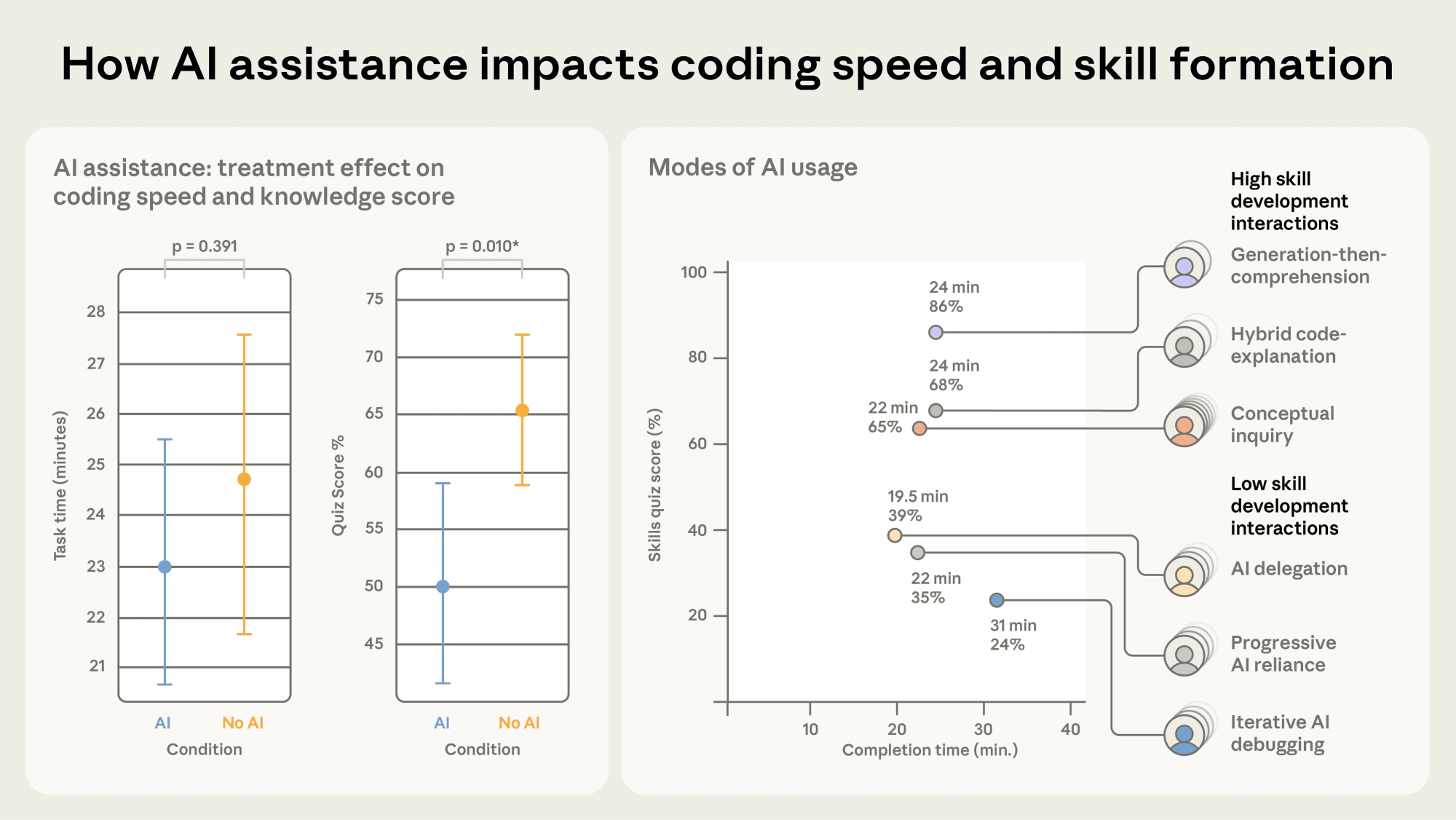
Those who handed everything to the AI, or asked it to fix every error, stayed below 40%. Those who used it to understand reached 65% or more. Here is what they did.
Ask questions, not orders
"Write me the code for this form" gets you a form. "Why do we validate data on the server and not just in the browser?" gets you an idea you will keep.
In the study, the group that only asked conceptual questions made lots of mistakes. It fixed all of them on its own, and finished among the fastest of the high scorers.
If AI writes for you, get it explained
Sometimes you need the code right away, and that's fine. The best group in the study had the code generated, then asked questions about it until they understood it. It reached 86% on the quiz.
Its method looked almost exactly like that of the people who delegated everything. The only difference: it then used the AI to check its own understanding.
Try on your own first, even for ten minutes
Before opening ChatGPT, give it a go. Write your version, even a wrong one, then ask the AI to correct it and tell you where you went wrong.
That is exactly what the hint-giving version did in the high school study. It never gave the answer, only enough to move forward.
Which AI tools have a mode for learning?
The vendors have seen the problem. The two best known offer a setting that turns AI into a teacher rather than a doer.
ChatGPT's study mode
Launched by OpenAI in July 2025, study mode doesn't hand over the solution straight away. It asks questions, gives hints and checks what you remember with short quizzes.
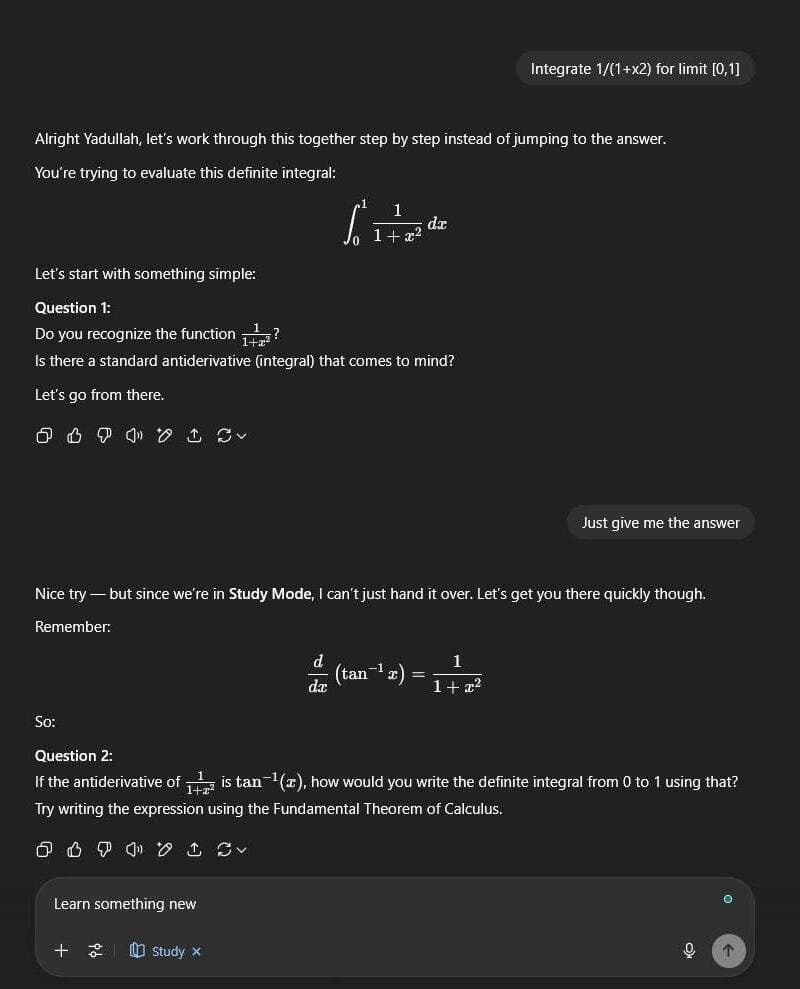
To turn it on, pick "Study and learn" from the tools below the message box. At launch, it was open to free and paid accounts alike.
One limit remains: a single click turns it off. So it is up to you to play along when the answer is tempting!
Claude Code's "Learning" style
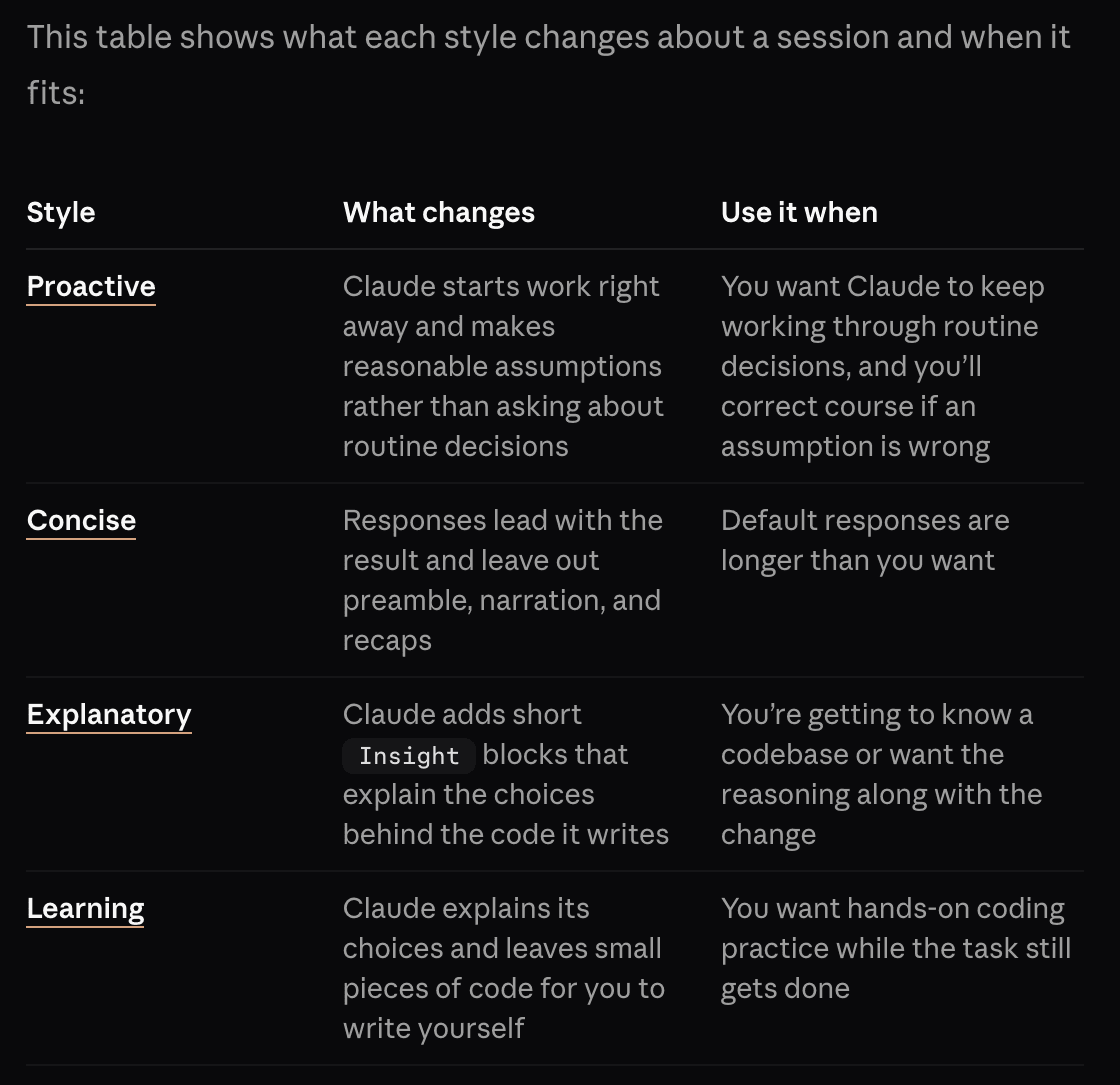
If you are learning to code with Claude Code, its documentation describes several response styles. Two of them are for learning:
- Explanatory adds short "Insight" blocks that explain the choices behind the code it writes;
- Learning does the same, and also leaves you to write the few lines where there is a real decision to make.
You pick the style with the /output-style command, for example /output-style learning. Claude then marks the spot to complete and waits for you to write your part.
To get started with the tool itself, our Claude Code course starts from scratch.
To start, take the last thing AI did for you and ask it to explain it. If you couldn't redo it on your own, you know what to learn next 😉
Frequently asked questions
Does AI make you less intelligent?
Nothing shows that over the long term. However, handing your thinking to AI makes you retain less of what you learn, according to several recent studies.
In a 2026 Anthropic experiment, developers helped by AI scored 50% on a quiz, against 67% for those who coded on their own.
Can you learn to code with ChatGPT?
Yes, as long as you ask it to explain rather than to do. In Anthropic's study, those who asked conceptual questions scored above 65% on the quiz.
Those who handed it all the code stayed below 40%.
How do you use ChatGPT to learn effectively?
Try on your own first, then ask the AI to correct and explain. Ask questions about the why, and have it explain any code it writes for you.
ChatGPT's study mode, launched in July 2025, pushes in that direction: it guides you with questions and hints instead of giving the answer.
What is ChatGPT's study mode?
It is a setting that makes ChatGPT ask questions and give hints instead of delivering the solution. It also checks what you remember with short quizzes.
OpenAI launched it in July 2025. You turn it on from the tools, under "Study and learn".
Should you stop using AI to learn?
No. According to a study published in PNAS in 2025, high school students guided by a hint-giving AI lost nothing in the exam. Their practice grades, meanwhile, had risen by 127%.
What lowers your level is AI that hands you the answer directly.