




What Does "Default Alive" Mean? "Default Dead"?
When it comes to evaluating the health and viability of a startup, it’s essential to understand the concepts of "Default Dead" and "Default Alive".
These concepts were introduced in 2015 by Paul Graham, the founder of Y Combinator. Y Combinator is a startup incubator that, for example, accelerated the growth of companies like Coinbase, Airbnb, and Dropbox...
The idea is quite simple. We start from the assumption that a company has:
- a constant level of expenses;
- a constant growth rate of revenue.
For a new company, not profitable from day one (since it doesn’t yet have substantial revenue), let’s consider a practical example:
- it starts with €500 in revenue the first month;
- it spends €9,000 per month;
- it has a 20% MoM growth in revenue.
MoM (Month-over-Month) Indicator
This indicator measures the percentage change for a given value over one month compared to the previous month. Widely used in financial analysis, it’s often combined with other indicators to get an idea of trends over a given period.
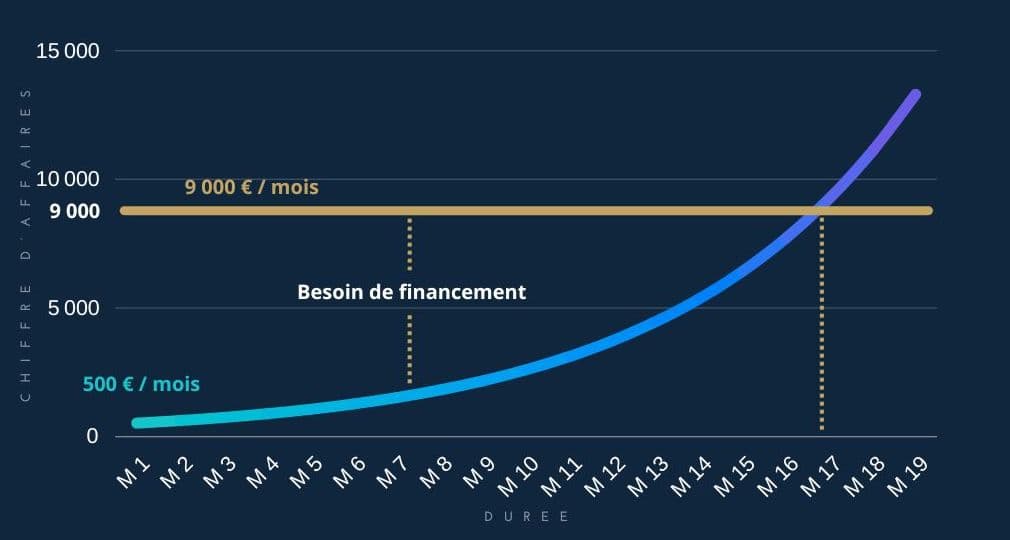
Here we find:
- 17 months needed to finance until it becomes profitable;
- a cash need of €76,661 (i.e. €153,000 in expenses over 17 months - €76,339 in revenue).
So, in this scenario, one would have to find enough money (for example, through a fundraising round) to cover those 17 months – at least €76,661 would be necessary.
By the way, let’s recall what “runway” means. Runway is the amount of time you have before you run out of money. Its length changes depending on your monthly expenses required to run your activity and on how much liquidity you have.
Generally, a fundraising round provides a runway of about 12 to 24 months.
If current cash > financing need → Default Alive
This means that if nothing changes, with the same level of expenses and the same revenue growth rate, your startup will become profitable. It might not necessarily become hugely profitable, but at least you’ll still be around.
If current cash < financing need → Default Dead
If the amount of money in your startup’s accounts isn’t enough to finance its expenses—assuming no change in spending level or growth rate—your startup will not survive.
You will need to:
- reduce your expenses (cut staff, reduce overhead);
- boost your growth;
- seek external financing.
The "Default Alive" Case
If your startup is in this situation, then you’re somewhat comfortable: no need to rush to find funds, no need to cut expenses to survive. It gives more power to the founders, allowing them to choose their partners. They have time.
This situation is not necessarily the most optimal, although one might think otherwise. It’s actually quite counterintuitive: it's common for a startup to accelerate its growth thanks to investors.
Investors typically prefer to invest in a “Default Dead” startup—a startup that cannot survive without external financing. This significant lack of time gives them leverage over the founders, who are then far less able to negotiate the terms of their fundraising.
On a psychological level as well, investing in a project that can’t operate without funding adds a “greater-than-oneself” dimension to the company’s vision: hopes will be higher, and... hope sells dreams.
However, there are many disadvantages to having a lot of time on your side:
- You might become complacent and thus move slower than your competitors;
- If you want to bring in investors, they will find it harder to commit.
Did you know?
Amazon was not profitable and thus “Default Dead” from its creation in 1994 until 2014. It then became profitable until 2021 but ended up in 2023 with a €3 billion deficit.
Meanwhile, Jeff Bezos—the founder of Amazon—has an estimated fortune of around €159 billion.
Who said you had to create a profitable company to become one of the richest individuals?
The "Default Dead" Case
There are two types of startups in a “Default Dead” situation:
- Startups that are "Default Dead" involuntarily;
- Startups that are "Default Dead" voluntarily (yes, you read that correctly).
The Involuntary "Default Dead"
This is the worst case for a startup: it severely lacks time, it doesn’t have enough money to cover its expenses, and its growth has stalled. This is what Paul Graham calls the "fatal pinch". A situation in which the margin for maneuver is extremely limited and reversing the curve is challenging.
Your startup’s future is no longer in your hands. You can’t maintain consistent revenue growth, nor can you manage (or reduce) your expenses adequately.
If you manage to negotiate external financing, this loss of leverage will be felt in the company’s valuation and the conditions set by the investors.
The Voluntary "Default Dead"
As we just saw with the Amazon example, your startup doesn’t need to be profitable to exist and completely dominate your market. This practice is far more widespread than you might think.
Are you familiar with Uber? It’s still not profitable since its creation in 2009. In 2022, it lost $9 billion.
Disney+? Not profitable since 2019 and has accumulated a deficit of $10 billion.
So then, why aren’t these startups profitable? The principle is simple: they spend all they earn to ensure the fastest possible growth.
Frédéric Mazzella, CEO of Blablacar
“We are not profitable at all because we are constantly innovating and expanding abroad. To be profitable, we would have to stop innovating and expanding, and that is not in our plans!”
Investors prioritize long-term vision and the team behind a startup rather than its profitability.
These startups that are voluntarily “Default Dead” are so by strategic choice. But beware: this is a very risky bet, and it’s not uncommon to meet former founders who ended up losing everything by opting for minimal compensation to reinvest as much as possible into their startup, which at some point ceased to find further growth.
They end up having spent years working endless hours, sacrificing their social lives and even family life, for a startup that raised millions but yielded them barely a minimum wage.
I obviously can’t talk about voluntarily “Default Dead” startups without also presenting the hidden side of this strategy.
Conclusion
Now that we’ve explored together the different types of startups—or at least the principle of "Default Alive" vs. "Default Dead"—it’s important to keep in mind that this is primarily a risk-taking, a long-term strategy. It’s a vision of your startup rather than a focus on immediate profit. It’s this vision that will attract investors.
You can also choose never to seek external investors—what we call “bootstrapped” startups. It all depends on your priorities as an entrepreneur:
- Ensuring the fastest possible growth for your project;
- Penetrating a market as quickly as possible;
- Providing yourself with a salary that allows you to live comfortably, at the risk of impacting your startup’s development and R&D.